Mars may not be as defenseless against the Sun as scientists once believed. A surprising new discovery using old NASA satellite data has now pushed researchers to rethink how the Red Planet reacts to dangerous solar storms in space. Even though Mars lost its global magnetic field billions of years ago, researchers recently found evidence of a mysterious plasma interaction that was never expected to happen there in the first place. The finding is already creating buzz among space scientists because it could completely change how planetary atmospheres are studied across the solar system.
The discovery came from data gathered by NASA’s MAVEN spacecraft during a powerful solar storm that slammed into Mars back in December 2023. Scientists had been revisiting the archived observations when they noticed unusual magnetic signatures hidden inside the storm activity. What looked strange at first eventually turned into one of the most unexpected Mars discoveries in recent years. Researchers now believe they detected the Zwan-Wolf effect on Mars for the very first time.
Scientists Detect A Rare Plasma Effect On The Red Planet
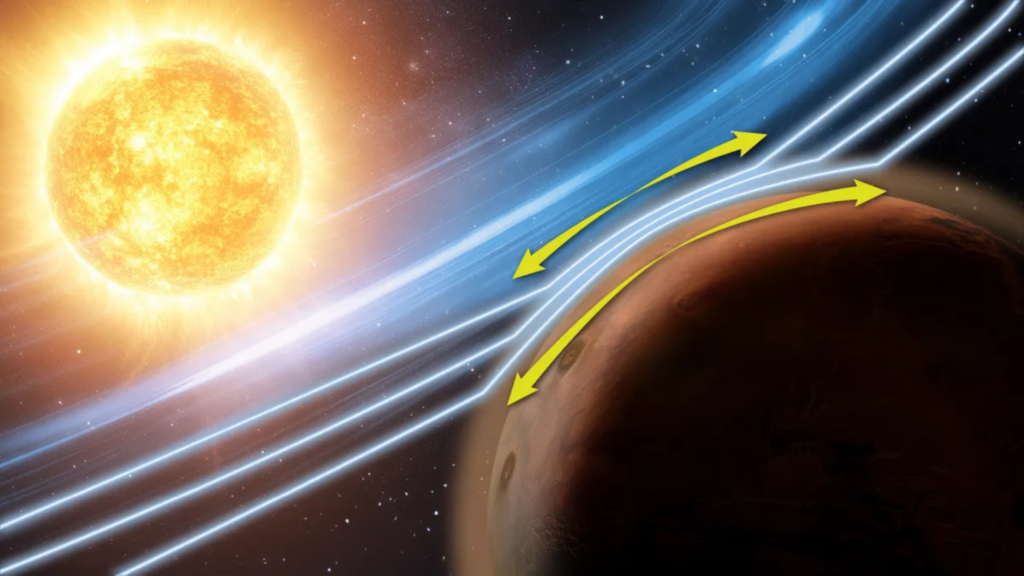
The research was published in Nature Communications and focused on a phenomenon first proposed nearly 50 years ago in 1976. The Zwan-Wolf effect happens when charged particles from the Sun interact with magnetic barriers around a planet, compressing plasma inside structures called flux tubes. Until now, many experts believed this process mostly depended on a strong global magnetic field like Earth’s. Mars was never really expected to produce this kind of behavior because its magnetic shield disappeared long ago.
Christopher Fowler from West Virginia University, who led the research team, reportedly became suspicious after seeing unusual patterns inside MAVEN’s magnetic field readings during the solar storm analysis. The more scientists examined the data, the clearer it became that something uncommon had happened in Mars’ upper atmosphere. Researchers now think the intense storm simply amplified an effect that may actually occur around Mars all the time but usually stays too weak to notice properly.
The finding is important because Mars has always been viewed as a planet slowly losing its atmosphere to space due to lacking strong magnetic protection. Scientists have spent years studying how solar wind strips gases away from the planet over time. This new discovery suggests Mars may interact with solar energy in far more complicated ways than earlier models predicted.
Discovery Could Change How Scientists Study Other Worlds
What makes the research even more exciting is that the same effect may also exist on other worlds without strong magnetic fields. Scientists now suspect Venus and Saturn’s moon Titan could experience similar plasma interactions during intense solar weather events. That means old assumptions about how unshielded planets behave in space might need major updates in future atmospheric models.
The discovery also arrives during a period when scientists are paying closer attention to space weather and its long-term effects on planetary evolution. Solar storms are capable of reshaping atmospheres, disrupting magnetic environments, and even affecting future human exploration missions. Understanding how planets react to those storms has become more important than ever as agencies like NASA continue planning deeper missions to Mars and beyond.
Researchers say more analysis will still be needed before scientists fully understand how common the Zwan-Wolf effect really is around Mars. But one thing already seems clear — the Red Planet still holds plenty of surprises, even inside data that has been sitting quietly for years.