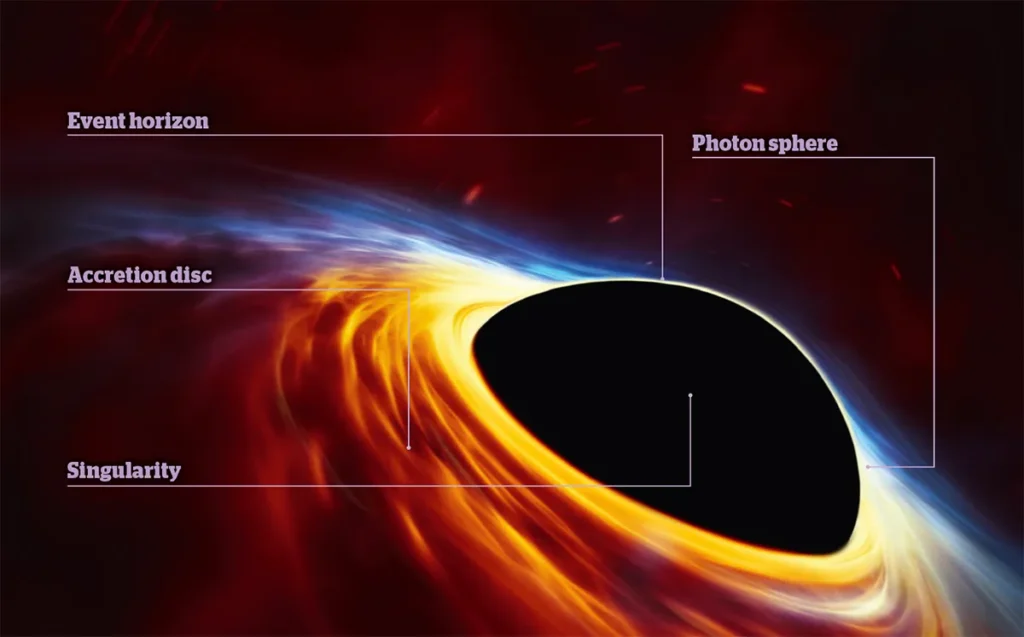
Black holes have always been described as the most terrifying objects in the universe, mostly because scientists believed something impossible exists at their center — a singularity. That is the point where gravity becomes infinitely strong and the normal laws of physics basically stop working completely. But now, a new theoretical study is questioning whether singularities actually need to exist at all, and the idea is already getting attention inside the physics world.
The research was carried out by Francesco Di Filippo from Goethe University Frankfurt and was published earlier this year in Physical Review Letters. According to the study, quantum effects combined with Hawking radiation may be capable of stabilizing the inside of black holes before a singularity ever forms. If the theory eventually holds up under further testing, it could seriously reshape how scientists understand gravity, space-time, and even dark matter itself.
How Charged Black Holes Could Avoid Singularities
The research specifically looked at something called Reissner–Nordström black holes, which are black holes carrying an electric charge. Under Einstein’s general relativity, these kinds of black holes are expected to contain two major problems. One is the singularity itself, where space-time curves infinitely. The second is something known as the Cauchy horizon, a strange region where physics loses predictability and scientists can no longer calculate what happens next.
Rμν−21Rgμν+Λgμν=c48πGTμν
Di Filippo’s calculations suggest that the electric repulsion generated by the black hole’s charge, mixed together with Hawking radiation, could counterbalance the collapse happening inside the object. Instead of matter compressing into an infinitely dense point, the core may remain stable in a quantum state that avoids both singularities and the destructive Cauchy horizon problem at the same time.
One reason physicists are paying attention to the paper is because the theory does not rely on highly speculative frameworks like string theory or loop quantum gravity. Instead, the work mainly uses established quantum field theory principles, which makes the proposal feel less disconnected from current physics. That doesn’t automatically mean the idea is proven, but it does make it harder to dismiss quickly.
Why This Could Change Modern Physics
The really interesting part is that the idea may not only apply to charged black holes. According to the study, similar quantum effects could potentially appear inside more common black holes found throughout the universe. If future research supports that possibility, scientists may have to rethink decades of assumptions about what exists at the center of these cosmic objects.
The implications stretch much further than black holes alone. Some researchers already believe singularity-free black holes could leave behind microscopic remnants after evaporating through Hawking radiation. Those tiny leftover objects are now being discussed as possible candidates for dark matter, the invisible substance believed to make up most of the universe’s mass but which still remains unexplained.
TH=8πGMkBℏc3
That possibility is exactly why studies like this create excitement even before experimental proof exists. Modern physics still struggles to connect gravity with quantum mechanics into one complete framework, and black holes sit directly in the middle of that conflict. Every new theory that removes infinities from the equations gives physicists another possible path toward solving one of science’s biggest mysteries.
Of course, this is still theoretical work and not observational proof. Scientists cannot directly observe what happens inside a black hole yet, so these ideas remain mathematical models for now. Still, the fact researchers are finding ways to describe black holes without singularities is already pushing the conversation into new territory, and that alone makes the study one of the more fascinating space physics discussions happening this year.