Astronomers have uncovered a fascinating new clue about the structure of our universe: the Milky Way may actually sit inside a gigantic sheet of dark matter stretching roughly 32 million light-years across.
The discovery offers a possible explanation for a long-standing mystery about how nearby galaxies move through space. For decades, scientists have observed that almost every major galaxy near the Milky Way appears to be drifting away rather than being pulled inward by gravity.
Now, new simulations suggest that the answer lies in a massive flat plane of invisible dark matter surrounding our galaxy.
A Giant Dark Matter Plane Shaping the Local Universe
The research team, led by astronomer Ewoud Wempe, used advanced computer simulations to recreate the evolution of our region of the universe starting from the Big Bang.
By adjusting how matter was distributed over billions of years, the scientists attempted to match what we observe today in the Local Group, which includes the Milky Way and its neighboring galaxies.
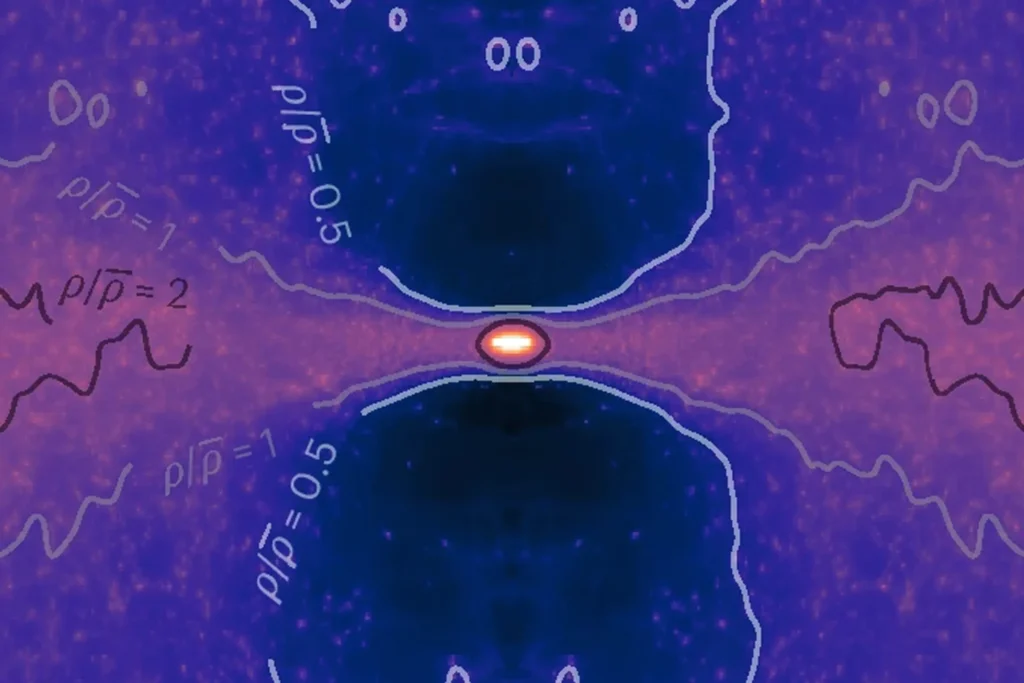
The simulations revealed something surprising. The only way to reproduce the real motions of nearby galaxies was if most of the matter surrounding the Local Group is arranged in a thin, flat structure roughly 10 megaparsecs (about 32 million light-years) wide.
This enormous cosmic “sheet” acts as a gravitational balancing structure that influences how galaxies move within our local region of space.
Vast Cosmic Voids Above and Below the Plane
Another striking feature of this structure is what lies above and below it.
According to the simulations, huge cosmic voids — regions with almost no galaxies — exist on both sides of the dark matter sheet. These empty areas lack the gravitational pull that would normally draw galaxies inward.
Because of this unusual geometry, the gravitational influence from matter within the plane balances out the pull of the Local Group.
The result is that nearby galaxies continue drifting outward, creating a smooth expansion pattern that astronomers describe as a quiet Hubble flow.
This behaviour fits well with predictions from the current standard cosmological model, which explains how matter and dark matter shape the universe’s large-scale structure.
Solving a Century-Old Cosmic Puzzle
The discovery may finally shed light on a puzzle first noticed by astronomer Edwin Hubble nearly a century ago.
Hubble famously observed that most galaxies are moving away from the Milky Way, a phenomenon that helped confirm that the universe is expanding.
But in our local cosmic neighborhood, the situation has always seemed slightly strange.
Almost every nearby large galaxy is drifting away — except one: Andromeda Galaxy.
Andromeda is actually moving toward the Milky Way at roughly 100 kilometers per second, and astronomers expect the two galaxies to eventually collide billions of years in the future.
The motion of other nearby galaxies, however, did not fully match earlier gravitational models, leaving scientists searching for a deeper explanation.
A New Piece of the Cosmic Web
The newly proposed dark matter sheet could be part of the universe’s vast cosmic web — the enormous network of filaments, sheets, and voids formed by dark matter across billions of light-years.
Dark matter itself cannot be seen directly, but its gravitational influence shapes how galaxies form, cluster, and move.
In this case, the presence of a flat dark matter structure surrounding our galaxy group may explain why nearby galaxies appear to drift away instead of falling inward.
Final Words
The idea that our galaxy exists within a gigantic dark matter sheet adds a fascinating new dimension to our understanding of the universe’s architecture. If confirmed by future observations, the discovery could help scientists better understand the large-scale structure of the cosmos and the role dark matter plays in shaping it.
For now, the findings provide a compelling answer to a mystery that has puzzled astronomers for decades — revealing that the Milky Way’s cosmic neighborhood may be far more structured than previously imagined.