For decades, astronomers have been puzzled by a strange contradiction hiding in the early universe. Massive galaxies that should have been furiously creating new stars suddenly appeared to go quiet surprisingly early in cosmic history. These so-called “dead galaxies” seemed to shut down only a few billion years after the Big Bang, leaving scientists wondering what could have extinguished their stellar factories so quickly.
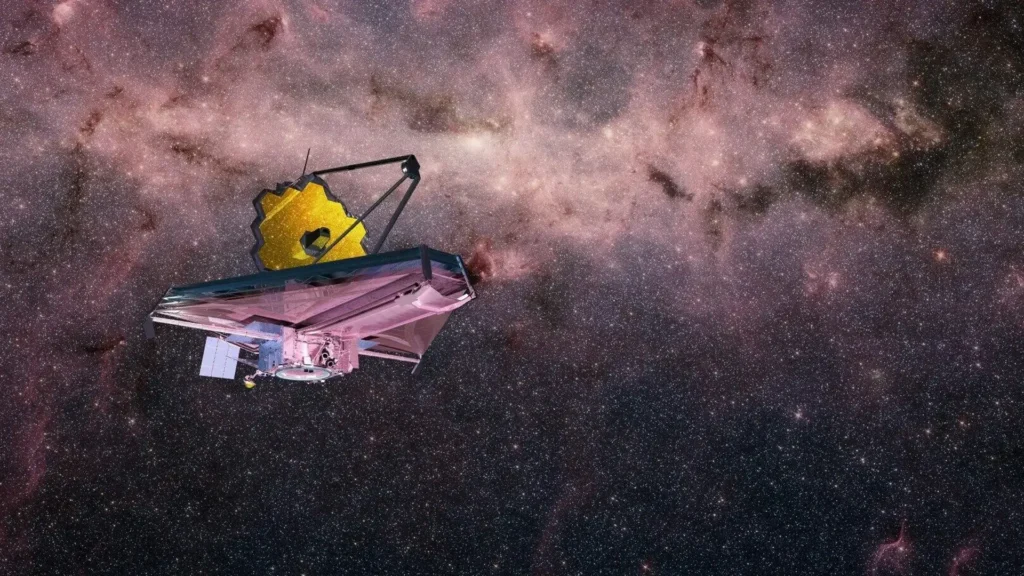
Now, an international team of researchers believes they may finally have found the culprit. Using observations from the James Webb Space Telescope (JWST) and the Atacama Large Millimeter/submillimeter Array (ALMA), scientists have captured what appears to be a galaxy destroying its own ability to make stars. Their findings suggest that powerful winds generated by intense stellar explosions may be sweeping away the raw materials needed for future star formation.
The discovery provides some of the strongest evidence yet for a theory that has lingered in astronomy for years: sometimes galaxies don’t slowly fade away—they effectively blow themselves out.
JWST and ALMA Caught a Galaxy in the Middle of Self-Destruction
The newly published study, which appeared on June 10 in the journal Monthly Notices of the Royal Astronomical Society, focused on a distant system known as CRISTAL-02. Led by researcher Rebecca Davies from Swinburne University of Technology, the team observed the galaxy as it existed roughly 1.1 billion years after the Big Bang, offering a rare glimpse into one of the universe’s earliest chapters.
By combining data gathered by JWST’s powerful NIRSpec instrument with ALMA’s observations of ionised carbon, researchers identified an enormous plume of cold gas being blasted out of the galaxy. The outflow stretched nearly seven kiloparsecs into space and was travelling at speeds reaching approximately 640 kilometres per second.
What stunned astronomers wasn’t simply the existence of the wind, but its sheer scale. The galaxy was losing gas at a rate nearly twice as fast as it was producing new stars. In simple terms, the system was expelling the very fuel required to sustain its future growth.
If this process continues uninterrupted, scientists estimate that CRISTAL-02 could exhaust its molecular gas supply in less than 100 million years. On cosmic timescales, that’s an incredibly short period, effectively cutting short the galaxy’s star-making life.
The Real Culprit May Not Be Black Holes After All
For years, many researchers believed supermassive black holes were primarily responsible for shutting down star formation in large galaxies. The immense energy released as black holes consume matter was thought capable of heating or ejecting gas, preventing new stars from forming.
This latest study points toward a different explanation—at least for some early galaxies.
CRISTAL-02 appears to be undergoing a dramatic merger involving colliding galaxies. Such encounters are known to trigger intense bursts of star formation, and in this case, the rate was roughly three times higher than what astronomers would typically expect for a galaxy of similar mass and age.
That explosive period of activity creates large numbers of massive stars, but those stars live fast and die young. When they eventually explode as supernovae, they release extraordinary amounts of energy into their surroundings.
According to the researchers, it may be these stellar explosions working together that generate the enormous winds now being observed. Rather than black holes acting alone, the deaths of countless massive stars could be powerful enough to strip galaxies of their star-forming material entirely.
A Missing Piece in the Story of the Early Universe
The implications extend far beyond a single galaxy.
Astronomers estimate that nearly half of all massive galaxies during this period of cosmic history experienced major mergers. If CRISTAL-02 is representative of what happened elsewhere, these supernova-driven outflows may have been remarkably common throughout the young universe.
That possibility could finally explain why astronomers have discovered so many unexpectedly dormant galaxies using modern telescopes. Instead of gradually running out of fuel over billions of years, many may have experienced violent episodes that rapidly shut down their stellar production.
The discovery also highlights the extraordinary capabilities of today’s observatories. JWST allows scientists to study the chemical fingerprints and motions of ancient galaxies with unprecedented precision, while ALMA reveals the cold gas reservoirs hidden within them. Together, they are uncovering details that previous generations of astronomers could only speculate about.
As the James Webb Space Telescope continues peering deeper into the cosmos, researchers expect more examples like CRISTAL-02 to emerge. Each new observation brings scientists a little closer to understanding how galaxies are born, how they evolve, and sometimes, how they unexpectedly bring about their own demise.
For now, one of astronomy’s longest-standing mysteries may finally have its answer: some of the universe’s earliest giant galaxies didn’t simply stop making stars. They blew away the ingredients needed to create them in the first place.