

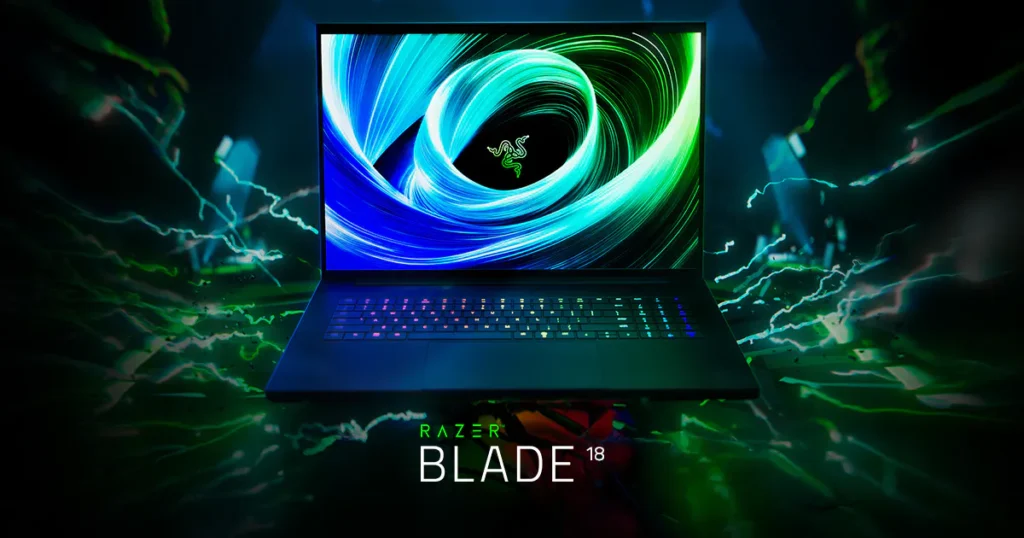
Razer has officially refreshed its massive Razer Blade 18 for 2026, and while the machine may not look dramatically different on the outside, the hardware packed inside it is honestly bordering on absurd. This thing is less of a regular laptop now and more like a portable desktop replacement built for gamers, creators, and increasingly, AI-focused workloads. The problem? The fully loaded version costs an eye-watering $7,000.
Yes, seven thousand dollars for a laptop. The updated Blade 18 now includes Intel’s new Intel Core Ultra 9 290HX Plus processor option, featuring 24 cores and boost speeds up to 5.5GHz. That instantly places it among the most powerful consumer laptop CPUs currently available. Combined with NVIDIA’s high-end RTX graphics lineup, the Blade 18 is clearly targeting users who want desktop-class performance without actually building a desktop PC.
Even the base model is far from “cheap.” Starting at around $4,000, the entry-level configuration includes 32GB of RAM and an NVIDIA GeForce RTX 5070 Ti GPU. But things escalate very quickly once users start upgrading components. Jumping to 64GB of RAM reportedly adds another $600, while pushing the machine all the way to 128GB of memory costs an additional $1,000 on top of that. The pricing honestly feels like a perfect example of how expensive premium PC hardware has become during the AI boom era.
A big reason behind those rising costs is the increasing demand for high-performance memory and GPU hardware driven by AI infrastructure worldwide. Data centers and enterprise AI systems are consuming huge amounts of advanced hardware right now, which has indirectly affected pricing even for consumer gaming products. So while Razer’s pricing sounds shocking, the wider PC industry has been heading in this direction for a while now.
Graphics options remain similar to the previous generation. Users can choose configurations ranging up to the NVIDIA GeForce RTX 5090, which is currently one of the most powerful laptop GPUs available. That hardware combination essentially turns the Blade 18 into a machine capable of handling ultra-high-end gaming, 3D rendering, AI workloads, and professional creative applications without much compromise.
Razer is also continuing with its unusual dual-mode display system, one of the laptop’s most interesting features. Users can reportedly switch between UHD+ resolution at 240Hz or FHD+ at an insanely fast 440Hz refresh rate depending on what they prioritize — visual clarity or competitive gaming speed. The company also says this year’s panel gets about 20 percent brighter, which should improve visibility and HDR-style gaming experiences.
Still, for all its raw power, the Blade 18 continues carrying the same problems that large gaming laptops almost always struggle with — weight and battery life. The machine reportedly still weighs around seven pounds, making it closer to carrying a compact desktop setup than a traditional portable laptop. Compared to slim ultrabooks or lightweight creator devices, the Blade 18 is undeniably massive. And unfortunately, portability problems extend beyond weight alone.
Battery life is expected to remain one of the system’s weakest areas. Last year’s Blade 18 model already performed poorly in battery testing, lasting just over two hours in some benchmarks. Since the 2026 version reportedly keeps the same 99Wh battery capacity despite even more powerful hardware, expectations for meaningful improvement are honestly very low. This is clearly a laptop designed to stay near a power outlet most of the time.
The port selection, however, remains extremely strong for professional users and creators. The laptop includes Thunderbolt 5, Thunderbolt 4, multiple USB-A ports, HDMI 2.1, Ethernet connectivity, and even a UHS-II SD card reader. That combination makes the Blade 18 appealing not only for gaming but also for video editing, streaming, photography workflows, and AI development tasks.
Interestingly, Razer’s marketing reportedly now includes separate messaging for gaming and AI usage. That detail says a lot about where premium PCs are heading overall. Gaming laptops are no longer being sold only to gamers. Companies increasingly want these systems to appeal to AI creators, developers, machine learning enthusiasts, and productivity-heavy professional users as well.
At the moment, the Razer Blade 18 feels like a machine built for people who simply want the most powerful portable hardware possible and are willing to pay almost any price for it. For regular users, the pricing will probably feel unrealistic. But for hardcore enthusiasts, professional creators, or developers chasing maximum performance in a portable form factor, Razer clearly believes there’s still a market willing to spend heavily. Whether that market is large enough to justify a $7,000 gaming laptop, though, is another question entirely.
