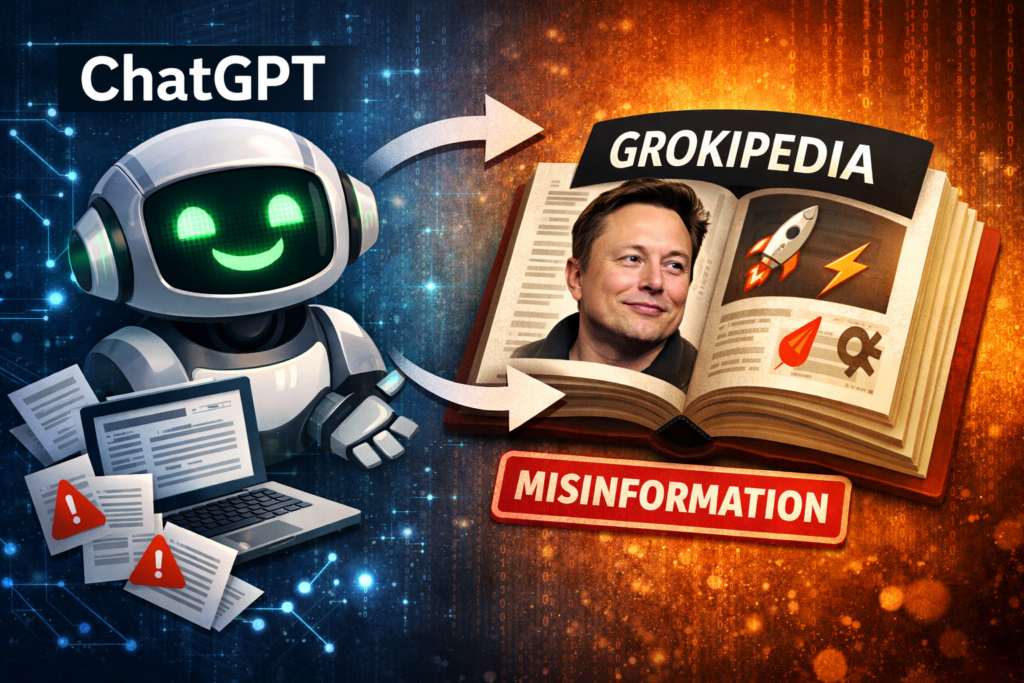
The already-tense rivalry between Elon Musk and Sam Altman has taken an unexpected turn — this time inside AI-generated answers themselves. A new report suggests that ChatGPT has repeatedly cited Grokipedia, the AI-built encyclopedia created by Musk’s xAI, raising serious questions about how misinformation can quietly circulate between competing AI systems.
ChatGPT and Claude Referencing Grokipedia
According to a report by The Guardian, GPT-5.2 — the latest large language model powering ChatGPT — cited Grokipedia multiple times while answering questions on a wide range of topics. These reportedly included sensitive and complex subjects such as Iran’s political structure and known Holocaust deniers.
It’s not just OpenAI’s chatbot either. Anthropic’s Claude was also found referencing Grokipedia while responding to prompts about petroleum production and even niche topics like Scottish ales. The pattern suggests Grokipedia is rapidly emerging as an alternative knowledge source — but not without controversy.
Why Experts Are Worried
Unlike Wikipedia, which relies on human editors and community moderation, Grokipedia is entirely powered by large language models. That difference is critical. LLMs are known to “hallucinate” — confidently presenting inaccurate or misleading information as fact.
Wikipedia co-founder Jimmy Wales had warned about this shortly after Grokipedia launched in October 2025. He publicly questioned whether AI-written encyclopedias could ever be reliable, stating that current language models are simply not good enough to handle factual, reference-style writing without making major errors.
The Feedback Loop Problem
What’s worrying researchers is the possibility of a self-reinforcing misinformation loop. When AI tools like ChatGPT and Claude begin citing another AI-generated platform, flawed data can bounce from system to system, becoming harder to trace, correct, or fully remove.
In some cases, ChatGPT reportedly cited Grokipedia while repeating already debunked claims, including misinformation related to historian Sir Richard Evans’ role in the David Irving trial. While the chatbot avoided Grokipedia citations when prompted about high-profile topics like the January 6 insurrection, it appeared more assertive — and less cautious — when dealing with obscure subjects.
OpenAI Responds
An OpenAI spokesperson said ChatGPT’s web search is designed to pull from a wide range of publicly available sources and viewpoints. The company claims it applies safety filters to reduce the risk of surfacing harmful or low-credibility content and clearly shows which sources inform its answers. OpenAI also noted it is working on tools to better detect influence campaigns and filter unreliable information.
Still, the report suggests those safeguards may not always catch AI-generated sources masquerading as factual references.
What Exactly Is Grokipedia?
Grokipedia presents itself as an AI-powered alternative to Wikipedia, with articles labelled as “fact-checked by Grok” and time-stamped for updates. Users cannot directly edit entries, but they can suggest changes or flag errors via a form. Some articles also carry disclaimers noting that content has been adapted from Wikipedia under a Creative Commons license.
Musk has previously described an AI-generated encyclopedia as “super important for civilisation,” arguing that removing human authors could eliminate ideological bias — a claim many experts strongly dispute.
Final Words
The growing presence of Grokipedia inside major AI chatbots highlights a deeper issue facing the AI industry: when machines start citing machines, the line between fact and fabrication becomes dangerously thin. As AI tools become more deeply embedded in everyday information discovery, how they choose — and verify — their sources may prove just as important as the answers they generate.