Scientists studying the heart of the Milky Way may have just uncovered one of the oldest surviving pieces of our galaxy’s history. Using observations from the James Webb Space Telescope alongside archival data from the Hubble Space Telescope, astronomers have confirmed the existence of what is known as a “bulge fossil fragment” — a rare stellar structure believed to preserve clues from the earliest stages of galactic formation.
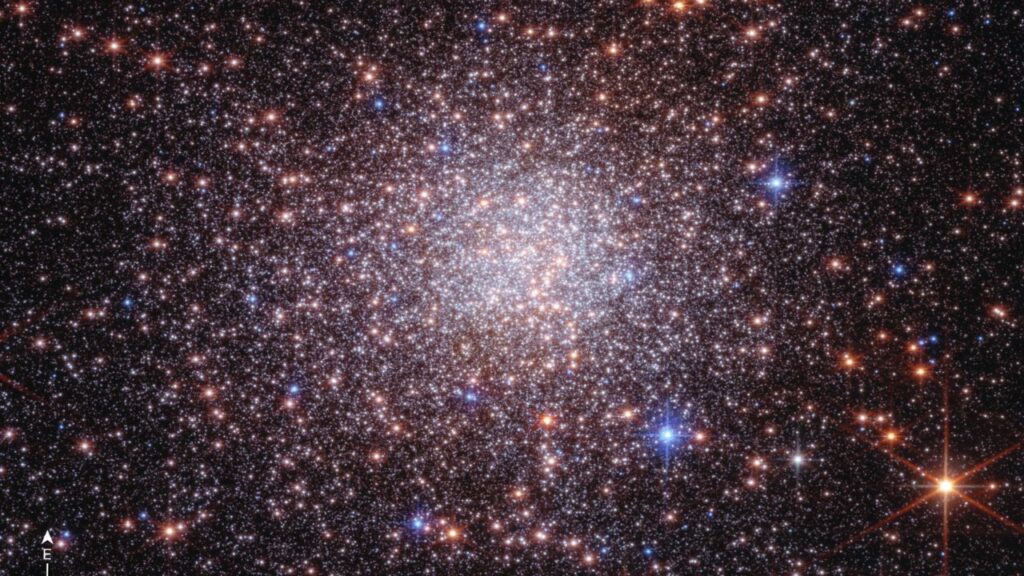
The discovery centers on Terzan 5, a densely packed region near the Milky Way’s core that has puzzled researchers for decades. Hidden behind thick clouds of cosmic dust and surrounded by enormous numbers of stars, the object has long been difficult to examine in detail. For years, astronomers classified Terzan 5 as a globular cluster, a type of ancient star cluster commonly found orbiting galaxies. However, the latest observations suggest the object is something far more unusual and scientifically valuable.
The findings provide researchers with a unique opportunity to study material that may have survived from the chaotic period when the Milky Way was still assembling itself billions of years ago. Understanding these ancient remnants could help answer some of the biggest questions about how galaxies like ours formed and evolved over cosmic time.
Terzan 5 Is Not What Scientists Originally Thought
One of the biggest revelations from the study is that Terzan 5 does not behave like a traditional globular star cluster. Most globular clusters contain stars that formed around the same period in the early universe, resulting in a relatively uniform stellar population. Terzan 5, however, tells a much more complicated story.
By analyzing the ages and composition of its stars, researchers discovered evidence of at least four separate periods of star formation spread across billions of years. According to the survey, two ancient stellar populations emerged roughly 12.5 billion years ago and 4.7 billion years ago. The team also identified younger generations of stars that formed approximately 3.8 billion and 2.5 billion years ago.
This layered history suggests Terzan 5 experienced repeated episodes of stellar birth rather than a single formation event. Such behavior is highly unusual and sets the object apart from ordinary globular clusters found elsewhere in the galaxy. Instead of being a simple cluster, it appears to be a surviving relic from a much earlier era of Milky Way development.
The discovery strengthens the idea that Terzan 5 may represent one of the original building blocks that helped create the central bulge of our galaxy. That possibility has made it one of the most intriguing structures currently being studied by astronomers.
A Fossil From the Milky Way’s Earliest Days
Researchers now describe Terzan 5 as a “bulge fossil fragment,” a term used for ancient structures that may have survived since the galaxy’s formation period. These fragments are thought to resemble massive stellar clumps that existed when the Milky Way was still young and rapidly evolving.
“For some reason, this peculiar clump of stars formed separately from the bulge and was not destroyed as the bulge itself formed,” said Francesco R. Ferraro, principal investigator of the Webb observations and professor at the University of Bologna. “Terzan 5 is what we now call a bulge fossil fragment because it resembles the primordial clumps that contributed to the formation of the bulge.”
The central bulge of the Milky Way is a densely populated region filled with stars located near the galaxy’s core. Scientists believe this structure formed very early in the galaxy’s history, but the exact process remains a subject of debate. Discoveries like Terzan 5 offer rare opportunities to test competing theories and improve our understanding of galactic evolution.
Because the region has survived for billions of years, it effectively serves as a cosmic time capsule. Its stars preserve information about conditions that existed long before Earth formed, allowing astronomers to look back into a period that would otherwise remain hidden.
What This Discovery Reveals About Galaxy Formation
Modern simulations suggest that young galaxies looked very different from the spiral structures commonly seen today. Rather than having stable shapes, many early galaxies were turbulent systems filled with enormous gas-rich disks. Those disks eventually fragmented into giant clumps where intense star formation occurred.
“Based on observations and in-depth simulations, we think that galaxies in the early Universe had huge discs of gas that fragmented into clumps and formed stars. These clumps migrated to the center of the galaxies, and many merged to form their bulges,” explained Barbara Lanzoni, associate professor at the University of Bologna and co-author of the study.
The idea is that most of these ancient stellar clumps eventually merged together or were destroyed as galaxies matured. Terzan 5 appears to be one of the rare exceptions that somehow survived the violent processes shaping the Milky Way billions of years ago. If that interpretation is correct, astronomers may now have direct access to a living remnant from the galaxy’s earliest construction phase.
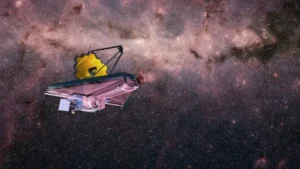
The James Webb Space Telescope has already transformed multiple areas of astronomy since beginning scientific operations, from studying distant galaxies to analyzing exoplanet atmospheres. This latest discovery demonstrates that Webb is also proving invaluable closer to home, helping researchers uncover hidden chapters of the Milky Way’s own story.
The findings have been published in the journal Astronomy & Astrophysics. As scientists continue examining Terzan 5 and similar objects, they hope to uncover more evidence about how the Milky Way assembled itself over billions of years. Each new observation brings researchers one step closer to understanding the origins of the galaxy that Earth calls home.