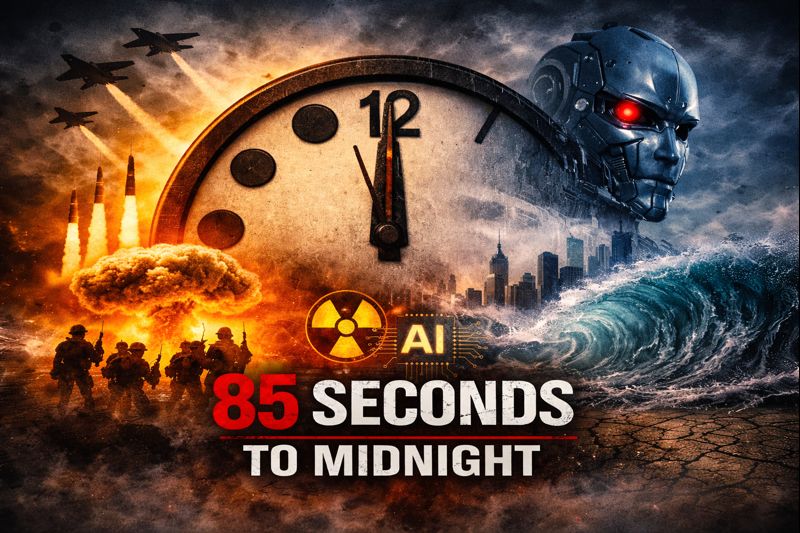
The world is now closer to catastrophe than ever before, according to atomic scientists. On January 27, the Bulletin of the Atomic Scientists officially moved the Doomsday Clock to 85 seconds before midnight, the closest it has been since the clock was first introduced in 1947.
The decision reflects mounting global dangers—from nuclear tensions and collapsing arms control to artificial intelligence risks and worsening climate threats—painting a grim picture of the current state of the world.
Why the clock moved closer
The Chicago-based nonprofit cited aggressive posturing by nuclear powers, particularly United States, Russia, and China, as a major factor behind the shift. Scientists pointed to rising geopolitical conflicts, including the ongoing war in Ukraine, tensions in the Middle East, and flashpoints across Asia, all unfolding under the shadow of nuclear escalation.
This marks the third time in four years that the clock has been pushed closer to midnight—an alarming trend that signals worsening global stability rather than progress.
Nuclear risks at an unsustainable level
According to Alexandra Bell, president and CEO of the Bulletin, nothing about nuclear risk improved in 2025. Longstanding diplomatic frameworks are fraying, proliferation concerns are growing, and the possibility of renewed nuclear weapons testing has resurfaced after decades of restraint.
She highlighted that the risk of nuclear weapon use is now “unacceptably high,” driven by unresolved conflicts, collapsing arms agreements, and renewed military brinkmanship.
The looming expiration of the New START treaty—the last remaining nuclear arms pact between the U.S. and Russia—has further deepened concerns, with no clear path forward yet agreed upon.
AI and climate change add new layers of danger
Beyond nuclear threats, scientists raised red flags about the unregulated use of artificial intelligence, particularly its integration into military systems. They warned that AI could accelerate misinformation, enable biological threats, and reduce human oversight in life-or-death decisions.
Climate change was also cited as a persistent and intensifying global risk, compounding instability and amplifying existing conflicts rather than easing them.
Global leadership under scrutiny
Bell stressed that the clock’s movement reflects a broader failure of global leadership, warning that rising nationalism, neo-imperial ambitions, and erosion of democratic norms are undermining international cooperation.
She also pointed to heightened tensions in regions such as the Korean Peninsula, cross-border friction between India and Pakistan, and growing concerns over China’s stance toward Taiwan—all of which contribute to an increasingly fragile global environment.
An ‘information Armageddon’
Journalist and Nobel Peace Prize laureate Maria Ressa also participated in the announcement, warning that modern technology is accelerating the spread of lies faster than facts. She described the current moment as an “information Armageddon,” driven by social media platforms and generative AI systems that are not grounded in truth.
A warning nearly eight decades old
Founded in 1945 by scientists including Albert Einstein and J. Robert Oppenheimer, the Bulletin introduced the Doomsday Clock in 1947 as a symbolic warning of humanity’s self-destructive potential.
At 85 seconds to midnight, that warning has never felt more urgent.
Final words
The latest Doomsday Clock update is not a prediction—but it is a stark signal. Scientists are urging governments and global leaders to reverse course, rebuild trust, and act decisively before compounding crises become irreversible.
For now, the clock is ticking faster than ever—and the margin for error has nearly disappeared. ⏳🌍