OpenAI has officially stepped into the advertising arena.
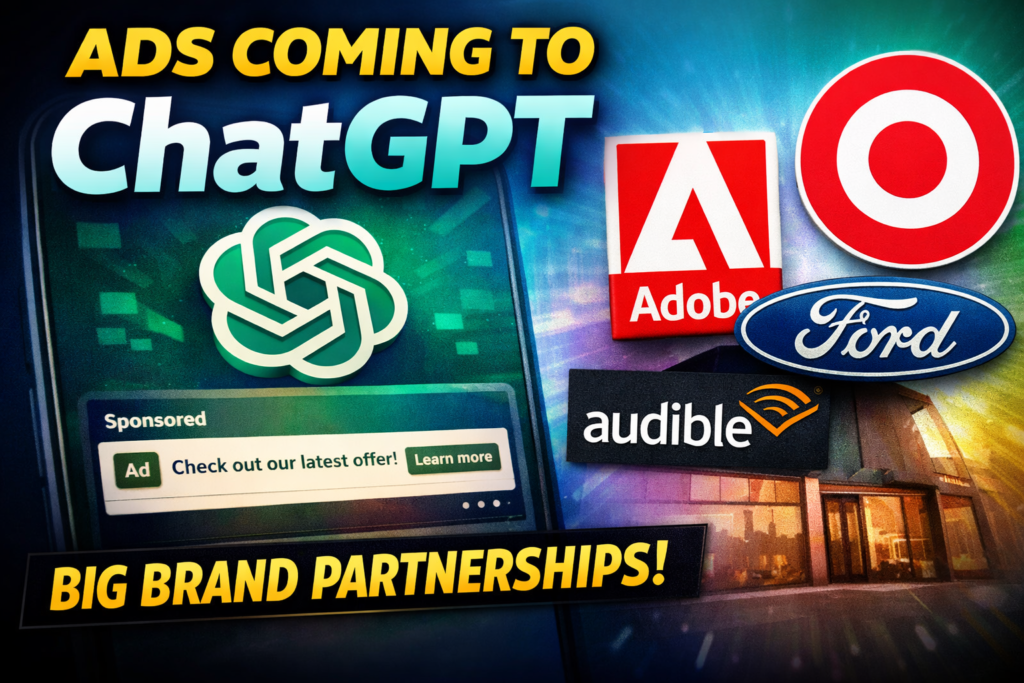
The company has started testing ads inside ChatGPT, and several major brands have already confirmed their participation in the pilot programme. Ads are currently being shown to free-tier users and ChatGPT Go subscribers in the United States.
And yes — this is a pretty big shift for conversational AI.
💼 Brands Announce Partnerships
Among the first wave of advertisers are:
- Adobe
- Audible
- Target
- Ford
- Mazda
- HelloFresh
- Williams-Sonoma
- Dentsu
Adobe will reportedly promote Acrobat Studio and Adobe Firefly, while Target plans to show ads based on user search intent. For example, if someone asks about convenient cooking appliances, they might see a sponsored air fryer listing.
Audible, in a LinkedIn post, said the pilot will help them understand how advertising can create value in conversational AI while maintaining user trust.
📍 How Ads Appear in ChatGPT
Ads appear at the bottom of a ChatGPT response, clearly separated from the main answer.
They are:
- Keyword-based (driven by what users ask)
- Influenced by past interactions and chat history
- Shown only to logged-in adult users in the US (for now)
This means if someone frequently asks about photography tools, they could see ads related to editing software or camera accessories.
In short, these aren’t random banners — they’re context-driven.
💰 OpenAI’s Ad Pricing vs Meta
According to The Information, OpenAI is reportedly charging $60 per 1,000 views (CPM) for ChatGPT ads.
For comparison, that’s roughly three times higher than what Meta typically charges on its platforms.
That premium suggests OpenAI believes conversational AI ad placements — especially during “high-intent” user queries — are more valuable than traditional social media impressions.
HelloFresh even described this as reaching customers during “high-intent moments,” when they are actively searching for solutions.
🔎 What This Means
This pilot could reshape how advertising works in AI environments.
Unlike scrolling through social media, ChatGPT interactions are usually problem-focused — users come with specific questions. That creates a potentially powerful ad moment, but it also raises questions about transparency, user trust, and data usage.
For now, ads are limited to a controlled US pilot. But if the experiment succeeds, this could become a major revenue stream for OpenAI — and a new advertising channel brands can’t ignore.
The big question?
Will users accept ads inside AI chats — or expect their conversations to remain purely informational?
That answer will likely determine how far this experiment goes.