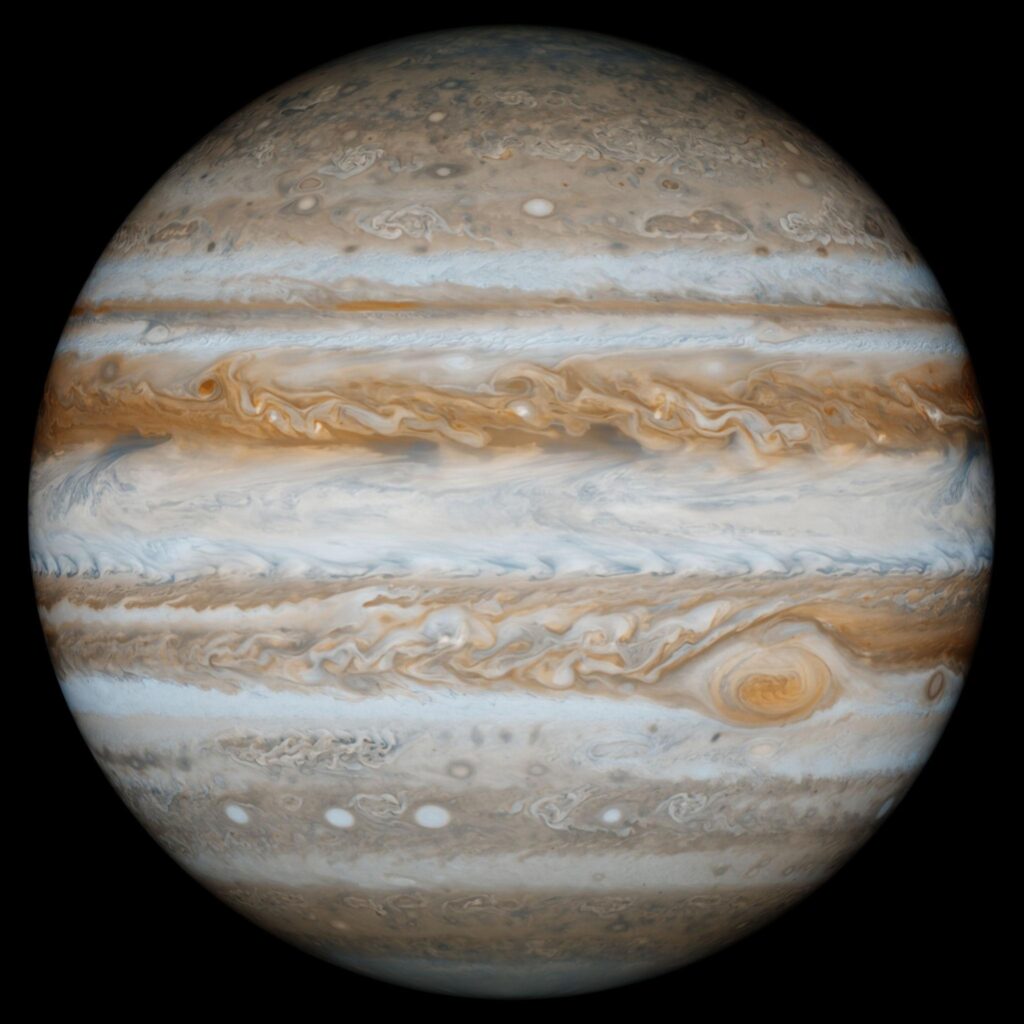
For decades, Jupiter has been known as the giant of our solar system — massive, swirling, and slightly squashed at the poles. But now, fresh data suggests the gas giant is just a bit smaller and flatter than scientists once believed.
Thanks to new measurements from NASA’s Juno spacecraft, researchers have refined Jupiter’s size with unprecedented precision — and the updates, while small in numbers, are big for planetary science.
📡 Radio Signals Unlock Jupiter’s True Shape
The breakthrough comes from repeated radio occultation observations conducted by Juno. Scientists tracked how radio signals bent as they passed through Jupiter’s dense, turbulent atmosphere. By studying those subtle distortions, they could map temperature, density, and the planet’s physical shape more accurately than ever before explain.
At the 1-bar pressure level — the atmospheric layer often used as a reference point — Jupiter’s updated dimensions are:
- Polar radius: 66,842 km
- Equatorial radius: 71,488 km
That’s about 12 km smaller at the poles and 4 km smaller at the equator compared to estimates from the late 1970s.
Small tweak? Yes. Scientifically meaningful? Absolutely.
🛰️ Why Earlier Measurements Were Less Precise
Earlier size estimates came from the Pioneer and Voyager missions in the 1970s. Back then, scientists had only six radio occultation readings to work with. Limited data meant larger uncertainty margins.
Jupiter’s atmosphere isn’t calm — it’s a stormy, high-speed environment dominated by powerful zonal winds. These winds distort the planet’s atmospheric layers, subtly altering its shape. Without enough measurements, earlier models couldn’t fully account for those distortions.
Juno, launched in 2011 and orbiting Jupiter since 2016, has provided a much richer dataset. Improved orbital tracking and advanced processing techniques allowed scientists to smooth out inconsistencies and build a more accurate planetary profile.
🌪️ A Slightly Flatter Giant
The updated findings confirm that Jupiter remains an oblate spheroid — meaning it bulges at the equator and flattens at the poles — but slightly more flattened than previously thought.
That equatorial bulge is caused by the planet’s rapid rotation. Jupiter completes one full spin in just under 10 hours, creating significant centrifugal force. Combine that with fierce atmospheric winds, and you get a subtly distorted shape.
Now, researchers have a cleaner, sharper picture of exactly how distorted.
🔭 Why These Tiny Numbers Matter
When it comes to planets, even a few kilometers make a difference.
Precise measurements help scientists refine models of Jupiter’s deep interior — including its core structure and gravitational dynamics. A better understanding of Jupiter also helps researchers interpret distant gas giants orbiting other stars.
In other words, measuring Jupiter more accurately doesn’t just teach us about one planet — it strengthens our broader understanding of planetary formation across the universe.
⭐ Final Words
Jupiter may still be the king of planets, but even kings get remeasured.
These updated dimensions don’t change its dominance — they sharpen our understanding of it. And in science, sharper always means better.
Sometimes, progress isn’t about discovering something new. It’s about measuring what we thought we already knew — just a little more precisely.