
After more than five decades away from the Moon, NASA is preparing to send humans back into deep space — not to land, but to prove that the road to the lunar surface is finally open again. The upcoming Artemis II mission, now targeting an early February 2026 launch window, marks the first crewed Moon flight since the Apollo era and a major turning point for human spaceflight.
At the heart of the mission is a striking image that’s already become symbolic: four astronauts in vivid orange pressure suits, standing against a dark backdrop, mission patches stitched across their chests. It’s a modern echo of Apollo — familiar, yet clearly built for a very different future.
Meet the Four Astronauts Heading Beyond the Moon
The Artemis II crew brings together experience, history-making firsts, and international collaboration:
- Reid Wiseman — Mission commander, leading NASA’s return to lunar orbit
- Victor Glover — Pilot, overseeing spacecraft operations
- Christina Koch — Mission specialist, part of NASA’s next-generation lunar team
- Jeremy Hansen — Mission specialist from the Canadian Space Agency, making history as the first non-American to fly on a Moon mission
Their destination isn’t the Moon’s surface — but a region of space humans have never reached before.
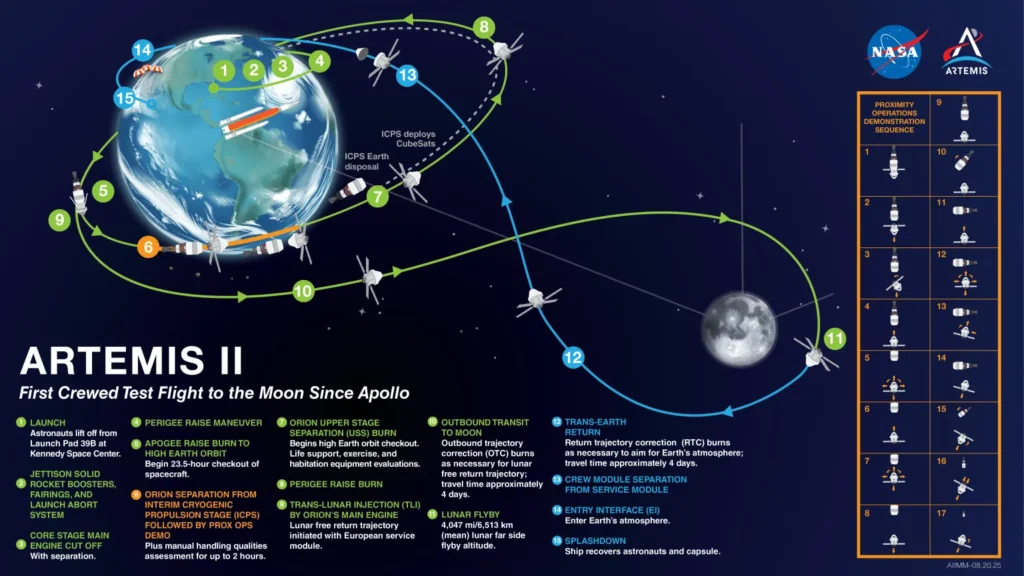
What Artemis II Will Actually Do in Space
This roughly 10-day mission is designed to test every critical system astronauts will rely on when they eventually land on the Moon.
After lifting off from Kennedy Space Center, the crew will:
- Become the first humans to fly aboard NASA’s Space Launch System rocket
- Test the Orion spacecraft manually in Earth orbit
- Travel thousands of kilometres beyond the Moon, farther than any crewed mission in history
- Stress-test Orion’s life support, navigation, propulsion, and power systems
- Operate in a compact, nine-cubic-metre cabin under higher radiation levels than the ISS
- Collect medical and performance data to prepare future Moon landings
The mission ends with a high-speed return through Earth’s atmosphere and a Pacific Ocean splashdown, a reminder that some things — like dramatic re-entries — never change.
Why Artemis II Won’t Land on the Moon
Despite the excitement, Artemis II is strictly a dress rehearsal. The actual lunar landing is planned for Artemis III, currently scheduled no earlier than 2027, with most experts pointing to 2028 as the more realistic target.
NASA is still deciding which lunar lander will carry astronauts to the surface — either SpaceX’s Starship-based system or a competing design from Blue Origin. New-generation spacesuits, being developed by Axiom, are also still in progress.
When that landing does happen, astronauts will touch down near the Moon’s south pole, a region believed to contain water ice — a key resource for long-term human presence.
The Bigger Plan: Living and Working Around the Moon
Artemis isn’t about quick visits. It’s about staying.
Future missions (Artemis IV and V) will begin assembling Gateway, a small space station orbiting the Moon. Over time, more countries will join, robotic rovers will expand surface exploration, and astronauts will spend longer stretches living and working in lunar space.
This marks a sharp contrast to Apollo, which ended with Apollo 17 in 1972 after political interest faded. Artemis is built around sustainability, partnerships, and commercial involvement — a Moon programme designed to last.
A Global Race Is Quietly Taking Shape
NASA isn’t alone in looking skyward:
- Europe and Japan have secured seats on future Artemis missions
- China is targeting a crewed Moon landing by 2030
- Russia continues to outline long-term lunar plans, though timelines remain uncertain
- India, fresh off the success of Chandrayaan-3 near the Moon’s south pole, has set its sights on sending astronauts to the Moon around 2040
The Moon, once again, is becoming crowded — and strategically important.
Final Words: A Quietly Historic Mission
Artemis II may not plant flags or leave footprints, but it carries something just as important: proof. Proof that humans can safely travel beyond low-Earth orbit again, operate deep-space systems, and prepare for a permanent return to the Moon.
If all goes as planned, February 2026 won’t just mark another launch — it will mark the moment humanity truly starts its next chapter beyond Earth.