Hubble Spots a Stellar Duo Trend in a Young Star Cluster
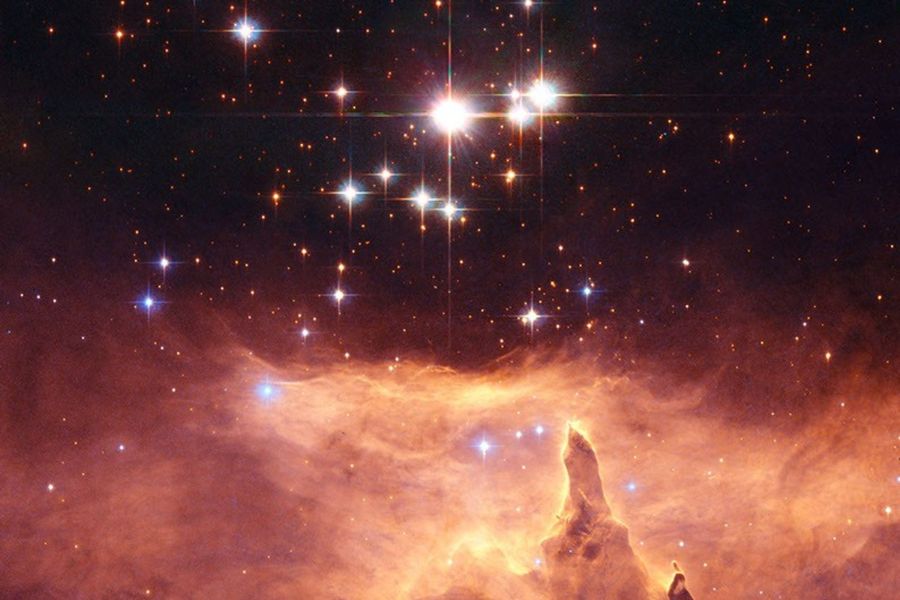
Astronomers using the legendary Hubble Space Telescope have uncovered fascinating details about a young star cluster known as Pismis 24, revealing that many of its stars exist not alone but as binary pairs.
Located inside the spectacular NGC 6357, the cluster sits about 5,500 light-years from Earth and contains dozens of extremely hot and massive stars. New observations show that a large portion of these stars are gravitationally linked to companions, orbiting each other in tight systems.
For astronomers studying the structure of the Milky Way, these stellar partnerships offer valuable clues about how star clusters evolve over time.
Inside Pismis 24: Massive Stars With Hidden Companions
Pismis 24 is one of the most energetic stellar nurseries in our galaxy, filled with blazing O-type stars—the hottest and most luminous stars known.
Hubble’s detailed imaging revealed that the cluster’s brightest star, Pismis 24-1, is not a single star as once believed. Instead, it is a complex system of three massive stars, each estimated to have close to 100 times the mass of the Sun, orbiting each other.
Another powerful star in the cluster, Pismis 24-18, also turned out to be a binary system, further strengthening evidence that stellar pairs are extremely common in this region.
Discoveries like these highlight how powerful modern telescopes have become—allowing astronomers to separate stars that once appeared as a single point of light.
Binary Stars: The Hidden Engines of Star Clusters
Scientists now believe binary stars act like internal engines that shape the life of a star cluster.
When two stars orbit each other, their gravitational interactions can dramatically affect surrounding stars. As binary systems interact with neighboring single stars, they can transfer energy through close encounters.
This process can:
- Increase the kinetic energy within the cluster
- Prevent the cluster from collapsing under gravity
- Sometimes eject stars out of the cluster entirely
Over millions of years, these interactions gradually reshape the structure and motion of the entire cluster.
In other words, binaries do far more than simply orbit each other—they actively influence the evolution of the cosmic environment around them.
The Birthplace of Exotic Stars
Binary systems can also produce some of the universe’s most unusual stars.
One example is blue stragglers—mysterious stars that appear younger and hotter than others in the same cluster. Astronomers believe these stars form when two stars collide or merge inside a binary system.
Such stellar mergers can rejuvenate a star, making it burn hotter and brighter than its neighbors despite being born at the same time.
Binary systems can also create dramatic events when one of the stars eventually explodes as a supernova. In some cases, the remaining companion star can be flung through space at extremely high speeds.
How Common Are Binary Stars?
Astronomers have long suspected that binary stars are extremely common across the galaxy. Recent Hubble studies of older star clusters suggest that around 38% of stars may exist in binary systems.
In younger clusters like Pismis 24, the fraction may be even higher, especially among massive stars.
These discoveries are helping researchers better understand how stars form, interact, and evolve within clusters, shedding light on the broader history of our own Milky Way.
Final Words
The new findings from the Hubble Space Telescope reveal that star clusters are far more dynamic than once imagined. Instead of quiet collections of stars drifting through space, clusters like Pismis 24 are bustling environments where binary stars constantly interact, collide, and reshape their surroundings.
As astronomers continue to study these stellar partnerships, they are gradually uncovering how such systems influence everything—from the birth of exotic stars to the long-term evolution of galaxies.