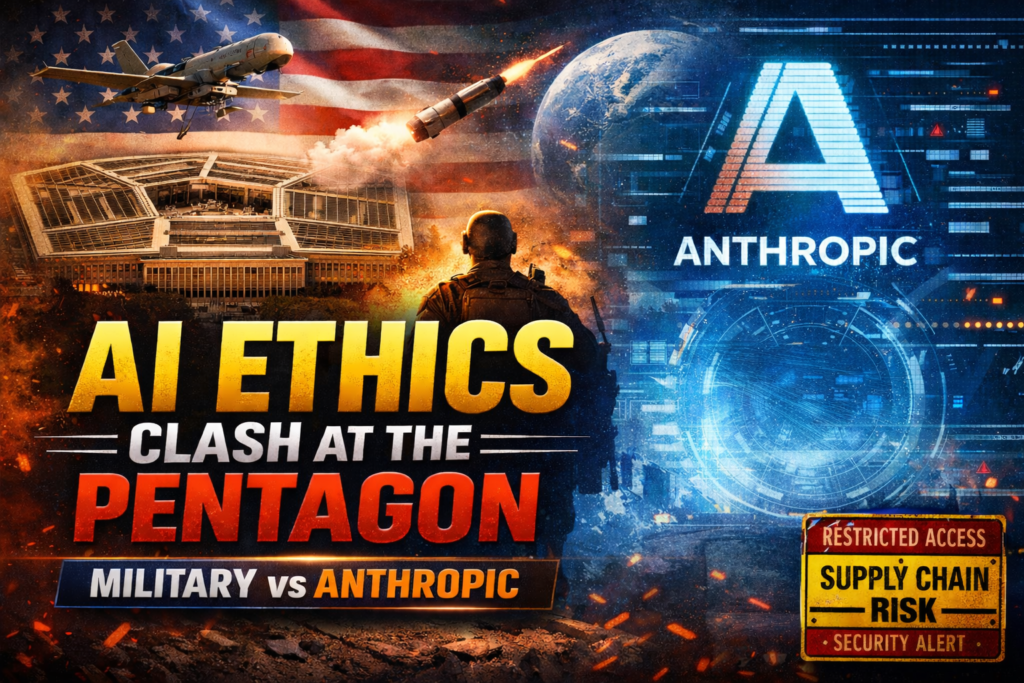
A major dispute has erupted between the U.S. Department of Defense and artificial intelligence firm Anthropic, highlighting the growing tension between military ambitions and ethical limits on artificial intelligence.
At the center of the controversy is the Pentagon’s push to expand the role of AI in modern warfare — including autonomous drones, missile defense systems, and advanced battlefield automation. The conflict escalated after a senior U.S. defense official publicly criticised the company’s restrictions on how its chatbot Claude can be used by the military.
The disagreement is now serious enough that the Pentagon has officially designated Anthropic as a “supply chain risk,” effectively cutting off its defense contracts and triggering a legal battle that could shape the future relationship between Silicon Valley and the U.S. military.
Pentagon Official Says AI Restrictions Became an Obstacle
According to Emil Michael, the Pentagon’s chief technology officer, the conflict developed during internal discussions about how artificial intelligence might support future defense systems — particularly a proposed missile defense initiative backed by Donald Trump.
The program, known as Golden Dome, aims to create a space-based missile defense shield capable of detecting and intercepting threats such as hypersonic missiles.
Speaking on the All-In Podcast, Michael said the military needs technology partners willing to support greater autonomy in defense systems, including swarms of armed drones and underwater vehicles that could operate with minimal human control.
He argued that strict ethical rules placed on AI technology could limit the military’s ability to compete with strategic rivals like China.
Michael explained that the Pentagon is increasingly preparing for a future where autonomous systems may need to make rapid decisions during combat scenarios.
Golden Dome Program at the Center of the Debate
One of the scenarios discussed during negotiations involved the Golden Dome missile defense concept, a program designed to place defensive systems in space capable of responding to emerging threats.
Michael described a hypothetical situation in which the United States might have only 90 seconds to react to a Chinese hypersonic missile launch.
In such cases, he argued, fully autonomous defensive responses could become necessary because human operators may not have enough time to visually identify and track incoming threats.
From the Pentagon’s perspective, AI-driven countermeasures in space would carry relatively low risk, since the goal would simply be intercepting a hostile object before it reaches its target.
The debate over these scenarios reportedly became one of the main points of disagreement between the Pentagon and Anthropic.
Pentagon Labels Anthropic a “Supply Chain Risk”
The conflict escalated dramatically when the Pentagon formally classified Anthropic as a supply chain risk, a designation typically used when national security systems could be vulnerable to external interference or operational limitations.
The decision immediately halted the company’s involvement in defense projects and also affected partnerships with other military contractors working with Pentagon technology systems.
In addition, the Trump administration directed federal agencies to stop using Anthropic’s AI tools, including its chatbot Claude.
However, the Department of Defense has been given six months to phase out the technology, as it is already integrated into several classified systems used by the U.S. military.
The decision has sent shockwaves through the AI industry, where companies are increasingly competing for government contracts linked to defense and national security.
Anthropic Pushes Back and Plans Legal Action
Anthropic has strongly rejected the Pentagon’s characterization and announced plans to challenge the decision in court.
The company insists that it never attempted to interfere with military decision-making and only placed limits on two specific uses of its AI technology:
• Mass surveillance of American citizens
• Fully autonomous weapons systems
According to the company, these restrictions are meant to ensure responsible development of AI rather than obstruct legitimate defense operations.
Anthropic also maintains that today’s AI models are not reliable enough to safely power fully autonomous weapons, making such restrictions necessary from a safety standpoint.
CEO Dario Amodei previously stated that the company understands that governments — not private companies — ultimately decide how military operations are conducted.
Broader Debate Over AI in Warfare
The disagreement highlights a much larger conversation happening across governments and technology companies around the world: how far artificial intelligence should be allowed to go in warfare.
Pentagon officials have increasingly pushed for AI systems capable of assisting or even replacing human operators in certain combat roles.
Michael noted that the military is already developing frameworks that define different levels of autonomy depending on the operational risk involved.
Examples include:
- AI systems that automatically intercept drones attacking a military base
- Autonomous underwater vehicles monitoring naval activity
- Drone swarms capable of coordinated battlefield actions
However, critics argue that removing human oversight from lethal systems raises serious ethical and safety concerns.
Other AI Companies Align With Pentagon Terms
While Anthropic resisted broader military use of its technology, other major AI developers appear to have agreed to the Pentagon’s contract terms.
Companies such as Google, OpenAI, and xAI have reportedly accepted conditions allowing “all lawful uses” of their AI technology within military programs.
Some of these companies are still preparing their infrastructure to handle classified defense workloads, but the Pentagon has indicated that they are willing to cooperate with broader AI defense applications.
For Anthropic, however, the sticking point remained the refusal to remove limits on autonomous weapons and surveillance tools.
What Happens Next
The standoff between Anthropic and the Pentagon is now expected to move into the legal arena, where courts may ultimately determine whether the government’s designation of the company as a supply chain risk is justified.
The outcome could have significant consequences for the rapidly evolving AI-defense partnership between Silicon Valley and Washington.
As militaries around the world race to integrate artificial intelligence into defense systems, the question of who sets the rules — governments or technology companies — is becoming increasingly urgent.
Final Words
The clash between Anthropic and the Pentagon reveals just how complex the future of AI in warfare has become. While defense officials argue that autonomous systems are essential for staying ahead of global rivals, technology companies are increasingly grappling with the ethical implications of the tools they build.
As the legal battle unfolds, the case could set a powerful precedent for how artificial intelligence will shape both national security and global technology policy in the years ahead.