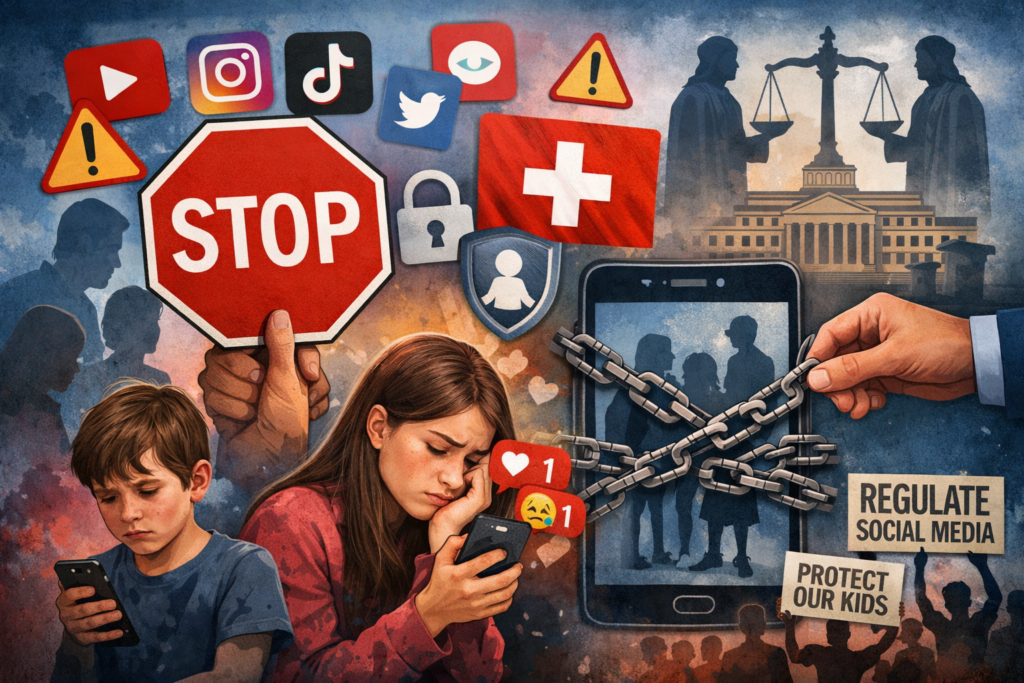
A growing global debate around social media safety has taken a strong turn in Switzerland, where public opinion is now clearly leaning toward stricter rules — especially when it comes to protecting children and teenagers online. A new survey has revealed overwhelming support among Swiss citizens for tighter controls, reflecting a broader shift happening worldwide as governments, courts, and communities begin to question the long-term impact of digital platforms on young users.
This isn’t just another policy discussion — it’s part of a much bigger conversation about responsibility, influence, and the role Big Tech plays in shaping modern society.
A Clear Message From Switzerland: Protect the Young
According to a recent study conducted by polling firm GfS Bern for the Mercator Foundation, an overwhelming 94% of Swiss respondents believe that minors need stronger protection from the harmful effects of social media. That’s not a narrow majority — it’s near-unanimous concern.
At the same time, 78% of those surveyed said they feel major technology companies hold too much power over public opinion. This combination of concerns paints a clear picture: people are not just worried about content, but also about influence, control, and the broader societal impact of these platforms.
The survey, which included around 1,000 participants aged 16 and above, was conducted in early December and carries a margin of error of 3.2 percentage points. While polls often show divided opinions, this one stands out for its consistency — suggesting that the issue has reached a tipping point in public consciousness.
From Concern to Action: Government Steps In
Public opinion is already beginning to shape policy conversations. Switzerland’s Interior Minister, Elisabeth Baume-Schneider, has openly stated that she is willing to consider strong measures — including the possibility of restricting or even banning social media access for younger users.
The Swiss government is currently working on legislation aimed at regulating major online platforms. The goal is to make these platforms more transparent and accountable, particularly in how they handle content, algorithms, and user data.
This move reflects a growing realization: self-regulation by tech companies may no longer be enough. Governments are now stepping in to create frameworks that prioritize user safety — especially for younger audiences who are seen as more vulnerable.
A Global Shift: Switzerland Is Not Alone
What’s happening in Switzerland is part of a much larger trend.
Just days before the survey gained attention, a Los Angeles jury found Meta and Google negligent in a case related to the impact of their platforms on young users. The verdict is being seen as a potential turning point — one that could influence similar lawsuits around the world.
Meanwhile, neighboring Austria has already taken a more direct approach, moving forward with plans to ban social media use for children under the age of 14. This kind of policy, once considered extreme, is now being seriously discussed across multiple countries.
From the United States to Europe, regulators are increasingly scrutinizing how platforms are designed — particularly the algorithms that determine what users see and how long they stay engaged.
Why the Concern Is Growing
The rising concern isn’t happening in isolation. Over the past decade, social media has become deeply embedded in daily life — especially for younger generations.
While these platforms offer connection, creativity, and access to information, they also come with risks. Studies and reports have linked excessive social media use to issues like anxiety, depression, sleep disruption, and exposure to harmful content.
There’s also the question of addictive design. Features like endless scrolling, notifications, and personalized feeds are designed to keep users engaged — but critics argue that they can be particularly harmful for children and teenagers who are still developing emotionally and psychologically.
This is where the debate becomes more complex. It’s not just about what content is available, but how platforms are built to capture attention in the first place.
Big Tech Under the Microscope
For companies like Meta and Google, this moment represents a significant challenge.
For years, these platforms have operated with relatively limited regulation compared to traditional industries. But that era may be coming to an end. Governments are now asking tougher questions about accountability, transparency, and user protection.
The recent U.S. court verdict adds another layer of pressure, suggesting that legal systems are also beginning to hold tech companies responsible for the real-world impact of their products.
If similar rulings emerge in other regions, it could lead to major changes in how social media platforms are designed and operated.
What’s Working in the Push for Regulation
One of the biggest strengths of the current movement is its global momentum. When multiple countries begin addressing the same issue at the same time, it creates a ripple effect.
Public awareness is also higher than ever. Parents, educators, and even young users themselves are increasingly vocal about the need for safer digital spaces.
Additionally, the conversation is no longer limited to experts or policymakers. It has entered mainstream discourse, making it harder for companies to ignore.
The Challenges Ahead
Despite strong public support, implementing effective regulation won’t be easy.
One of the biggest challenges is defining what “protection” actually means. Should it involve age restrictions, content moderation, time limits, or a complete ban for certain age groups? Each approach comes with its own set of complications.
There’s also the issue of enforcement. In a digital world that crosses borders, regulating platforms within one country may not be enough. Coordinated international efforts could become necessary — something that is easier said than done.
And then there’s the balance between safety and freedom. Social media is also a space for expression, creativity, and connection. Over-regulation could risk limiting those benefits, especially for older teens who use these platforms responsibly.
A Turning Point for the Digital Age
What’s happening right now feels like a turning point. For years, the conversation around social media focused on growth, innovation, and connectivity. Now, it’s shifting toward responsibility, impact, and long-term consequences.
Switzerland’s survey results are just one piece of this larger puzzle — but they highlight how public opinion is evolving. When 94% of people agree on something, it’s no longer just a debate. It’s a signal.
As governments draft new laws and courts begin to weigh in, the future of social media could look very different from what we know today.
And at the center of it all is a simple but powerful question: how do we protect the next generation in a world that is increasingly shaped by screens?