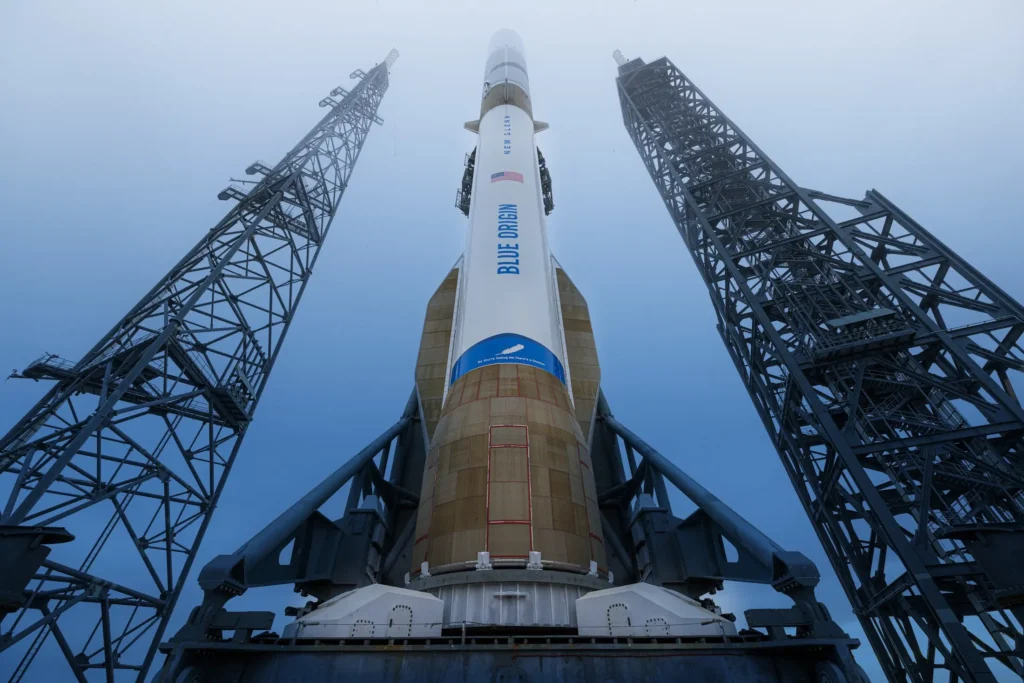
Blue Origin has finally received clearance from the Federal Aviation Administration to move ahead with the next launch of its massive New Glenn rocket after months of investigation and technical review. The approval comes after the company faced serious scrutiny following New Glenn’s troubled third mission earlier this year, where the rocket failed to place its payload into the correct orbit.
The company confirmed the update through a post on X, revealing that the FAA has officially accepted both its investigation report and the corrective actions taken after the incident. Blue Origin also teased that preparations for New Glenn’s fourth mission, known internally as NG-4, are already continuing, although the company still has not announced an exact launch date.
The clearance is an important moment for Blue Origin because New Glenn is considered one of the company’s biggest long-term projects in the commercial space race. The heavy-lift rocket is expected to compete directly with launch systems from SpaceX and other major players in the private space industry. Any long delay or repeated technical problem could have affected confidence around the program, especially after the highly publicized mishap during its previous mission.
What Went Wrong During New Glenn’s Third Flight
Back in April, New Glenn’s third mission initially appeared to be a success. Blue Origin even managed to successfully reuse the rocket’s first-stage booster for the first time, which was seen as a major milestone for the company’s reusable rocket ambitions. However, problems started during the second-stage burn while the rocket attempted to deploy a satellite for AST SpaceMobile.
At the time, Blue Origin admitted that the payload had been placed into what it called an “off-nominal orbit.” Later, AST SpaceMobile confirmed that although the satellite separated correctly from the rocket, it ended up too low in altitude to continue operating properly. Because the satellite lacked enough onboard propulsion capability to recover from the situation, it was eventually expected to deorbit.
The FAA quickly classified the incident as a “mishap” and temporarily grounded New Glenn while investigators worked to identify the root cause. Soon after the failed mission, Blue Origin CEO Dave Limp explained that early data pointed toward one of the rocket’s BE-3U engines failing to generate enough thrust during the second upper-stage burn.
Cryogenic Leak Identified As Main Cause Of Failure
According to details later shared with SpaceNews, the FAA’s final report concluded that the direct cause of the anomaly was a cryogenic leak. The leak reportedly froze a hydraulic line during flight, which then created a thrust issue affecting the rocket’s upper-stage engine performance.
Blue Origin has since implemented nine corrective measures aimed at preventing the same issue from happening again. While the company has not publicly detailed every change, the FAA’s acceptance of those corrective actions was necessary before New Glenn could return to flight operations.
Meanwhile, Dave Limp recently shared footage showing New Glenn’s transporter erector system as the company prepares for integrated hotfire testing ahead of the upcoming mission. That testing phase is considered one of the final major steps before another launch attempt can officially happen.
The next New Glenn mission is now being watched very closely across the aerospace industry because it will likely determine how quickly Blue Origin can scale its launch operations in the coming years. After years of delays, the company is under growing pressure to prove New Glenn can become a reliable commercial launch vehicle capable of competing consistently in the rapidly evolving global space market.