One of the solar system’s most intriguing worlds just got even more interesting. Scientists studying old data from Galileo have discovered signs of ammonia-bearing compounds on Europa, Jupiter’s icy moon — marking the first time ammonia has ever been detected there.
The finding strengthens the case for Europa as one of the top candidates for life beyond Earth, thanks to its vast hidden ocean and rich chemistry.
Why Europa Matters So Much
Europa isn’t just another frozen moon. Beneath its cracked, icy crust lies a global saltwater ocean — one that scientists believe contains twice as much water as all of Earth’s oceans combined. That ocean has long been suspected to hold the right chemical ingredients for life.
What’s been missing until now is clear evidence of nitrogen-based compounds — a critical building block for biology. That’s where ammonia comes in.
What Scientists Found in the Galileo Data
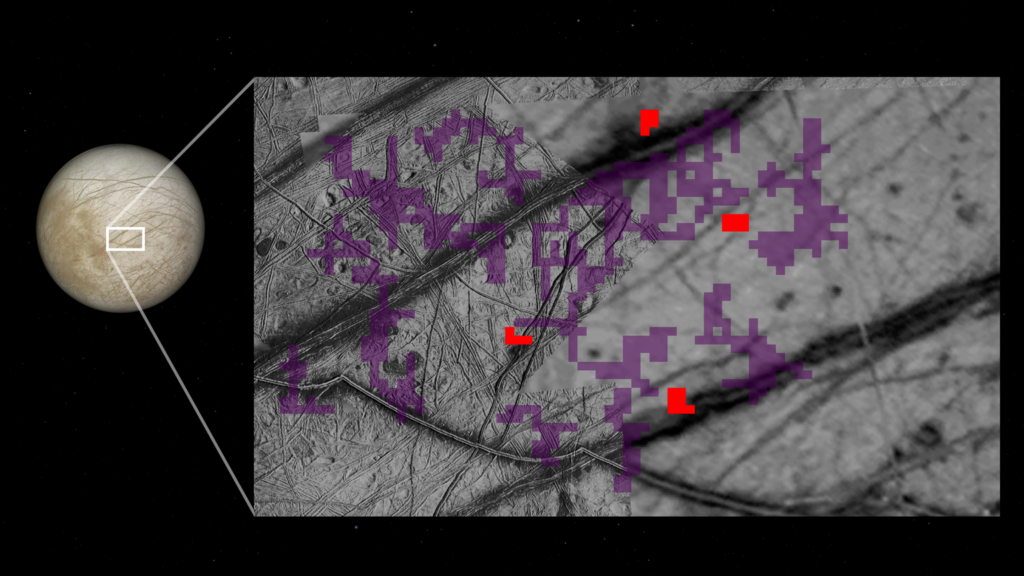
In a fresh reanalysis of Galileo spacecraft observations from a 1997 Europa flyby, researchers identified weak but consistent spectral signals of ammonia-bearing material on Europa’s surface.
According to NASA, these ammonia signals appear along Europa’s dark cracks and ridges, which span the moon’s entire surface. These fractures are believed to act like conduits between the subsurface ocean and the surface.
The most likely explanation?
Ammonia-rich water may have recently erupted upward through cryovolcanic activity, freezing as it reached the surface.
Why Ammonia Is a Big Deal
Ammonia doesn’t survive long on Europa’s surface. Jupiter’s intense radiation quickly breaks it down. That means any ammonia detected there must have arrived recently — likely from the ocean below.
Even more importantly, ammonia contains nitrogen, one of the essential elements for life as we know it. Combined with water, salts, and other chemicals already known to exist on Europa, this discovery adds another crucial piece to the puzzle.
In short:
👉 Europa’s ocean isn’t just wet — it may be chemically alive.
What This Means for the Search for Life
The presence of ammonia suggests Europa’s ocean could be:
- Chemically active
- Capable of supporting complex reactions
- More Earth-like than previously confirmed
While this doesn’t prove life exists, it dramatically increases Europa’s astrobiological potential.
Europa Clipper: The Next Big Step
NASA’s upcoming mission, Europa Clipper, is set to arrive at the moon in 2030. Equipped with advanced instruments, the spacecraft will:
- Analyze Europa’s surface chemistry
- Study its icy crust
- Probe the ocean beneath
- Search for more compounds like ammonia
This new discovery gives Europa Clipper clear targets to investigate — and raises expectations for what it might find.
Final Words
Europa has always been mysterious. Now, it’s becoming compelling.
The detection of ammonia on its surface suggests a dynamic connection between the moon’s ocean and its icy shell, and confirms that key ingredients for life may be actively circulating.
As scientists prepare for Europa Clipper’s arrival, one thing is becoming increasingly clear:
If life exists anywhere beyond Earth in our solar system, Europa is one of the best places to look.