In a discovery that sounds straight out of science fiction, astronomers have identified a galaxy that is almost completely invisible — because it’s made up almost entirely of dark matter.
The galaxy, named CDG-2, sits roughly 300 million light-years away inside the Perseus galaxy cluster. What makes it extraordinary isn’t just its distance, but its composition: scientists estimate that about 99% of its mass is dark matter, with barely any visible starlight.
The finding comes from a research team led by Dayi (David) Li of the University of Toronto, using data from Hubble Space Telescope, Euclid, and the Subaru Telescope.
Detecting an Invisible Galaxy
What’s remarkable is how CDG-2 was found.
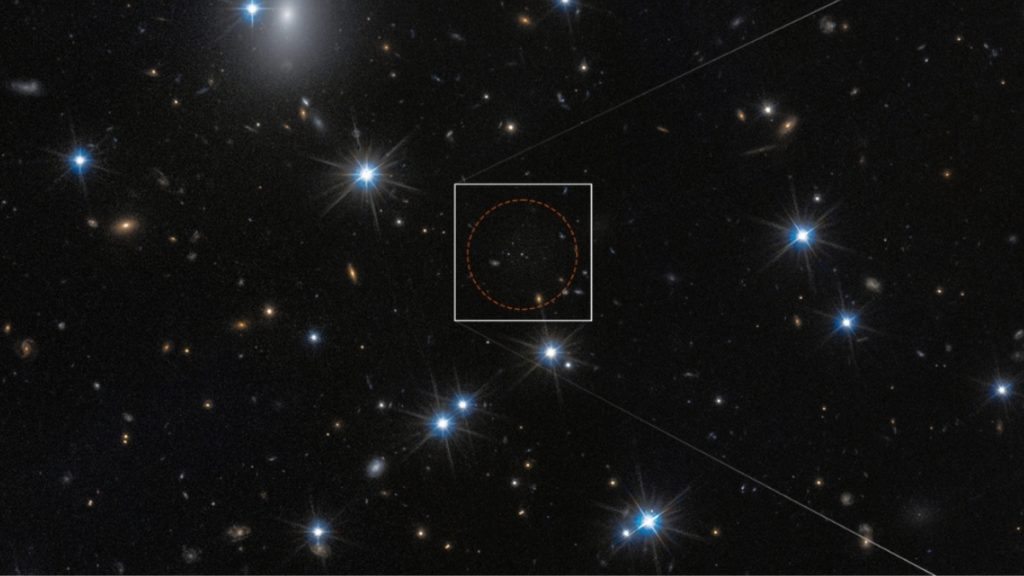
Astronomers didn’t spot it by looking for glowing stars — because there were hardly any to see. Instead, they searched for globular clusters, which are dense, spherical groups of stars that typically orbit galaxies.
Within the Perseus cluster, researchers identified four compact globular clusters using combined observations from Hubble, Euclid, and Subaru. When they layered and enhanced the images, a faint glow appeared around these clusters — revealing the hidden galaxy.
According to NASA, this is the first time a galaxy has been discovered solely through its globular clusters rather than direct starlight.
A Galaxy Dominated by Darkness
Further analysis revealed just how unusual CDG-2 is.
The galaxy emits the equivalent light of only about six million Suns — incredibly dim by galactic standards. Of that already faint starlight, around 16% comes from its globular clusters alone.
The rest? Dark matter.
Scientists estimate that roughly 99% of CDG-2’s total mass is made up of this mysterious substance. Dark matter cannot be seen directly, but its gravitational effects shape galaxies and clusters across the universe.
Researchers believe CDG-2 may have once contained more gas and stars, but gravitational interactions within the Perseus cluster likely stripped much of its material away. What remains is a ghost-like structure — star clusters embedded in a massive halo of dark matter.
Why This Discovery Matters
Dark matter is thought to make up about 85% of the universe’s total matter, yet it has never been directly observed. Galaxies like CDG-2 provide rare opportunities to study its behavior more clearly, without the “noise” of bright stars overwhelming measurements.
In most galaxies, visible matter — stars, dust, gas — plays a significant role in shaping structure. In CDG-2, dark matter overwhelmingly dominates, making it an ideal cosmic laboratory.
Future missions could uncover more such hidden systems. Upcoming observatories like NASA’s Roman Space Telescope and the Vera C. Rubin Observatory are expected to conduct deeper, wider sky surveys that may reveal additional dark galaxies lurking in clusters.
Final Words
CDG-2 challenges how we think about galaxies. It barely shines, holds almost no visible stars, and yet its gravitational presence is undeniable.
In many ways, it’s a reminder that most of the universe remains unseen. And sometimes, to find what’s invisible, astronomers have to stop looking for light — and start looking for what surrounds it.