In a breakthrough that feels almost like watching the universe write its own origin story, astronomers have directly observed two massive planets forming around a young star — giving scientists one of the clearest looks yet at how planetary systems like our own come to life.
The discovery, centered on the infant star WISPIT 2, has been published in The Astrophysical Journal Letters and is already being described as a “once-in-a-generation” opportunity to study planetary formation in real time.
Located about 437 light-years away in the constellation Aquila, WISPIT 2 is just 5.4 million years old — incredibly young by cosmic standards. And yet, it’s already hosting the birth of worlds that could help scientists understand how Earth itself came into existence billions of years ago.
A Cosmic Snapshot of Planets Being Born
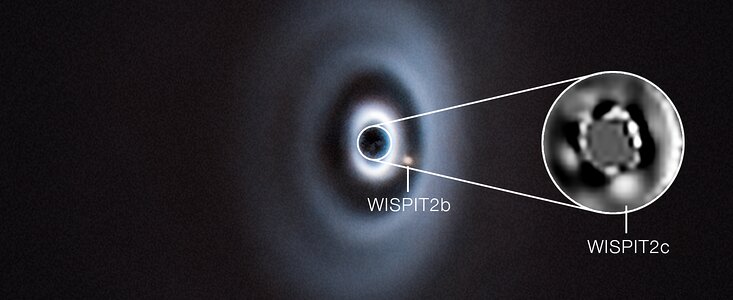
At the heart of this discovery are two forming gas giants — WISPIT 2b and WISPIT 2c — both significantly more massive than Jupiter.
WISPIT 2b, first identified in 2025, is already a giant among giants. It has about five times the mass of Jupiter and orbits far from its host star — roughly 60 times the distance between Earth and the Sun. That puts it deep within the outer regions of the system’s protoplanetary disk.
The newly discovered WISPIT 2c is even more intriguing. It’s estimated to be twice as massive as WISPIT 2b and sits much closer to the star — roughly four times nearer than its sibling.
Together, these planets are not just forming quietly — they’re actively shaping their environment.
Their immense gravity is carving visible gaps and rings in the surrounding disk of gas and dust, pulling in material as they grow. These disk gaps are one of the strongest pieces of evidence that planets are forming, essentially acting like footprints left behind during their creation.
Technology That Made the Discovery Possible
This level of detail wouldn’t have been possible just a decade ago.
Astronomers used the Very Large Telescope along with advanced instruments like SPHERE and the upgraded GRAVITY+ system to observe the system.
One of the most remarkable aspects of the discovery is the detection of carbon monoxide in the atmosphere of WISPIT 2c — a key indicator that the planet is actively forming and accumulating material.
These tools allow scientists not just to see the planets, but to analyze their composition and behavior — turning distant points of light into dynamic, evolving worlds.
A System That Mirrors Our Own Origins
What makes WISPIT 2 especially exciting is how closely it resembles what scientists believe our own solar system looked like in its earliest stages.
Billions of years ago, the Sun was surrounded by a similar disk of gas and dust. Over time, that material clumped together to form planets — including Earth.
In WISPIT 2, astronomers are essentially watching that process unfold again.
The arrangement of planets, the structure of the disk, and the presence of multiple forming bodies all point to a system that could evolve in ways similar to our own cosmic neighborhood.
That’s why researchers are calling it a “laboratory” for planetary science — a place where theories about planet formation can be tested against real observations.
Not Just Two Planets — Possibly More
The story may not end with just WISPIT 2b and 2c.
Astronomers have identified additional gaps in the disk that suggest the presence of more forming planets. One particularly interesting candidate is a potential Saturn-mass world in the outer regions of the system.
While it hasn’t been directly observed yet, the evidence is strong enough to make it a target for future studies.
And those future observations could come sooner than expected.
The Next Frontier: Even More Powerful Telescopes
The upcoming Extremely Large Telescope, currently under construction in Chile’s Atacama Desert, is expected to play a major role in studying systems like WISPIT 2.
With its unprecedented resolution and sensitivity, the telescope could directly image smaller, fainter planets — potentially confirming the existence of additional worlds in the system.
This next generation of instruments will allow scientists to move from observing large gas giants to studying Earth-sized planets in formation — bringing us even closer to understanding how habitable worlds emerge.
A Rare Comparison: Only the Second of Its Kind
WISPIT 2 is only the second known system where astronomers have directly observed two planets forming simultaneously.
The first was PDS 70, which provided the initial proof that such observations were possible.
However, WISPIT 2 appears to be even more complex.
Its disk is larger, more structured, and filled with distinct rings and gaps — suggesting a more active and possibly more crowded system. This makes it an even richer target for studying how multiple planets interact as they form.
Why This Discovery Matters
Beyond the excitement of the find itself, this discovery answers a deeper question: how do planetary systems actually come together?
For decades, scientists relied on simulations and indirect evidence. Now, they are watching the process happen in real time.
This helps refine models of:
- How gas giants form
- How planets migrate within a system
- How disk material evolves over time
- And how smaller, rocky planets might eventually emerge
In other words, WISPIT 2 isn’t just another star system — it’s a window into our own past.
A Moment That Comes Once in a Generation
Lead researcher Chloe Lawlor described the discovery as a rare opportunity — and it’s easy to see why.
Astronomy often deals with timescales so vast that change is nearly impossible to observe directly. But in this case, scientists are catching a system in the act of becoming something new.
It’s like finding a snapshot of the solar system billions of years ago — except this one is unfolding right now.
Looking Ahead
As observations continue and new technology comes online, WISPIT 2 is likely to remain one of the most studied star systems in the coming years.
Each new discovery within it will bring us a little closer to answering one of humanity’s oldest questions: how did we get here?
And for now, the answer seems to be written in the dust and light surrounding a young star — where two giant worlds are still taking shape, and many more may be waiting to be found.