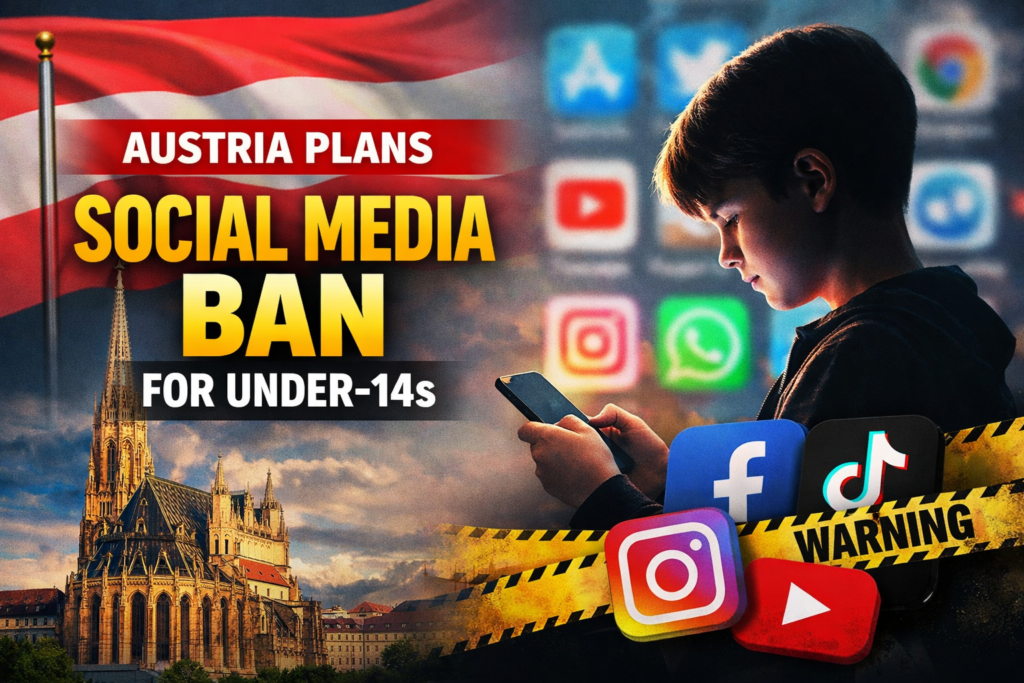
Austria is preparing to take a strong stand against the growing influence of social media on young users. In a move that reflects a wider global shift, the country’s conservative-led coalition government has announced plans to introduce a ban on social media use for children under the age of 14 — a decision aimed at addressing rising concerns around digital addiction and harmful online content.
The announcement, made in Vienna on March 27, signals a major policy direction from the European nation, placing child safety and mental well-being at the center of its digital strategy. While the proposal is still in its early stages, it has already sparked conversation about how governments worldwide are beginning to rethink the role of social platforms in young people’s lives.
A Ban Focused on Protection, Not Just Restriction
According to officials, the proposed ban is not just about limiting screen time — it’s about addressing the deeper risks associated with how social media platforms operate.
Vice Chancellor Andreas Babler emphasized that the government’s priority is to shield children from what he described as “addictive algorithms” and exposure to inappropriate content, including material linked to sexual abuse.
His statement reflected growing concern among policymakers that social media platforms are designed in ways that encourage prolonged engagement, often without considering the psychological impact on younger users.
Babler made it clear that authorities believe the risks have been overlooked for too long. According to him, the time has come for decisive action — not just warnings or guidelines, but enforceable policy.
How the Ban Might Work
While the intent behind the ban has been agreed upon by all three ruling parties, several key details are still being worked out.
One of the biggest questions is implementation.
Officials have confirmed that draft legislation is expected to be prepared by the end of June, but the government has not yet finalized how the ban will be enforced in practical terms. This includes challenges such as age verification, platform accountability, and monitoring compliance without violating privacy norms.
Interestingly, the government does not plan to target specific platforms by name. Instead, it aims to define which services fall under the ban based on their behavior — particularly how addictive their algorithms are and whether they host harmful or exploitative content.
This approach suggests a broader regulatory framework rather than a platform-specific crackdown, potentially setting a precedent for how future digital laws are shaped.
A Growing Global Trend
Austria’s move is not happening in isolation. Around the world, governments are increasingly stepping in to regulate how young people interact with social media.
In December, Australia became the first nation to introduce a nationwide ban on social media use for children under 16 — a bold step that drew both praise and debate globally.
Meanwhile, France has also been moving in a similar direction. Earlier this year, the lower house of its parliament approved a proposal to restrict social media access for children under 15.
These developments point to a broader shift in how policymakers view digital platforms. What was once seen primarily as a space for connection and entertainment is now increasingly being scrutinized for its potential risks — especially for younger audiences.
The Debate Around Digital Freedom vs Safety
As with any major regulation, Austria’s proposed ban is likely to spark debate.
Supporters argue that such measures are necessary to protect children from online harms, including cyberbullying, exposure to explicit content, and the mental health effects of excessive screen time.
Critics, however, may question whether a complete ban is the right approach. Concerns around enforcement, digital rights, and the role of parental responsibility are likely to be part of the conversation as the proposal moves forward.
There’s also the challenge of practicality. In an age where children are increasingly tech-savvy, ensuring compliance with such a ban could prove difficult without robust systems in place.
Why This Matters Now
The timing of Austria’s proposal reflects a growing urgency around digital well-being.
Over the past few years, studies and reports have increasingly linked heavy social media use among children and teenagers to issues such as anxiety, depression, and reduced attention spans. At the same time, the rise of algorithm-driven content has made it easier for harmful material to spread — often without adequate safeguards.
Governments are now under pressure to respond, not just with recommendations but with concrete action.
Austria’s plan suggests that policymakers are no longer willing to rely solely on tech companies to self-regulate. Instead, they are stepping in to define clear boundaries — especially when it comes to protecting younger users.
What Happens Next
For now, Austria’s proposed ban remains a work in progress. The coming months will be crucial as lawmakers draft the legislation and work through the complexities of implementation.
Key questions remain unanswered:
- How will age restrictions be verified?
- What penalties will platforms or users face for violations?
- How will the law balance safety with privacy and digital rights?
The answers to these questions will determine not just the success of the policy in Austria, but also its influence on similar efforts worldwide.
A Turning Point in Digital Regulation
Whether or not the final law matches the initial proposal, one thing is clear — Austria’s move represents a significant moment in the global conversation around social media and young users.
It reflects a growing recognition that the digital world, while full of opportunities, also carries risks that cannot be ignored — especially for children.
As more countries explore similar measures, Austria’s approach could become part of a larger blueprint for how governments navigate the complex intersection of technology, safety, and freedom in the years ahead.