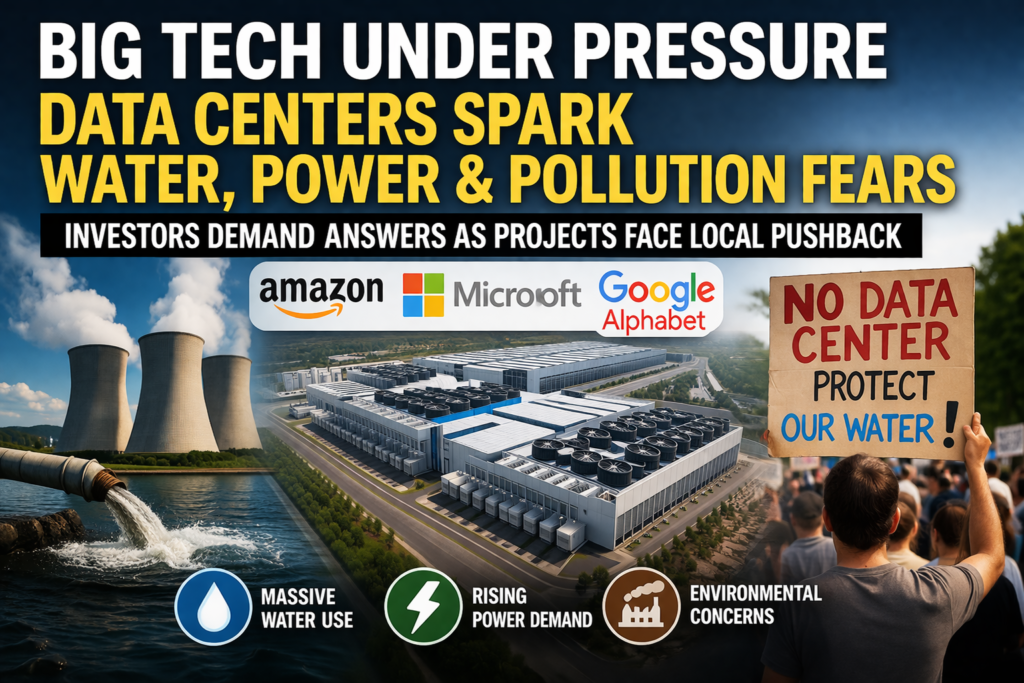
The race to build massive data centers for AI and cloud computing is starting to hit resistance—and not from competitors, but from communities and investors.
Projects backed by Amazon, Microsoft, and Google have recently been paused or scrapped after local pushback over water usage, electricity demand, and environmental strain. Now, shareholders are stepping in, asking tougher questions that go beyond expansion plans.
Growth vs Ground Reality
Data centers are the backbone of AI, streaming, and cloud services—but they come with a cost that’s becoming harder to ignore.
Communities near proposed sites are raising concerns about land use, pollution, and especially water consumption. These facilities require massive cooling systems, and in many regions, that means tapping into already stressed water resources.
That tension is now forcing companies to rethink not just where they build—but how.
Investors Want Answers, Not Promises
The pressure isn’t just coming from the ground. Investors are now pushing from the top.
Boston-based Trillium Asset Management has formally asked Alphabet Inc. to explain how it plans to meet its climate goals as energy demand surges.
Back in 2020, Alphabet committed to cutting emissions and running on carbon-free energy by 2030. But instead of falling, emissions have reportedly jumped significantly—raising concerns about whether those targets are still realistic.
And this isn’t an isolated case. Other investment groups are also preparing similar moves, signaling that ESG scrutiny is tightening across the tech sector.
Water Usage Becomes the Flashpoint
If there’s one issue that’s quickly becoming central, it’s water.
Data centers in North America alone reportedly consumed close to a trillion liters of water in 2025—roughly matching the annual needs of a major city like New York.
Companies have started shifting toward more efficient cooling systems, but the data they share is inconsistent.
Meta Platforms, for example, reported rising water usage at its owned facilities but didn’t fully account for leased or under-construction sites. Others like Amazon and Microsoft have shared totals, but without detailed breakdowns.
That lack of transparency is exactly what investors are now challenging.
Why Local Data Matters
For communities and shareholders alike, the issue isn’t just how much water is used—it’s where and how.
Site-specific data helps determine whether a project is sustainable in a particular location. Without that clarity, it’s difficult to assess the real impact on local resources.
That’s why investors are now asking for more granular disclosures—not just global numbers, but local realities.
A Shift in How Tech Expands
Behind the scenes, the industry is starting to adapt.
According to the Data Center Coalition, companies are placing more focus on community engagement—trying to explain resource usage upfront and reduce resistance before projects even begin.
It’s a sign that the old approach—build first, explain later—is no longer working.
Bigger Than Just Data Centers
This isn’t just about infrastructure—it’s about the future of AI growth.
As demand for computing power explodes, so does the pressure on energy grids and water supplies. And now, both communities and investors are making it clear: growth alone isn’t enough.
If tech giants want to keep expanding, they’ll need to prove they can do it without draining the very resources they depend on.
Because at this scale, sustainability isn’t just a side issue anymore—it’s becoming the main story.