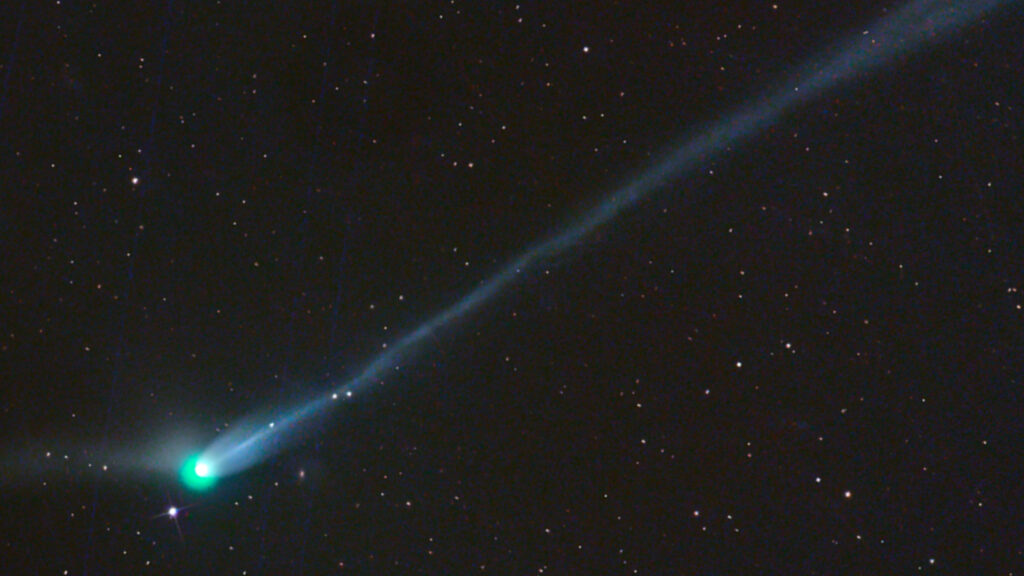
A rare celestial visitor is putting on a luminous show — and it won’t be sticking around. The bright green comet C/2024 E1 (Wierzchoś) is rapidly intensifying as it approaches Earth, with astronomers tracking its closest pass on February 17, 2026. After that, it’s goodbye for good.
Scientists say this icy wanderer is likely on a one-time visit, destined to be flung out of the solar system after its dramatic solar encounter.
☄️ A Striking Green Glow and a Long Journey
Discovered in March 2024 by Polish astronomer Kacper Wierzchoś at Mount Lemmon Observatory, the comet quickly grabbed attention for its vivid green glow. The color comes from carbon-based molecules glowing under sunlight — a signature trait of some carbon-rich comets.
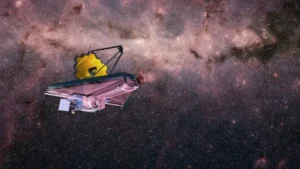
Follow-up observations from the James Webb Space Telescope revealed unusually high levels of carbon dioxide in its coma — the glowing cloud of gas and dust that surrounds a comet’s nucleus. Early estimates suggested the nucleus could be around 13.7 kilometers wide, roughly the size of a small city, though scientists now suspect that figure may have been slightly overestimated.
What makes C/2024 E1 especially fascinating is its path: it appears to be traveling on a hyperbolic orbit, meaning it won’t loop back around the Sun again.
🌌 A Visitor From the Oort Cloud?
Researchers believe the comet likely originated in the distant Oort Cloud — a vast shell of icy bodies that surrounds our solar system far beyond Pluto. Objects from this region can take millions of years to drift inward.
Experts estimate C/2024 E1 may have spent between one and three million years gradually spiraling toward the Sun before entering the inner solar system for the first — and only — time.
After its perihelion (closest approach to the Sun) in January, it is now heading toward its nearest point to Earth. For skywatchers with binoculars or small telescopes, the coming days could offer a rare viewing opportunity.
🚀 A Solar Slingshot Into Deep Space
The comet’s fate is already sealed. As it swings past the Sun, gravitational forces will effectively slingshot it out of the solar system. Instead of returning on a predictable orbit like Halley’s Comet, C/2024 E1 is expected to drift into interstellar space — potentially wandering the Milky Way for millions or even billions of years.
In astronomical terms, it’s a fleeting moment. In human terms, it’s a once-in-a-lifetime spectacle.
Final Words
C/2024 E1 is more than just a pretty green streak in the sky. It’s a time capsule from the outermost edges of our solar system, possibly formed billions of years ago and now briefly passing through our cosmic neighborhood.
Catch it while you can — because once it’s gone, it won’t be coming back.