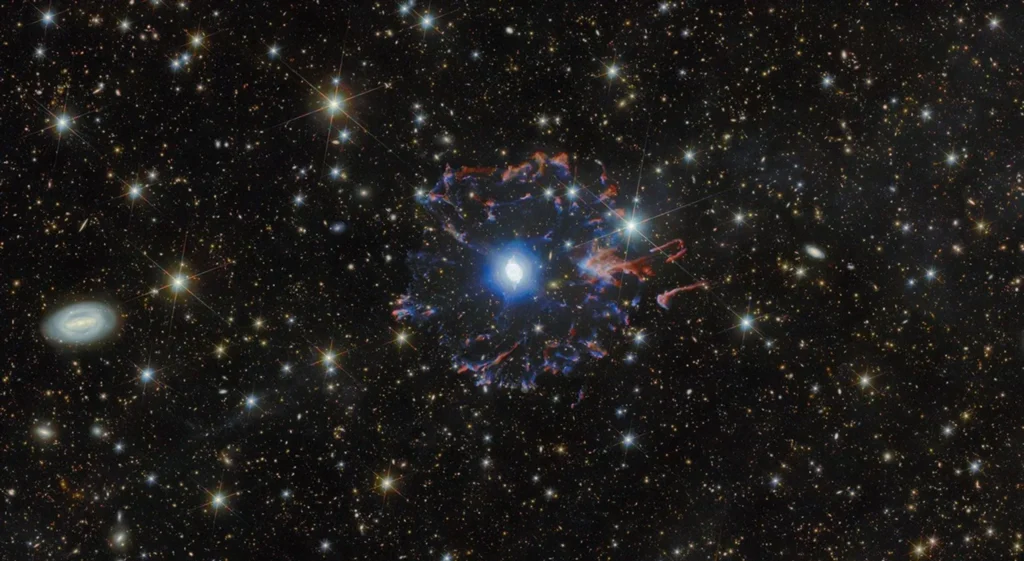
Astronomers have unveiled a breathtaking new image of the Cat’s Eye Nebula (NGC 6543), created through a collaboration between NASA’s Hubble Space Telescope and the European Space Agency’s Euclid space telescope. The combined observations reveal extraordinary detail in one of the most complex planetary nebulae known, offering scientists new insight into the final stages of a dying star.
Located in the constellation Draco, about 4,300–4,400 light-years from Earth, the Cat’s Eye Nebula is famous for its intricate structure of glowing gas shells, jets, and rings formed as its central star slowly sheds material into space.
Two Telescopes, One Detailed Cosmic Portrait
The new image blends the strengths of both telescopes. Euclid, designed primarily to map the distant universe and study dark matter and dark energy, captured the wider environment surrounding the nebula. Its wide-field cameras revealed delicate arcs, filaments, and an extended halo of gas that surrounds the nebula’s core.
Meanwhile, Hubble’s high-resolution instruments focused on the nebula’s central region. This close-up view exposed incredibly fine structures — overlapping shells of gas, dense knots, and fast-moving jets shooting outward from the central star.
Together, the two telescopes created a composite image that shows both the broad cosmic context and the intricate internal details of the nebula at the same time.
Layers of Gas Tell the Story of a Dying Star
Planetary nebulae like the Cat’s Eye form when a Sun-like star reaches the final stage of its life. As the star runs out of fuel, it ejects layers of gas into space. Over time, these expanding shells glow due to radiation from the hot stellar core left behind.
In the new image, astronomers can see multiple rings and shells of gas, each representing a different episode of material expelled from the star over centuries. These structures create what scientists describe as a “fossil record” of stellar activity, preserving evidence of the star’s violent outbursts.
Euclid’s wide view even reveals a faint outer ring, believed to have formed during an earlier phase of mass loss long before the nebula’s central structure appeared.
A Historic Object Still Revealing New Secrets
The Cat’s Eye Nebula holds an important place in astronomy. In 1864, scientists used spectroscopy on this nebula to confirm that planetary nebulae are expanding clouds of gas, a discovery that helped astronomers understand how stars evolve.
More than a century later, advanced telescopes like Hubble and Euclid continue to uncover new layers of detail in this famous object.
Reconstructing Centuries of Stellar Evolution
By studying the different gas shells and their expansion speeds, astronomers can effectively reconstruct the timeline of the star’s final centuries. Each ring represents a separate phase when the star expelled material into space.
The combined observations from Hubble’s Advanced Camera for Surveys (ACS) and Euclid’s wide-field imaging help researchers piece together how the star lost mass over time — revealing the dramatic transformation from a normal star into a glowing planetary nebula.
Final Words
The collaboration between Hubble and Euclid demonstrates how combining data from multiple space telescopes can unlock deeper insights into the universe. The new image of the Cat’s Eye Nebula not only showcases a stunning cosmic structure but also provides a rare glimpse into the turbulent final moments of a dying star.
For astronomers, these glowing shells and rings are more than beautiful — they are records of stellar history, written across the sky in expanding clouds of cosmic gas.