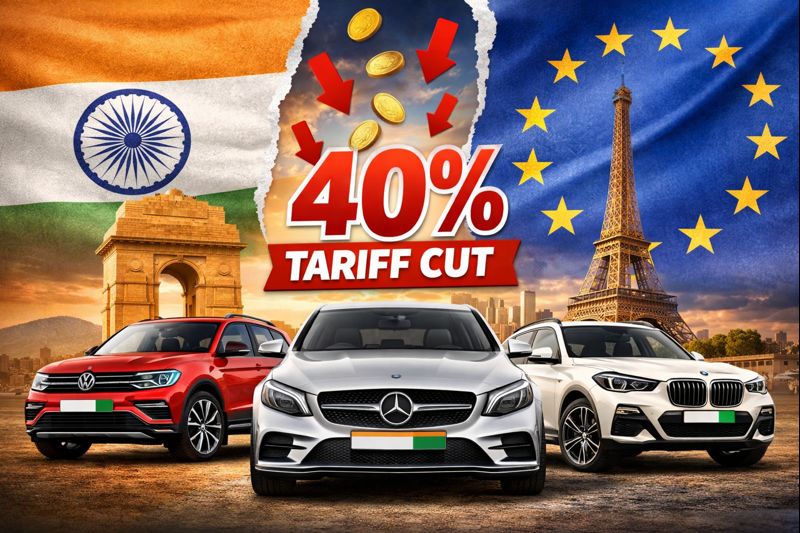
India is preparing for its boldest opening yet of the automobile sector as trade talks with the European Union reach their final stage. According to people familiar with the negotiations, the Centre has agreed to slash import duties on select European cars from as high as 110% to 40%, with further reductions planned over time—marking a major shift in one of the country’s most tightly protected industries.
The announcement is expected as early as Tuesday, when India and the EU are likely to formally conclude negotiations on a long-awaited free trade agreement, already being described in trade circles as the “mother of all deals,” according to Reuters.
What’s Changing for Imported Cars
Under the proposed framework, India will immediately reduce tariffs to 40% on a limited number of imported EU cars priced above €15,000. Over the years, that duty could eventually fall to as low as 10%, significantly improving access to the Indian market for European automakers.
The move is being seen as a breakthrough moment for brands such as Volkswagen, Renault, Mercedes-Benz, BMW, and Stellantis, all of whom have long argued that India’s steep import duties restrict product expansion.
Sources say the immediate cut may apply to around 200,000 internal combustion engine vehicles annually, though final quotas could still see last-minute adjustments.
Electric Vehicles Get a Breather—For Now
While conventional cars stand to benefit quickly, electric vehicles (EVs) will remain protected in the short term. Import duties on EVs will not be reduced for the first five years, giving domestic manufacturers time to stabilise investments in the still-developing segment.
This buffer is aimed at safeguarding Indian players such as Mahindra & Mahindra and Tata Motors, both of whom have made aggressive bets on electric mobility. After the five-year period, EVs are expected to follow a similar duty reduction path.
Why This Deal Matters So Much
India is currently the world’s third-largest car market, trailing only the US and China. Yet despite selling 4.4 million cars annually, the market remains heavily dominated by domestic and Japanese brands—particularly Suzuki Motor, along with Mahindra and Tata, which together command nearly two-thirds of sales.
European carmakers, by contrast, account for less than 4% of total sales—despite local manufacturing footprints. High tariffs have made it difficult for them to test new models or expand portfolios without heavy upfront investment.
Lower import taxes could change that equation, allowing global manufacturers to experiment with broader lineups, gauge consumer demand, and then scale local production more confidently.
Trade Pact Beyond Cars
The auto tariff concession is just one piece of a much larger economic puzzle. The India–EU trade deal is expected to boost bilateral trade across multiple sectors, including textiles and jewellery—industries that have faced fresh pressure after steep US tariffs introduced in late 2025.
With India’s car market projected to grow to 6 million units annually by 2030, the timing is critical. European automakers are already repositioning: Renault is recalibrating its India strategy to offset slowing growth in Europe, while the Volkswagen Group is finalising its next investment phase through its Skoda brand.
Final Words
If sealed as expected, the India–EU trade agreement could mark a turning point for India’s automotive landscape—loosening long-standing protectionism while still shielding strategic domestic sectors. For European carmakers, it’s a long-awaited opening. For Indian consumers, it could mean more choices, sharper pricing, and greater competition in the years ahead.