India may be preparing for a quiet but significant shift in its digital payments landscape.
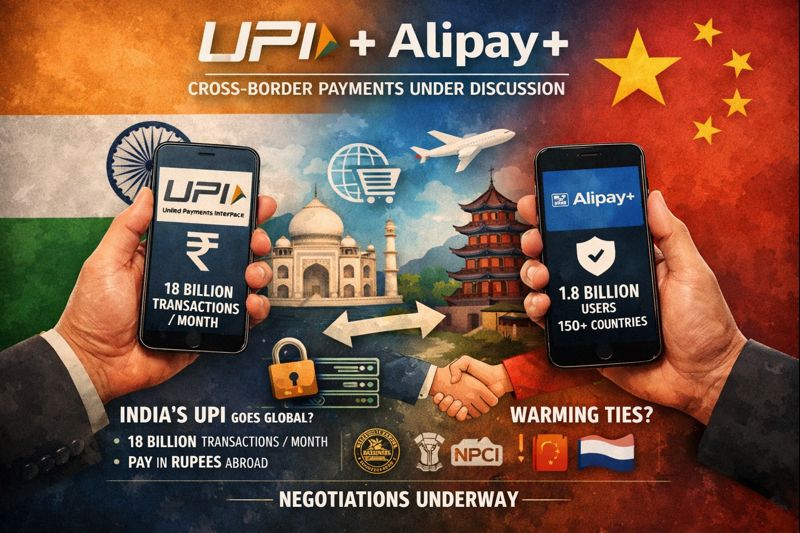
According to people familiar with the discussions, New Delhi is in talks with Ant International to potentially link Alipay+ with India’s homegrown Unified Payments Interface (UPI) for cross-border transactions. If cleared, the move could allow Indian users to pay seamlessly at overseas merchants connected to the Alipay+ network — using UPI in Indian rupees.
The discussions involve Indian government officials, central bank representatives, and Ant International, which was originally founded by Ant Group but now operates independently from Singapore.
Why This Matters for Indian Travellers
At a practical level, the linkage could dramatically simplify payments for Indian tourists and business travellers. Alipay+ already connects around 1.8 billion user accounts with more than 150 million merchants across 100+ global markets, with a strong footprint in Asia, Europe, the Middle East, and Latin America.
For India, where UPI now processes nearly 18 billion transactions every month, expanding its reach internationally has been a long-term policy goal. Officials have been keen to reduce friction and high conversion costs for Indians paying abroad, while also promoting the use of the rupee for cross-border commerce.
Security and Geopolitics Still Key Hurdles
Despite the potential benefits, officials stress that no final decision has been taken. Any approval will hinge on security clearances and data protection safeguards, especially given Alipay’s historical links to China.
“There are sensitivities involved,” one source said, pointing to concerns around geopolitical positioning, digital infrastructure security, and data sovereignty.
These concerns trace back to 2020, when India imposed stricter investment rules on Chinese firms following a border standoff. Those regulations remain in force and have stalled multiple high-profile deals, including a proposed $1 billion electric vehicle investment by BYD.
A Sign of Slowly Warming Relations
The talks also reflect a broader — though cautious — easing of tensions between India and China.
After years of strained relations that slowed the flow of capital, technology, and skilled talent, New Delhi began carefully re-engaging with Beijing last year, partly under pressure from global economic headwinds and rising US tariffs.
Prime Minister Narendra Modi visited China for the first time in seven years, holding discussions with Chinese President Xi Jinping on stabilising bilateral ties. India also resumed direct commercial flights to China after a five-year gap and eased visa norms for Chinese professionals.
Silence From Regulators — For Now
India’s Reserve Bank of India, the Finance Ministry of India, and the National Payments Corporation of India have not publicly commented on the talks. Ant International has also declined to respond.
Officials emphasise that discussions remain confidential and exploratory, with policy, security, and diplomatic implications still under review.
The Bigger Picture
If approved, the UPI–Alipay+ linkage would mark one of the most concrete steps yet in blending India’s digital public infrastructure with a China-linked global platform — something that would have been unthinkable just a few years ago.
For now, it remains a balancing act: unlocking convenience for millions of Indian users while navigating the complex realities of geopolitics, trust, and digital sovereignty.
Final Words:
The talks signal opportunity, but also restraint. Whether UPI eventually shakes hands with Alipay+ will depend not just on technology — but on how comfortable India is letting geopolitics and payments intersect on the global stage.