Unlocking the Mysteries of Cislunar Orbits: The Computational Journey
In a world where space exploration often feels like a race to the stars, the space between Earth and the Moon has sparked new intrigue. Lawrence Livermore National Laboratory (LLNL) recently embarked on an ambitious journey to map this lesser-explored region with the power of supercomputers. Could this be the next frontier for space missions? Let’s dive into the cosmic dance of satellites and the groundbreaking research that could redefine our understanding of cislunar space.
Harnessing Supercomputers to Chart the Unknown
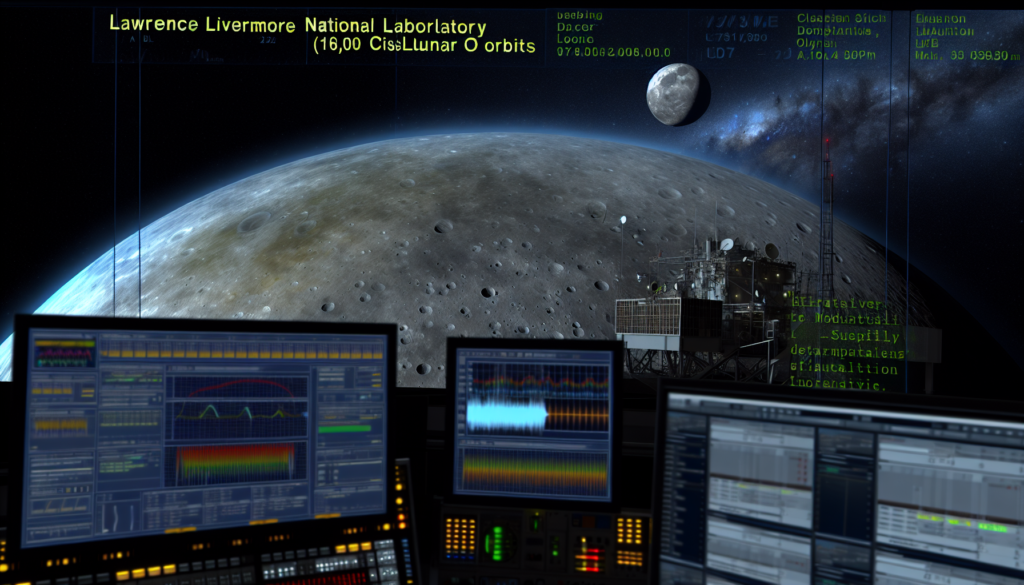
LLNL scientists took on the challenge of simulating one million theoretical satellite orbits in the space between our planet and the Moon, known as cislunar space. With the aid of two high-powered supercomputers, Quartz and Ruby, they embarked on a computational marathon, clocking in an astounding 1.6 million CPU hours. Remarkably, thanks to the prowess of parallel processing, this Herculean task was accomplished in just three days. The objective? To understand the stability of these orbits without any preconceived notions.
Travis Yeager, the lead author of the study, emphasized their approach: to explore the unknown expanses of cislunar space by setting aside assumptions and letting the data lead the way. This approach allowed them to survey a vast array of initial conditions, painting a comprehensive picture of this celestial corridor.
The Surprising Stability of the Earth-Moon Dance
The results were both revealing and promising. Amidst the dizzying array of simulated paths, fewer than 10% stood the test of time, maintaining stability across a six-year observation period. This means approximately 97,000 orbits offered a reliable course for future space ventures. Yet, even the unstable paths contribute valuable insights, highlighting potential pitfalls and challenges in satellite deployment beyond low Earth orbit.
This discovery comes at a crucial time when low Earth orbit is becoming increasingly crowded, teetering on the brink of a chain reaction of collisions. The cislunar space, with its unexplored potential, may provide a new avenue for satellite placement and a fresh breathing space for the bustling satellite industry.
A Celestial Future Awaits
For the space industry and satellite operators, LLNL’s findings are a beacon of hope and innovation. The identification of stable orbits opens up a realm of possibilities for future missions, potentially relieving the congestion in low Earth orbit. This could mean safer, more efficient satellite operations, and perhaps even a new era of lunar exploration.
In conclusion, as we gaze towards the stars, the space between Earth and the Moon beckons with untapped potential. LLNL’s comprehensive study marks another step in humanity’s quest to explore the cosmos, offering new paths and possibilities for future space endeavors. The celestial dance continues, and with it, the promise of new discoveries and adventures.