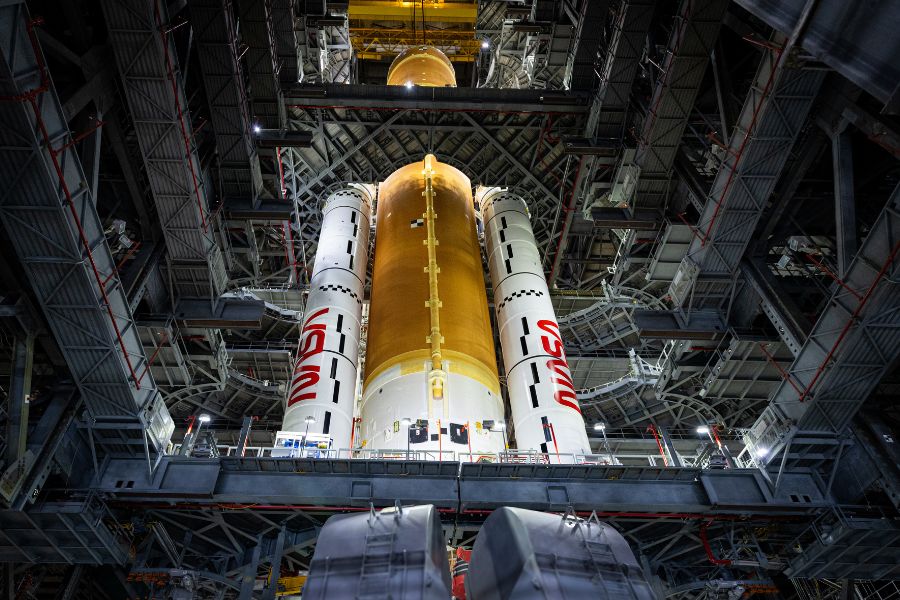
After nearly half a day of slow, deliberate movement, NASA’s mega rocket for Artemis II is officially in position. The towering Space Launch System (SLS) has completed its 4-mile journey to Launch Pad 39B at the Kennedy Space Center in Cape Canaveral, marking a major milestone ahead of humanity’s first crewed Moon mission in more than 50 years.
The rollout, captured in timelapse and live streams, took close to 12 hours as the 98-metre-tall rocket was transported vertically on NASA’s iconic crawler-transporter — creeping along at less than 1 mph.
Final countdown preparations begin
With the rocket now secured at the pad, NASA will move into the last stretch of pre-launch preparations. Over the coming days, engineers will carry out final system checks, fuel tests, and a full “wet dress rehearsal,” which simulates the entire countdown process ahead of launch.
NASA says the earliest possible launch window opens on February 6, though additional windows are available later in February, as well as in March and April, depending on technical readiness and weather conditions.
Meet the Artemis II crew
Watching the rollout in person were the four astronauts who will soon be riding the rocket beyond Earth orbit:
- Reid Wiseman
- Victor Glover
- Christina Koch
- Jeremy Hansen
In just weeks, they’ll be strapped into the Orion spacecraft atop the SLS, preparing for a 10-day mission that will send them farther into space than any humans have travelled since the Apollo era.
First crewed Moon mission since 1972
Artemis II will be the first human mission to the Moon since Apollo 17 in December 1972. While the spacecraft won’t land on the lunar surface, it will orbit the Moon and fly around its far side, laying crucial groundwork for a future landing.
NASA says the mission could take the crew deeper into space than ever before, including views of Earth as a single blue sphere — a perspective no human has experienced firsthand.
The first two days of the mission will be spent in Earth orbit before the spacecraft heads roughly 250,000 miles toward the Moon. During the lunar flyby, the crew will have dedicated time to observe, photograph, and study the Moon’s surface, helping planners prepare for future missions targeting the Moon’s south pole.
European contribution powers the mission
A critical part of the Orion spacecraft — the European Service Module — was built in Germany and provided by the European Space Agency, with Airbus leading its construction.
The module supplies propulsion, power, air, water, and life-support systems for the astronauts. Engineers say Orion simply cannot reach the Moon without it, underlining the international nature of the Artemis program.
Pressure builds, but safety comes first
Artemis II has already faced years of delays, putting pressure on NASA to move forward. Still, mission leaders insist there will be no shortcuts.
NASA officials have repeatedly stressed that crew safety remains the top priority — even if that means waiting longer to launch.
Final words
With the Artemis II rocket now standing on Launch Pad 39B, the return of humans to deep space feels closer than ever. The slow 12-hour journey may have looked uneventful, but symbolically, it represents a giant step toward the Moon — and toward a new era of human space exploration.
If all goes to plan, the next time this rocket moves, it won’t be crawling across Florida — it’ll be blazing a trail back to lunar orbit. 🚀🌕