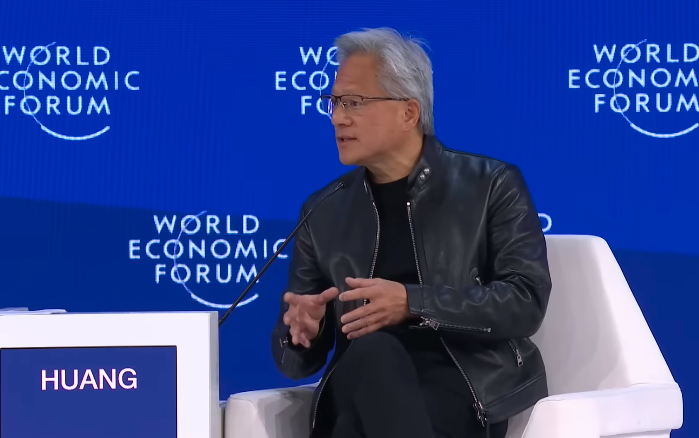
Nvidia CEO Jensen Huang believes Europe is standing at the edge of a rare technological moment. Speaking at the World Economic Forum in Davos, Huang described AI-powered robotics as a “once-in-a-generation opportunity” for the region, pointing to Europe’s deep-rooted strength in industrial manufacturing.
According to Huang, Europe is uniquely positioned to merge its manufacturing expertise with artificial intelligence — a combination that could redefine the continent’s role in the global tech race.
From Software to ‘Physical AI’
Addressing global leaders and industry executives, Huang said Europe now has a chance to leap beyond the traditional software-dominated era.
“You can now fuse your industrial capability, your manufacturing capability, with artificial intelligence,” he explained. “That brings you into the world of physical AI, or robotics.”
In Huang’s view, this fusion could allow Europe to move faster than regions that focused primarily on software platforms, giving it a strategic edge in robotics-driven industries — from factories and logistics to autonomous systems.
Robotics Momentum Is Already Building
Interest in autonomous and AI-powered robotics has surged across Europe over the past year. Major industrial players such as Siemens, Mercedes-Benz Group, Volvo, and Schaeffler have all announced new robotics initiatives or partnerships with advanced technology firms.
Big Tech is also doubling down on the sector. Elon Musk previously claimed that 80% of Tesla’s future value could come from its Optimus humanoid robots. Meanwhile, DeepMind rolled out new robotics AI models in 2025, and Nvidia announced partnerships with Alphabet to advance physical AI technologies.
Investors Are Paying Attention
The surge in interest is being matched by serious money. According to Dealroom data, companies focused on robotics raised a record $26.5 billion in 2025, underlining investor confidence that robotics will be one of the next major growth engines in tech.
Huang suggested this momentum is only the beginning.
Energy and Infrastructure: Europe’s Biggest Challenge
While bullish on Europe’s potential, Huang also flagged a critical obstacle — energy. He stressed that Europe must significantly expand its energy supply to support large-scale AI infrastructure.
“I think it’s fairly certain that you have to get serious about increasing your energy supply,” Huang said, adding that energy constraints could limit the development of a thriving AI ecosystem.
According to him, AI has already triggered what he called the “largest infrastructure buildout in human history.”
“We’re now a few hundred billion dollars into it,” Huang said. “There are trillions of dollars of infrastructure that still need to be built.”
Final Words
Jensen Huang’s message was clear: Europe has the talent, the factories, and the industrial heritage to lead the next wave of AI-driven robotics — but only if it acts decisively. With global competition intensifying and infrastructure demands rising, the choices Europe makes now could determine whether it becomes a leader in physical AI or watches the opportunity pass by.