For years, Nvidia has been almost synonymous with GPUs. Mention AI data centers, and Nvidia’s silicon instantly dominates the conversation. From hyperscalers to startups, its chips are the backbone of modern AI training and inference.
But beneath the headlines and hardware launches, Nvidia has been building something far more strategic — and arguably far more durable. Its real advantage isn’t just powerful GPUs. It’s the way those chips are tightly fused with a deep, ever-expanding software ecosystem. And with the arrival of Nemotron 3, that strategy is becoming impossible to ignore.
Nvidia’s Real Moat Isn’t Hardware — It’s the Stack
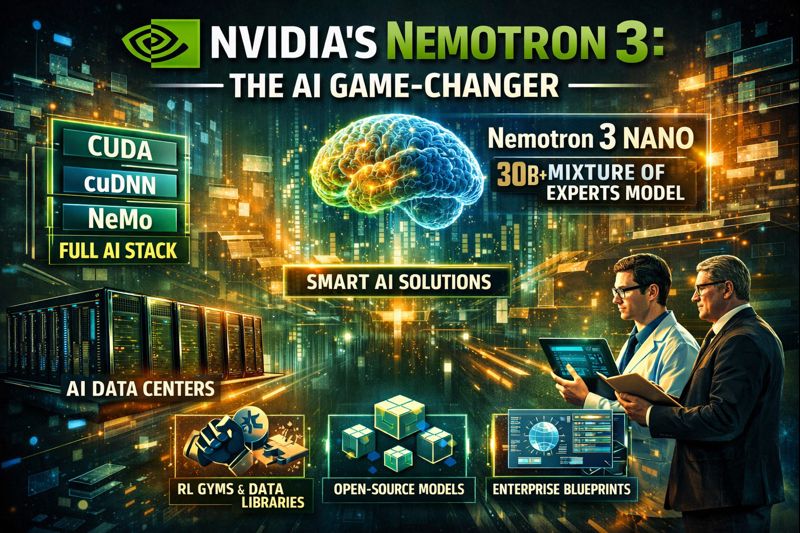
At the heart of Nvidia’s AI dominance is an end-to-end platform that stretches far beyond silicon. CUDA laid the foundation. cuDNN accelerated deep learning workloads. NeMo pushed into large language and multimodal model training.
Nemotron takes that evolution one step further — turning raw compute into practical, deployable intelligence.
In simple terms, Nemotron represents Nvidia’s belief that frontier AI doesn’t live on hardware alone. The company recently emphasized this point while discussing OpenAI’s GPT-5.2, noting that leading models rely on elite accelerators, advanced networking, and fully optimized software working in lockstep.
While Nvidia’s Blackwell and GB200 systems grab attention, it’s the software layer that makes tens of thousands of GPUs behave like one massive, coherent AI machine. Nemotron sits right in that critical middle layer — bridging infrastructure and real-world applications.
Why Nemotron 3 Is a Big Deal
Originally, Nemotron was designed to seed the open-source ecosystem with capable, efficient models. But with Nemotron 3, Nvidia is clearly thinking bigger.
According to Nvidia’s enterprise generative AI leadership, open models accelerate innovation by allowing researchers everywhere to build on shared foundations — not just Big Tech labs with deep pockets.
That philosophy isn’t just talk. In 2025, Nvidia emerged as the single largest contributor of open models and datasets on Hugging Face, releasing hundreds of models and datasets. This approach quietly pulls startups, researchers, and enterprises into Nvidia’s software orbit, making its platform the default environment for serious AI work.
Nemotron 3 formalizes that approach into a roadmap rather than a loose collection of experiments.
The headline release is Nemotron 3 Nano, a mixture-of-experts model with more than 30 billion parameters — yet only a small fraction activates per token. The result? Reasoning performance that rivals much larger dense models, while operating at a dramatically lower compute cost.
What’s Under the Hood
Nemotron 3 brings together several ideas that now define modern reasoning models:
- Hybrid architecture combining Transformer attention with Mamba-style state-space modeling, improving efficiency on long contexts
- Mixture-of-experts design, activating only a subset of parameters per token
- Massive context length, stretching close to one million tokens — enough to process entire codebases or multi-day conversations in a single pass
The takeaway is simple: better reasoning without exploding inference costs.
Why Data Centers Should Care
AI scaling is no longer just about throwing more GPUs at pre-training. Nvidia now talks about three levers: pre-training, post-training, and “long thinking.”
Long thinking — test-time reasoning, self-reflection, and multi-agent collaboration — dramatically increases token usage and inference cost. Nemotron 3 is built to tackle that challenge head-on, delivering stronger reasoning per token than earlier open models.
What truly sets it apart is what comes with the model.
Nvidia is releasing Nemotron 3 alongside the same reinforcement learning environments, libraries, and datasets used internally. These RL “gyms” simulate realistic tasks like coding challenges, math problems, and scheduling scenarios — allowing enterprises to replicate Nvidia’s own training loops instead of building everything from scratch.
On the data side, the company is shifting from “big data” to smarter, curated data. Nemotron 3 is trained on more than 10 trillion tokens of synthetically cleaned text, plus millions of instruction-tuning examples generated from permissively licensed models. Nvidia claims this led to a substantial jump in reasoning quality, especially in instruction-following and conciseness.
From Research Model to Enterprise Blueprint
Nemotron isn’t being positioned as a lab experiment. Nvidia is packaging it with deployment “blueprints” — reference stacks for research assistants, video search and summarization, and enterprise-grade retrieval-augmented generation systems.
For CIOs and enterprise teams, this matters far more than benchmark charts. It turns Nemotron into something you can actually deploy — on your own infrastructure, your preferred cloud, and your own data.
All of this neatly reinforces Nvidia’s full-stack pitch. The company already powers the majority of frontier model training, from GPT-class systems to cutting-edge video generators. Its GPUs dominate MLPerf benchmarks, and Blackwell systems are now standard offerings across major cloud providers.
Nemotron 3 effectively becomes Nvidia’s “house model” — deeply optimized for its chips, networking, and compilers.
What About the Competition?
Nemotron 3 undeniably strengthens Nvidia’s position, but it doesn’t eliminate competition.
AMD has made serious progress with its Instinct accelerators and ROCm software stack, running large language models at major cloud providers with increasingly competitive economics. AMD is also pushing rack-scale systems designed to rival Nvidia’s offerings.
Where Nvidia pulls ahead is ecosystem depth. Nemotron 3 isn’t just a model — it’s a tightly integrated package of open weights, RL environments, curated data, and deployment templates under one unified brand.
For enterprises building agentic AI systems, that kind of cohesive yet open toolkit is hard to resist. It shortens time-to-value while subtly locking customers into Nvidia’s way of doing things.
That said, Nemotron isn’t an unbreakable moat. The techniques it uses are well understood, and the models are open-weight. In theory, they can run on non-Nvidia hardware — though without the same level of optimization.
The Bigger Signal Behind Nemotron 3
Viewed correctly, Nemotron 3 isn’t a knockout blow. It’s another turn of Nvidia’s flywheel.
It makes GPUs more valuable by pairing them with efficient, transparent models. It strengthens the software platform by bundling the tools needed to customize those models. And it deepens Nvidia’s ties with the open-source community that increasingly drives AI innovation.
In the short term, that’s likely enough to keep Nvidia ahead as the AI data center market explodes. In the long run, Nemotron’s real impact may be cultural.
By treating models like versioned software libraries — complete with recipes, tools, and roadmaps — Nvidia is trying to define how serious AI systems should be built.
For enterprises placing multi-billion-dollar bets on AI infrastructure, that narrative may matter just as much as raw compute power.