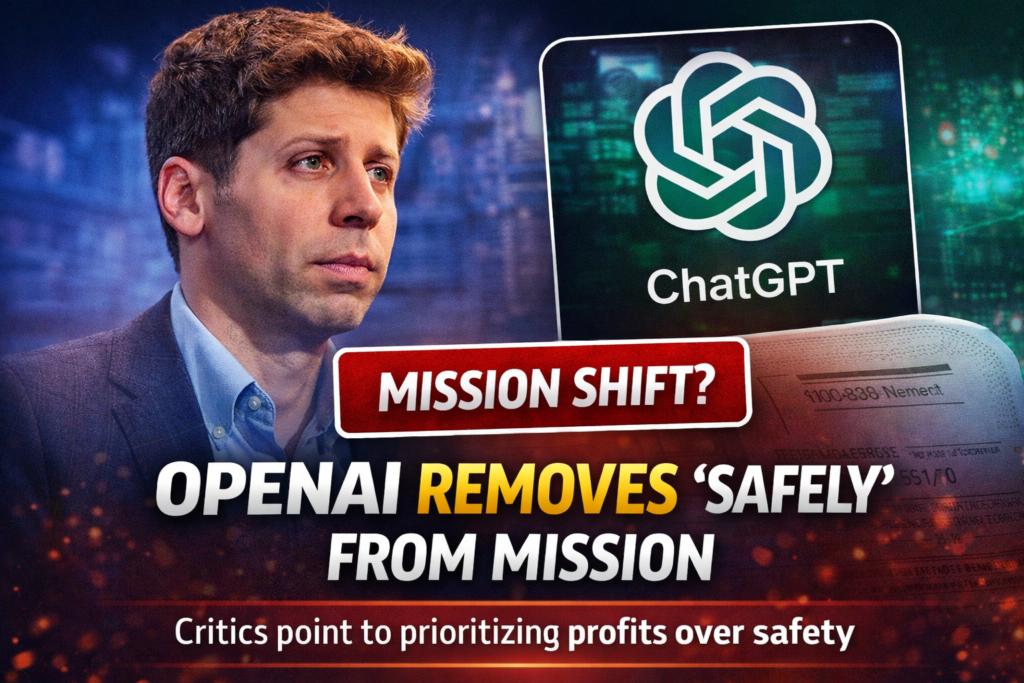
OpenAI once pledged to build AI that “safely benefits humanity, unconstrained by a need to generate financial return.” But that language has quietly changed — and critics say the edit signals something bigger than a wording tweak.
A review of the company’s 2024 IRS filing, released in late 2025, shows that OpenAI removed the word “safely” from its formal mission statement. The updated wording now reads: “to ensure that artificial general intelligence benefits all of humanity.”
The timing coincides with the company’s structural transformation from a nonprofit research lab into a more conventional for-profit business model.
🔍 What Changed — and Why It Matters
OpenAI was founded in 2015 as a nonprofit research lab. Its goal was to publish findings openly and develop artificial intelligence for the broader good, not profit.
In 2019, under CEO Sam Altman, the organisation created a for-profit subsidiary to raise capital for increasingly expensive AI development. Microsoft invested $1 billion initially — a figure that grew to over $13 billion by 2024.
But a 2024 funding round reportedly introduced a new condition: investors would convert funding to debt unless OpenAI transitioned to a traditional for-profit structure with share ownership and uncapped returns.
In October 2025, OpenAI reached an agreement with the attorneys general of California and Delaware to restructure into two entities:
- The OpenAI Foundation (nonprofit)
- The OpenAI Group (for-profit public benefit corporation)
Under the new structure, the nonprofit owns roughly 26% of the for-profit arm — no longer a controlling stake. Microsoft holds about 27%, with remaining shares divided among employees and other investors.
⚖️ Legal and Governance Implications
A public benefit corporation must consider societal impact alongside shareholder value. However, its board determines how to weigh those interests — and what to report publicly.
OpenAI’s previous IRS filings (2022 and 2023) explicitly stated its mission included building AI that “safely benefits humanity” and was “unconstrained” by financial returns.
The 2024 filing removed both phrases.
At the same time, reports indicate the company disbanded its “mission alignment” team, according to tech outlet Platformer.
OpenAI’s website still references safety broadly, stating that advancing AI requires balancing capability, safety, and positive impact. But the explicit commitment to safety no longer appears in its formal IRS mission declaration.
🚨 Lawsuits and Safety Scrutiny
The mission shift comes as OpenAI faces multiple lawsuits related to product safety. Plaintiffs have alleged psychological manipulation, negligence, wrongful death, and assisted suicide claims linked to AI usage.
Critics argue that removing “safely” from the formal mission statement — even if safety is still referenced elsewhere — weakens accountability.
Nonprofit boards are legally bound to uphold their mission. If safety is not embedded directly in that mission, holding leadership accountable becomes more complicated.
🏛️ A Governance Test Case
Observers say OpenAI’s restructuring represents a broader societal question: How should organisations that develop powerful, potentially world-altering technology be governed?
The restructuring memorandum includes safeguards, such as:
- A safety and security committee with authority to require mitigation measures
- The nonprofit board appointing members of the for-profit board
However, critics point out that most board members currently serve on both boards, raising oversight concerns.
Comparisons have been drawn to other hybrid governance models. For example, when Health Net converted from nonprofit to for-profit in 1992, regulators required 80% of equity to transfer to another nonprofit foundation. And The Philadelphia Inquirer became a public benefit corporation owned by a nonprofit institute to preserve mission alignment.
Some nonprofit coalitions have argued that OpenAI should have transferred more assets into independent nonprofit control.
💰 Investment Surge Follows Restructuring
Shortly after the restructuring, SoftBank finalised a reported $41 billion investment in OpenAI — reinforcing predictions that the move would unlock larger capital inflows.
Supporters argue that AI development at global scale requires massive funding, and that hybrid models are the only viable path forward.
Critics counter that profit incentives may conflict with cautious deployment of powerful systems.
Final Words
OpenAI’s revised mission statement may appear subtle, but words matter — especially in governance documents.
Whether the removal of “safely” reflects a shift in priorities or merely an editorial refinement remains debated. But as AI systems grow more capable — and lawsuits mount — oversight structures are no longer abstract concerns.
The conversation is no longer just about building intelligent machines. It’s about who ensures those machines remain aligned with public safety — and how firmly that commitment is written into the rules.