OpenAI has unveiled GPT-5.3-Codex, calling it its most capable agentic coding model to date — and one that even helped build itself.
The San Francisco-based AI company says the new model significantly expands Codex’s ability to handle end-to-end software workflows. From building complex video games to debugging full codebases and deploying production-ready applications, GPT-5.3-Codex is positioned as a major step forward in autonomous coding.
🚀 What Makes GPT-5.3-Codex Different?
According to OpenAI, GPT-5.3-Codex merges the coding performance of GPT-5.2-Codex with the deeper reasoning and professional knowledge of GPT-5.2 into a single system.
The result?
- 25% faster task execution
- Better long-horizon reasoning
- Real-time interaction without losing context
- Full workflow support from research to deployment
One key upgrade: users can now steer the model mid-task. That means you can ask for updates, challenge its approach, refine requirements, or redirect it — without the AI dropping context or restarting the job.
That’s a big shift from earlier versions.
🧠 It Helped Build Itself
In a surprising twist, early iterations of GPT-5.3-Codex were used internally by the Codex team during development.
The model reportedly assisted with:
- Debugging training runs
- Managing deployment
- Diagnosing evaluation results
OpenAI said this self-assistance significantly accelerated development — making it the first model that played a meaningful role in improving its own release cycle.
📊 Benchmark Performance
OpenAI shared internal benchmark results showing incremental but notable gains:
- SWE-Bench Pro: 56.8% accuracy (vs 56.4% on GPT-5.2-Codex)
- Terminal-Bench 2.0: 77.3% (up from 64.0%)
- OSWorld-Verified: 64.7% (vs 38.2% previously)
These benchmarks measure real-world software engineering ability, command-line task handling, and agent performance in desktop productivity environments.
The improvements, particularly in OSWorld-Verified, signal stronger real-world workflow capabilities beyond just code generation.
🎮 Beyond Just Writing Code
GPT-5.3-Codex can:
- Build complex web games from minimal prompts
- Iterate autonomously across millions of tokens
- Generate production-ready websites
- Handle features like dynamic pricing, testimonials, and UI logic
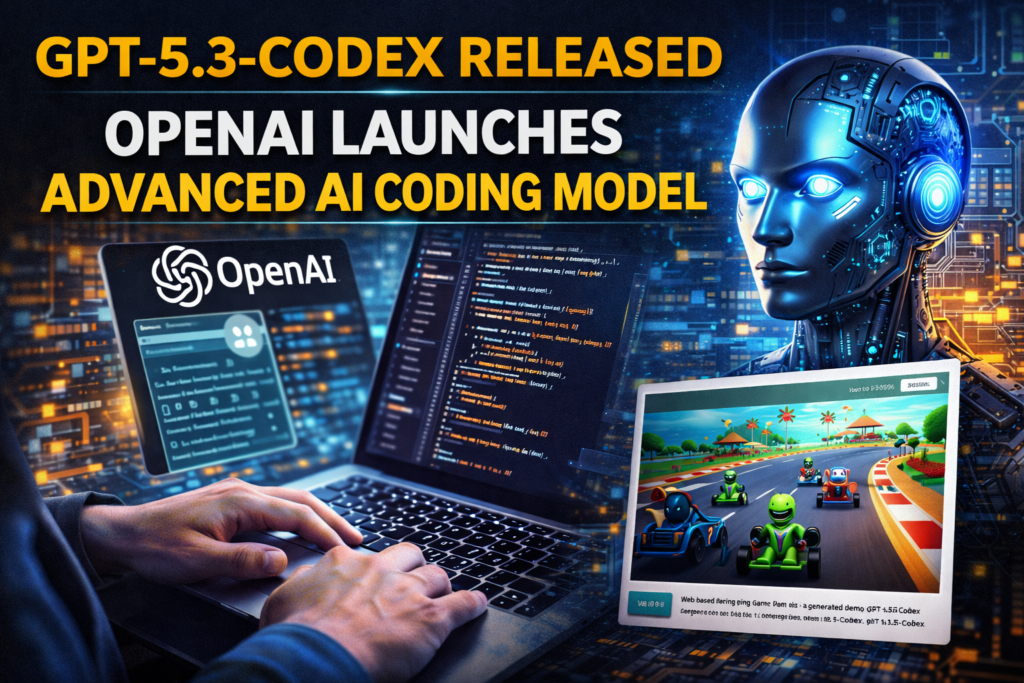
OpenAI showcased a demo where the model created a racing game complete with maps, items, and playable characters.
It also extends beyond coding into broader software lifecycle tasks:
- Writing product requirement documents (PRDs)
- Editing copy
- Conducting user research
- Creating slide decks
- Analyzing spreadsheets
- Monitoring systems
This positions it not just as a coding assistant — but as a workflow partner.
🔐 Cybersecurity: A New Classification
GPT-5.3-Codex is the first OpenAI model rated “High capability” under its cybersecurity preparedness framework.
To address risks, OpenAI says it implemented:
- Dedicated safety training
- Automated monitoring systems
- Access controls
- Threat intelligence enforcement
This designation highlights both the model’s power and the need for tighter oversight.
💻 Availability
GPT-5.3-Codex is available now across paid ChatGPT plans globally, including:
- Mobile and desktop apps
- CLI
- IDE extensions
- Web interface
API access is expected soon.
🎯 Why This Matters
The AI coding race is intensifying. As models shift from autocomplete tools to autonomous agents capable of handling full projects, the definition of a “developer assistant” is rapidly evolving.
GPT-5.3-Codex signals OpenAI’s push toward AI systems that don’t just suggest code — they manage entire software lifecycles.
And with real-time steering and context retention, the human-AI collaboration loop just got tighter.
Final Words
GPT-5.3-Codex isn’t just another incremental update. It’s a statement about where agentic coding is headed — toward autonomy, continuity, and deeper integration into real-world development workflows.
If the benchmarks hold up outside internal tests, this could redefine how complex software gets built in 2026 and beyond.