Something dramatic just played out near the Sun — and this time, scientists actually got to watch it happen almost in real time.
A comet named C/2026 A1 (MAPS), part of the dangerous “sungrazer” category, didn’t survive its close encounter with the Sun. Instead of swinging past and continuing its journey, it completely broke apart — turning into nothing more than dust and gas.
And yes, NASA spacecraft were watching the whole thing.
NASA Literally Saw It Disappear
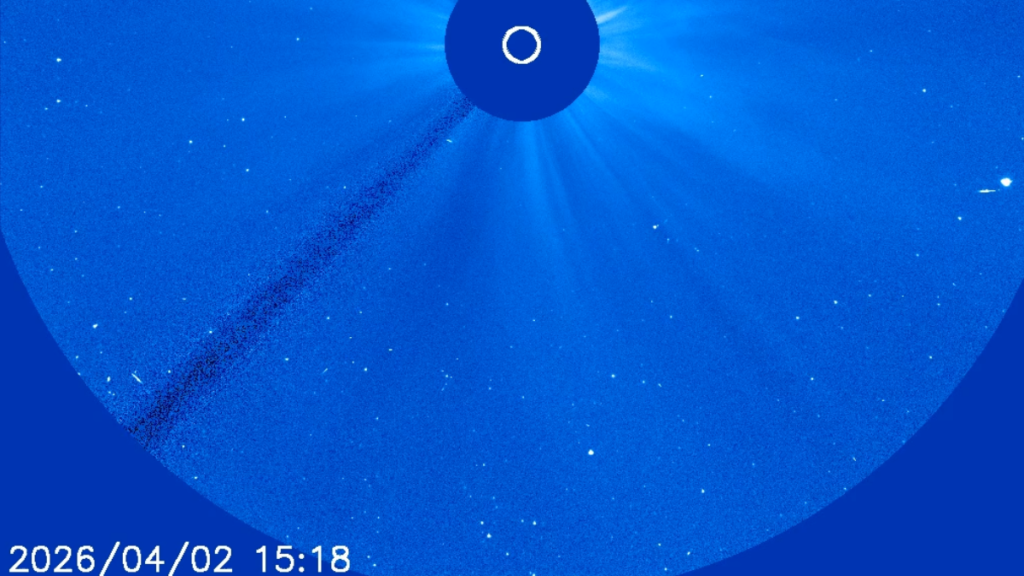
Multiple missions, including SOHO and STEREO, tracked the comet as it moved toward the Sun.
At first, everything looked normal. SOHO’s instruments clearly showed the comet heading inward, still intact. But then something changed.
After its closest point to the Sun — what scientists call perihelion — there was no comet anymore. Just a fading cloud of dust.
From another angle, STEREO showed the same thing in a slightly different way. The comet curved around the Sun… and then simply vanished.
No dramatic explosion. No fragments flying off. Just gone.
What Actually Destroyed It?
It wasn’t just one thing. It was everything hitting at once.
As the comet got closer to the Sun, the heat became extreme. Ice inside the comet started vaporising rapidly, building pressure from within. At the same time, the Sun’s gravity began stretching it — what scientists call tidal forces.
And then there’s the speed. MAPS was moving at nearly 1.6 million km per hour. At that velocity, even small structural weaknesses become fatal.
Put all that together, and the comet didn’t stand a chance.
Why Scientists Care About This
It might look like just another space event, but for researchers, this is valuable data.
Comets like MAPS are basically leftovers from the early solar system — frozen time capsules. Watching one break apart gives clues about what it’s made of and how these ancient objects behave under extreme conditions.
NASA’s newer mission, PUNCH, had already captured images of the comet before its final approach. Now, scientists will study how its remaining dust interacts with the solar wind.
Even earlier, missions like Parker Solar Probe have seen similar events, confirming that sungrazing comets rarely survive these encounters.
A Short Life, But A Useful One
MAPS was first spotted by amateur astronomers just months ago. It didn’t have a long life in the spotlight — but in its final moments, it gave scientists exactly what they needed.
A real-time look at how comets die near the Sun.
And honestly, that’s the kind of data you can’t recreate in a lab.