The global semiconductor tug-of-war just got louder.
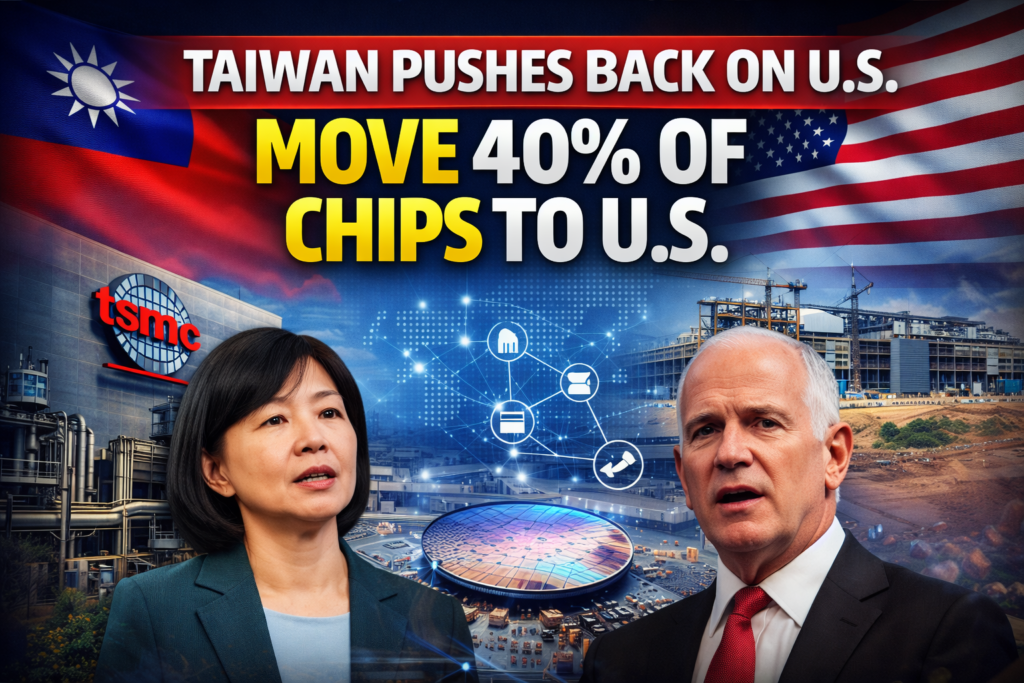
Taiwan has firmly rejected calls from U.S. officials to move as much as 40% of its chip production capacity to American soil, saying such a shift would be “impossible” given the island’s deeply rooted ecosystem.
At the center of the debate: who controls the future of advanced semiconductor manufacturing.
“Impossible,” Says Taiwan
Cheng Li-chiun, Taiwan’s Vice Premier and chief tariff negotiator, made it clear in a televised interview that relocating such a significant portion of the island’s semiconductor capacity simply cannot happen.
She emphasized that Taiwan’s chip industry has been built over decades, supported by tightly integrated science parks, supply chains, advanced packaging facilities, and specialized talent pools. That infrastructure, she said, is not something that can be uprooted and transplanted elsewhere.
“Our overall capacity will only continue to grow,” she noted, adding that while Taiwan is open to expanding investment in the U.S., it will remain firmly anchored at home.
The US Position: Strategic Shift
Howard Lutnick has been vocal about bringing semiconductor manufacturing back to the United States.
In recent comments, he argued that it is illogical for such a large share of advanced chip production to be located so close to China. His stated goal: achieve 40% market share in leading-edge semiconductor manufacturing during the current administration’s tenure.
In a separate interview last month, he suggested that if Taiwan does not move a significant chunk of its chip supply chain to the U.S., tariffs could rise sharply — potentially up to 100%.
That warning has added urgency to the conversation.
Recent US–Taiwan Trade Deal
Taiwan and the United States recently reached an agreement lowering tariffs on Taiwanese exports to 15% from 20%, alongside commitments for increased Taiwanese investment in America.
Cheng stressed, however, that there will be no relocation of Taiwan’s science parks — the backbone of its semiconductor dominance. Instead, Taiwan is willing to share expertise in building industrial clusters while maintaining its core manufacturing base domestically.
The TSMC Factor
TSMC, the world’s largest contract chipmaker, is already investing heavily in the U.S., with a $165 billion commitment to build factories in Arizona.
But even with that massive expansion, Taiwan remains the epicenter of advanced chip production globally. Officials argue that the island’s current and planned capacity — spanning advanced nodes, packaging, and supply chain operations — will far exceed its overseas investments.
Bigger Than Tariffs
At stake is more than trade policy.
Semiconductors power everything from AI systems to defense technology and electric vehicles. For Washington, reducing reliance on overseas production is a national security priority. For Taipei, maintaining industrial leadership is both an economic lifeline and strategic leverage.
The U.S. wants diversification.
Taiwan wants expansion — without displacement.
Final Words
This isn’t just about percentages on a spreadsheet. It’s about control of the world’s most critical technology supply chain.
Taiwan is signaling it will deepen ties with the U.S., but not at the cost of hollowing out its own ecosystem. Meanwhile, Washington is making it clear that semiconductor self-reliance is non-negotiable.
The 40% target may be aspirational for the U.S., but for Taiwan, the message is firm: growth abroad, roots at home.