NASA is preparing for another major journey to Mars, but this time it is turning to a relatively new player in the private space industry. The agency has announced a partnership with Relativity Space, the aerospace company controlled by former Google CEO Eric Schmidt, for an ambitious Martian orbiter mission known as Aeolus.
The mission represents another example of NASA’s growing reliance on commercial partners to carry scientific payloads beyond Earth. Just as the agency has worked closely with private companies for cargo missions, lunar exploration and crew transportation, Relativity Space will now be tasked with helping deliver critical scientific instruments to the Red Planet. If everything stays on schedule, the mission could launch as early as 2028.
What Is the Aeolus Mission?
Unlike Mars rovers that explore the planet’s surface, Aeolus will operate from orbit, focusing entirely on the Martian atmosphere. NASA believes the mission can fill important gaps in scientific understanding by providing a comprehensive view of weather patterns and atmospheric changes across the entire planet.
The agency says the project builds upon decades of research gathered through missions such as Mars Reconnaissance Orbiter, Mars Odyssey and MAVEN. Together, those spacecraft transformed scientists’ understanding of Mars, but questions still remain about how the planet’s atmosphere behaves on a day-to-day basis.
Aeolus aims to provide what NASA describes as the first integrated global view of Martian winds, temperatures, clouds and dust activity. Instead of examining isolated regions or limited weather events, the spacecraft will continuously monitor atmospheric conditions across the entire planet, creating a more complete picture of Mars’ climate system.
This type of information is becoming increasingly important as both government agencies and private companies begin planning more complex missions to the planet.
Four Advanced Instruments Will Study Mars in Detail
At the heart of the mission are four scientific instruments designed to work together. Each one focuses on a different aspect of the Martian atmosphere, allowing researchers to combine multiple streams of data into a single global model.
The first instrument is the Doppler Wind and Temperature Sounder, known as DWTS-Ozone. Its primary role will be measuring atmospheric wind speeds and temperature profiles. Understanding wind behavior is particularly important because dust storms and atmospheric turbulence remain major challenges for spacecraft operations around Mars.
The second instrument, called the Thermal Limb Sounder, will collect vertical temperature profiles while also observing water-ice clouds and airborne dust. These measurements could help scientists better understand how heat moves through the atmosphere and influences weather patterns.
NASA is also sending the Surface Radiometric Sensor Package, or SuRSeP. This instrument will focus on surface energy balance and investigate the properties of clouds and dust particles. Since dust plays a critical role in Martian climate behavior, even small improvements in understanding could have significant scientific value.
Completing the payload is the Wide-Field Context Camera. Unlike the other instruments, this system will capture daily global images of atmospheric activity, giving scientists a visual record of weather changes occurring across the planet.
All four instruments are being developed by researchers at NASA’s Ames Research Center in California’s Silicon Valley.
Why Understanding Mars Weather Matters
For casual observers, measuring winds and temperatures on Mars may sound like purely academic science. In reality, the information could have direct implications for future exploration efforts.
Landing safely on Mars remains one of the most difficult tasks in spaceflight. The planet’s atmosphere is thick enough to create friction and turbulence during descent, yet too thin to slow spacecraft efficiently using conventional methods. Small changes in weather conditions can therefore have major consequences during landing operations.
By creating detailed atmospheric maps, Aeolus could help engineers design safer entry, descent and landing systems for future missions. That includes robotic spacecraft, cargo deliveries and eventually human expeditions.
Dust is another major concern. Massive dust storms can engulf large portions of the planet and disrupt communications, reduce solar power generation and complicate surface operations. Better forecasting models would allow future missions to prepare for these events more effectively.
As NASA and private companies continue discussing long-term plans for human exploration, atmospheric data is becoming as valuable as geological discoveries.
A Big Test for Relativity Space and Eric Schmidt
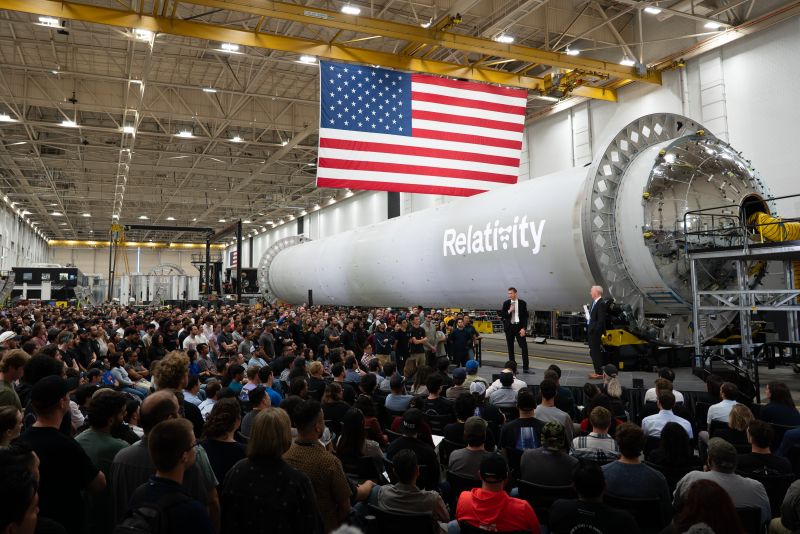
The partnership also marks an important milestone for Relativity Space. While the company has attracted significant attention within the aerospace industry, this mission represents one of its most ambitious opportunities to date.
Eric Schmidt acquired a controlling interest in Relativity Space in 2025, bringing one of Silicon Valley’s most recognizable technology leaders into the space sector. Shortly after the acquisition, Schmidt revealed broader ambitions that extended beyond traditional launch services, including concepts involving orbital computing infrastructure and space-based data centers.
However, turning those ambitions into reality requires proving that the company can successfully execute large-scale space missions. Aeolus will effectively serve as both a scientific mission and a demonstration of Relativity Space’s long-term capabilities.
NASA has confirmed that the company will provide spacecraft systems, launch services and cruise operations needed to transport the payload to Mars. Technical details regarding the rocket and spacecraft architecture have not yet been publicly disclosed, leaving many questions unanswered about how the mission will be executed.
What Happens Next?
With a targeted launch date in 2028, engineers still have several years of development, testing and mission planning ahead of them. The scientific instruments must be completed, spacecraft systems finalized and launch infrastructure prepared before the mission can leave Earth.
If successful, Aeolus could become a key source of atmospheric data for future Mars exploration programs. It may also help establish a new model for collaboration between NASA and emerging commercial space companies, extending partnerships far beyond Earth orbit and into deep space exploration.
For NASA, the mission represents another step toward understanding Mars in greater detail. For Relativity Space and Eric Schmidt, it may become the project that proves the company can compete for some of the most demanding missions in modern space exploration.