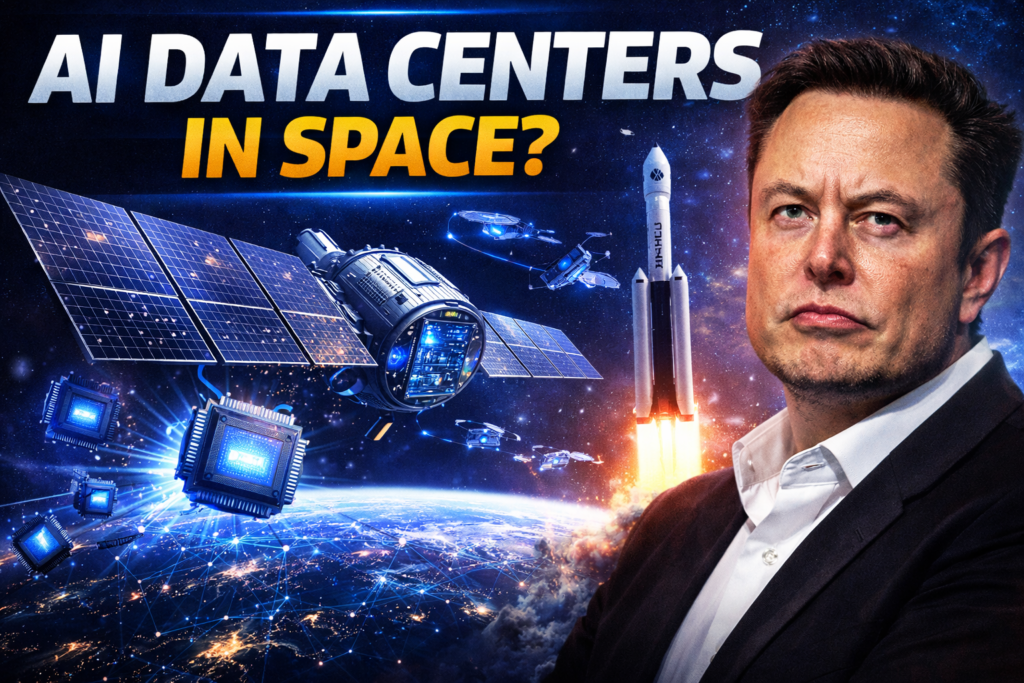
For decades, space-based computing lived firmly in the realm of science fiction, imagined by futurists and novelists rather than engineers. Now, that idea is edging closer to reality. A fresh spotlight has landed on orbital data centers after Elon Musk moved to merge his AI startup xAI with SpaceX, a step that has reignited debate about whether the future of AI infrastructure might actually be off-planet.
Why Tech Giants Are Looking to Space
The logic behind space-based data centers isn’t new. Engineers at NASA have explored the idea for years, mainly to solve one growing problem on Earth: energy-hungry computing. In orbit, solar power is constant, land is unlimited, and heat can theoretically be expelled directly into space.
Recently, the concept has caught the attention of major players. Alphabet and Blue Origin have both begun exploring space-based AI infrastructure, signaling that this is no longer a fringe idea.
Musk himself summed it up bluntly this week, arguing that long-term AI scaling will require access to energy far beyond what Earth can provide — and that space is the only logical answer.
SpaceX’s Big Advantage in the Orbital Race
What separates SpaceX from rivals is control. Unlike traditional aerospace firms, SpaceX owns nearly every piece of the puzzle: rockets, satellites, launch cadence, and now AI ambitions. The company has already filed with the Federal Communications Commission seeking approval to deploy up to one million solar-powered satellites designed to function as orbital data centers.
If approved, the proposed constellation would dwarf SpaceX’s existing Starlink network and could reshape how computing infrastructure is built. Analysts say this tightly integrated ecosystem gives SpaceX structural advantages few companies can match — especially as it prepares for what could be a $1.5 trillion IPO.
The Massive Challenges Still in the Way
Despite the excitement, experts warn that orbital data centers face steep technical and economic barriers.
Radiation is a major concern. AI chips in space would be constantly bombarded by cosmic rays, requiring either hardened hardware or new designs that don’t yet exist at scale. Cooling is another issue. Space may be cold, but it’s also a vacuum, meaning excess heat must be pushed into large radiators — increasing weight, size, and cost.
Then there’s the economics. Launching, maintaining, and replacing hardware in orbit remains enormously expensive. Some analysts believe commercial viability is still a decade or more away, even with SpaceX’s cost advantages.
Big Tech Isn’t Waiting on the Sidelines
While Musk pushes aggressively forward, others are testing the waters. Google has already exposed one of its AI chips to simulated space radiation as part of a research effort known as Project Suncatcher, which aims to build a solar-powered orbital AI network. Early results were promising, and a prototype launch is planned for 2027.
These experiments suggest that while space-based computing isn’t ready to replace Earth-bound data centers, the groundwork is quietly being laid.
Old Physics, New Economics
The science behind space infrastructure dates back to Cold War-era research in the 1970s, when U.S. agencies explored orbital solar power. Back then, launch costs killed the idea. What’s changed now is scale, private capital, and reusable rockets — areas where SpaceX dominates.
As one analyst put it, much of the optimism comes down to Musk himself. His track record of turning unlikely ideas into working systems has made investors and competitors pay attention, even when the risks remain high.
Final Words
Space-based data centers still sound futuristic — and in many ways, they are. Radiation, cooling, latency, regulation, and cost remain serious obstacles. But with SpaceX, Google, and Blue Origin now actively experimenting, orbital computing is no longer just theory.
Whether this becomes the backbone of future AI or remains a niche experiment will depend on breakthroughs still years away. What’s clear is that the race to move computing beyond Earth has officially begun — and Elon Musk intends to be at the center of it.