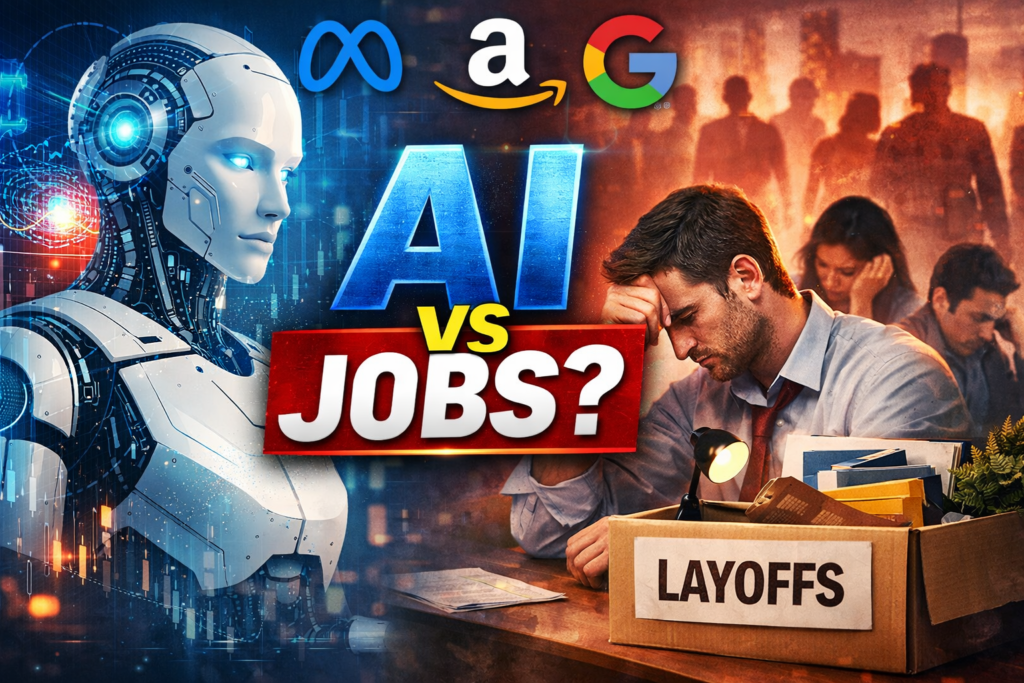
Artificial intelligence has quickly become the most powerful—and controversial—word in the tech world. Over the past few months, companies like Meta, Amazon, and Google have all announced layoffs. The common explanation? AI is making companies more efficient.
But not everyone is buying that story.
AI As The New Reason For Layoffs
There’s a noticeable shift in how companies are explaining job cuts. Earlier, terms like “over-hiring” or “cost optimisation” were common. Now, AI has taken center stage.
Executives are increasingly saying that new AI tools allow teams to do more with fewer people. And on the surface, it makes sense—automation reduces manual work.
But the timing raises questions.
Because while layoffs are happening, investments in AI are exploding.
Big Cuts, Bigger AI Spending
Take Meta, led by Mark Zuckerberg. The company has cut hundreds of roles recently, including around 700 jobs in a single week across multiple departments.
At the same time, Meta is aggressively investing in AI infrastructure and talent.
The broader industry tells a similar story. Tech giants are expected to collectively spend around $650 billion on AI in the coming year. Amazon alone is reportedly planning investments exceeding $200 billion.
So while jobs are being cut, hiring is still happening—just in different, AI-focused areas.
“AI Makes A Better Story”
This is where the narrative gets interesting.
Tech investor Terrence Rohan suggests that blaming AI might actually be a strategic choice. According to him, saying layoffs are driven by AI sounds more forward-looking than admitting it’s about cost-cutting or shareholder pressure.
In simple terms, “AI” feels like innovation. “Cost cuts” feel like damage control.
And companies would rather be seen as evolving than downsizing.
Leaders Aren’t Hiding The Shift
Some executives, however, are being more direct.
Jack Dorsey, through his company Block, has openly stated that smaller teams powered by intelligent tools can outperform larger traditional setups. He believes this shift will become standard across industries very soon.
Meanwhile, Zuckerberg has already signaled that AI will fundamentally change how people work—starting now, not in the distant future.
What’s Actually Happening Behind The Scenes
The reality likely sits somewhere in the middle.
Yes, AI is improving efficiency. Certain roles—especially repetitive or process-driven ones—are becoming less essential. But at the same time, companies are also restructuring after years of rapid hiring during the tech boom.
So while AI is part of the story, it may not be the whole story.
The Bigger Shift: Fewer People, More Output
What’s clear is the direction the industry is heading.
Tech companies are moving toward leaner teams with higher output, powered by AI tools. That doesn’t necessarily mean fewer jobs overall—but it does mean different kinds of jobs.
More engineers, fewer layers of management.
More AI specialists, fewer routine roles.
The Real Question Going Forward
The debate isn’t just about layoffs anymore. It’s about transparency.
Are companies being honest about why jobs are disappearing?
Or is AI becoming a convenient explanation for deeper structural changes?
Either way, one thing is certain—AI isn’t just changing products. It’s changing how companies are built.
And that shift is only just beginning.