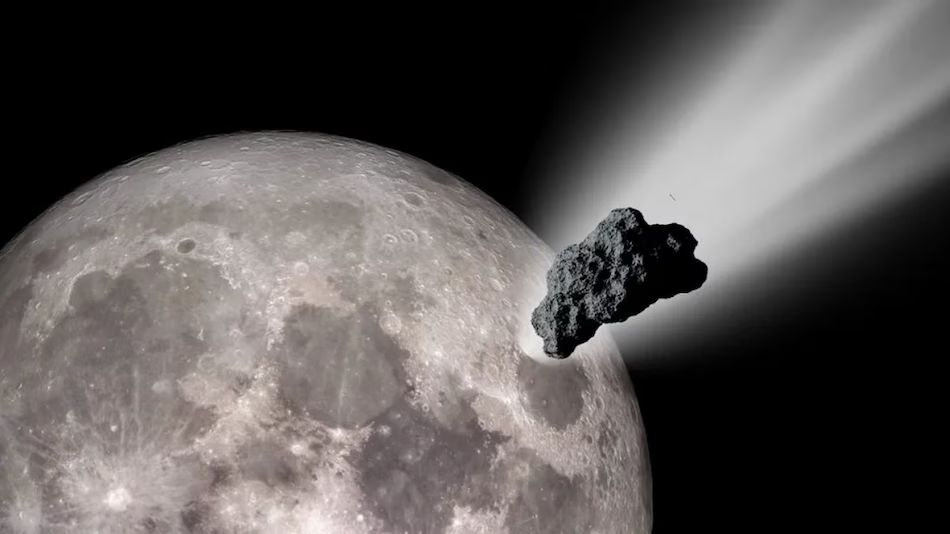
A violent event from the Moon’s distant past may finally explain one of its biggest mysteries. Fresh analysis of lunar rocks suggests that a colossal asteroid impact billions of years ago didn’t just scar the Moon’s surface—it may have fundamentally altered its internal chemistry, leaving the far side starkly different from the familiar, dark-faced Moon we see from Earth.
What the New Samples Revealed
The breakthrough comes from samples collected by China’s Chang’e-6 mission in June 2024 from the South Pole–Aitken basin, one of the largest impact craters anywhere in the solar system. According to reporting by Space.com, scientists studying the basaltic rocks found something unexpected: an unusually high concentration of the heavy potassium isotope potassium-41 compared to its lighter counterpart, potassium-39.
This isotopic imbalance stands out because it’s not seen in Apollo-era samples brought back from the Moon’s near side, hinting that something dramatic happened specifically on the far side.
Ruling Out Other Explanations
Researchers explored whether cosmic radiation or internal volcanic mixing could explain the isotope shift. But those processes, they found, would only cause minor changes—nowhere near enough to account for what showed up in the Chang’e-6 samples.
That led scientists to a more dramatic conclusion: the chemical signature is likely a leftover fingerprint of the massive impact that created the South Pole–Aitken basin.
How One Impact Changed the Moon
The study proposes that the sheer heat from this ancient collision was intense enough to vaporise volatile elements—those with low boiling points—right off the Moon’s surface. Lighter potassium-39 would have escaped into space more easily, while heavier potassium-41 stayed behind, skewing the isotope ratio.
At the same time, the impact may have suppressed large-scale magma formation on the Moon’s far side. With less molten material rising to the surface, fewer dark volcanic plains—known as maria—were able to form.
Solving the Near Side vs Far Side Puzzle
This chain reaction offers a compelling explanation for one of lunar science’s longest-running questions: why the Moon’s far side looks so different from the near side. While the Earth-facing side is dotted with vast, dark maria, the far side is rugged, brighter, and far less volcanic.
If the new findings hold up, the Moon’s two faces aren’t just visually different—they’re the result of very different geological histories, shaped by a single, catastrophic moment early in the solar system’s life.
Final Words
The Chang’e-6 samples are giving scientists a rare peek into the Moon’s deep past, showing how one ancient impact may have rewritten its internal structure and surface evolution. As more analysis continues, this discovery could reshape how we understand not just the Moon, but how violent collisions sculpt rocky worlds across the solar system.