Google has temporarily disabled a newly launched AI image-generation feature in Google Earth, less than 24 hours after introducing it to users. The decision came after screenshots of AI-generated images began circulating online, with some appearing to violate the company’s content policies. Although the feature was designed to help users create realistic visual concepts using Google Earth’s mapping data, it quickly sparked concerns about misinformation and the misuse of artificial intelligence.
The move highlights the growing challenge technology companies face as they rapidly expand generative AI capabilities across consumer products. While these tools are designed to unlock new creative possibilities, they also create opportunities for misuse, forcing companies to balance innovation with stronger safety measures.
AI Images Could Be Created From Real Locations
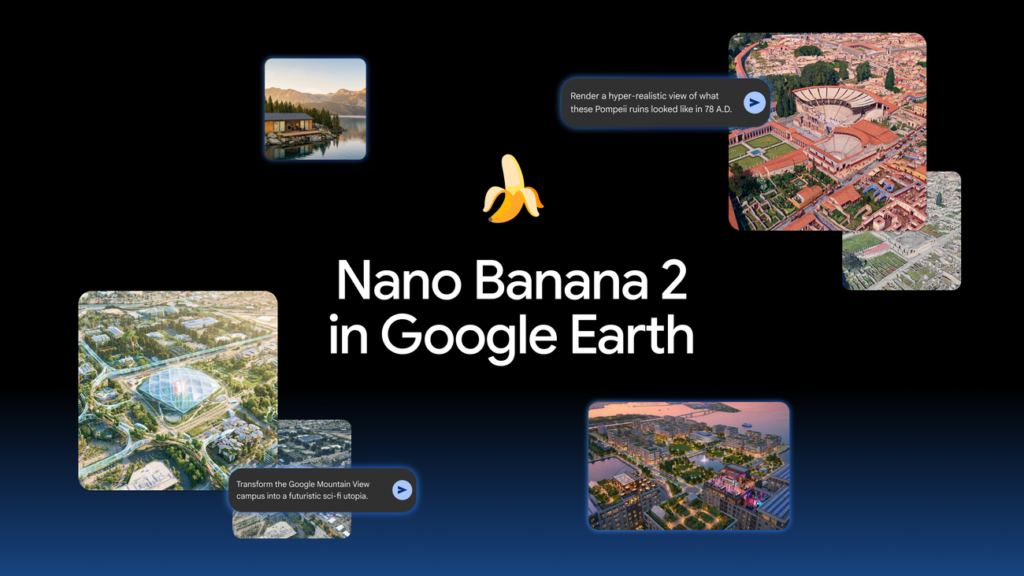
The experimental feature was powered by Google’s Nano Banana 2 AI model and allowed users to generate photorealistic images by entering text prompts linked to virtually any location on Earth. Instead of creating images from scratch, the AI used Google Earth’s satellite imagery, aerial photography and 3D mapping data as the foundation for generating new scenes.
That capability attracted immediate attention because users could create fictional events or altered landscapes based on real-world landmarks and cities. Critics warned that the technology could potentially be used to produce convincing but entirely fabricated images of famous monuments or public places, making it easier to spread misleading content online.
Responding to the growing concerns, Google announced on X that it would pause the feature while additional safeguards are developed. “We’ve seen geospatial professionals using this feature for a range of useful purposes, however we’ve also seen people sharing screenshots of generated imagery that appear to violate our policies,” the company said. “We’re pausing the capability while we work on stronger guardrails.”
Google did not specify exactly which images breached its policies. However, the company clarified that the AI-generated content never appeared within the standard Google Earth experience and that every generated image included an AI watermark identifying it as synthetic content.
AI Safety Remains a Growing Challenge for Tech Companies
The incident reflects a wider trend across the technology industry, where companies are increasingly rolling back or modifying AI features after unexpected user behavior exposes new risks. As artificial intelligence becomes more powerful and widely available, developers continue facing pressure to prevent misinformation, protect privacy and reduce opportunities for abuse without limiting legitimate creative uses.
Google has invested heavily in integrating generative AI across its ecosystem, introducing AI-powered features into products ranging from Search and Workspace to Android and Gemini. However, each rollout has also required continuous refinement as real-world usage exposes scenarios that internal testing may not fully anticipate.
The temporary suspension of the Google Earth tool follows a similar move by Meta earlier this month. The company discontinued Muse Image, an AI feature that allowed users to generate images using publicly available Instagram accounts, after facing criticism over privacy concerns. The backlash included objections from a Hollywood performers’ union, which questioned how public images were being used to train and power AI systems.
More Guardrails Expected Before the Feature Returns
Google has not announced when the Google Earth AI image generator will become available again. The company has only confirmed that it is working on stronger protections before restoring access. Those safeguards are expected to focus on limiting the creation of misleading or policy-violating content while preserving legitimate uses for architects, urban planners, educators and geospatial professionals who could benefit from the technology.
The rapid rollback demonstrates how quickly AI products can evolve once they reach the public. Even with watermarking and built-in restrictions, companies continue discovering new challenges as millions of users test the limits of emerging tools. For Google, the pause represents another reminder that building advanced AI systems is only part of the challenge—ensuring they are used responsibly has become just as important.