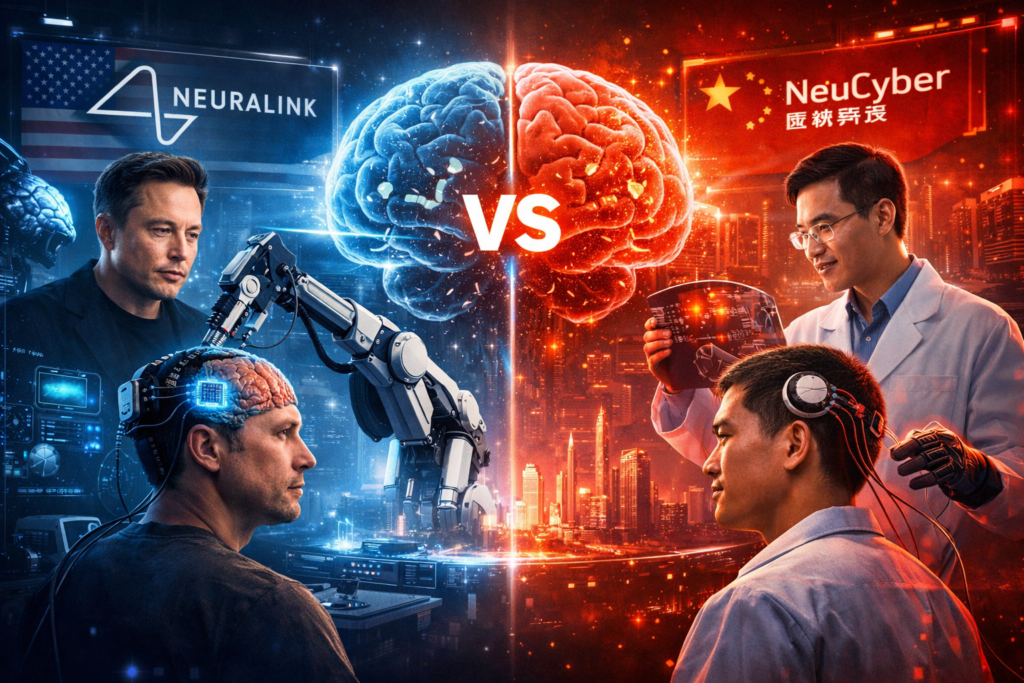
The global race to merge human brains with machines is no longer a futuristic concept — it’s unfolding in real time, and China is now moving aggressively to close the gap with the United States. At the center of this push is NeuCyber Neurotech, a state-backed startup working on advanced brain-computer interface (BCI) technology that could redefine how humans interact with devices.
While the company openly admits it is still trailing Neuralink by a few years, its rapid progress — combined with strong government backing — signals that the competition in this space is about to intensify in a big way.
China Takes a Historic First Step in Brain Chip Approval
In a move that has quietly reshaped the global BCI landscape, China recently became the first country to approve an invasive brain-computer interface device for commercial use. This milestone places it ahead of every other nation in terms of regulatory approval, even though the U.S. still leads in clinical deployment and technological maturity.
The approved device, developed by Shanghai-based Neuracle, is a coin-sized wireless implant designed to sit on the brain’s outer layer. Its primary use is to help patients with spinal cord injuries regain limited motor function — for example, controlling a robotic glove using neural signals.
This approval isn’t just symbolic. It shows that China is willing to fast-track real-world applications of BCI technology, turning experimental science into usable medical solutions faster than many expected.
NeuCyber’s ‘Beinao’ Vision: Catching Up With the Best
NeuCyber’s most advanced project, known as Beinao-2, represents China’s next leap in invasive brain implants. Unlike semi-invasive systems, this device is designed to be fully implanted into the brain using flexible electrodes, allowing for more precise signal capture and interaction.
Right now, Beinao-2 is still in the animal testing phase, which highlights the gap between NeuCyber and Neuralink. According to company leadership, Neuralink currently has a clear edge — with over 20 human patients already using its N1 chip.
That difference matters.
Neuralink’s biggest advantage lies in its surgical robot, which can insert hundreds of electrodes into the brain within minutes — a level of precision and scalability that few competitors have matched so far.
NeuCyber’s leadership has acknowledged this gap, estimating that their technology is roughly three years behind. But rather than slowing down, that gap appears to be fueling urgency.
Real Patients, Real Progress: Early Results From China
While Beinao-2 is still under development, NeuCyber has already made meaningful progress with its earlier system, Beinao-1. This semi-invasive device has been implanted in several human patients, including individuals with severe spinal cord injuries.
The results, though still early, are promising.
Patients have reportedly regained partial control over hand movements and have been able to operate computer cursors using only their thoughts after several months of use. These outcomes hint at the transformative potential of BCIs — not just as experimental tools, but as life-changing medical devices.
NeuCyber is now planning to expand trials to around 50 patients, which could make it one of the largest BCI clinical programs globally. If successful, this would significantly strengthen China’s position in the field.
The Bigger Picture: A Strategic National Priority
What’s driving this rapid acceleration isn’t just innovation — it’s policy.
China has officially classified brain-computer interfaces as a core “future industry” in its latest five-year plan. This places BCIs alongside cutting-edge fields like quantum computing, embodied AI, and nuclear fusion.
In simple terms, this isn’t just a tech project. It’s a national priority.
With government funding, institutional support from organizations like the Chinese Institute for Brain Research, and a growing ecosystem of startups, China is building a pipeline that could rival — and eventually challenge — Western dominance in neurotechnology.
NeuCyber alone has reportedly received around $29 million in backing from the Beijing government, highlighting the level of commitment behind these efforts.
A Global Tech Race With No Clear Winner Yet
Despite China’s regulatory lead, the broader BCI race remains wide open.
The U.S. still holds a strong advantage in terms of innovation, private investment, and early human trials. Neuralink, in particular, has captured global attention with its bold vision and rapid clinical progress.
At the same time, other tech players are entering the space, exploring different approaches to human-machine interaction. From non-invasive wearables to fully implanted chips, the field is evolving quickly — and unpredictably.
What makes BCIs especially challenging is that success isn’t just about hardware. It involves neuroscience, software, ethics, regulation, and long-term safety — all of which need to align for widespread adoption.
From Sci-Fi to Reality: Why This Matters
For decades, brain-computer interfaces have been a staple of science fiction — often depicted as tools for telepathy, memory enhancement, or even human augmentation.
Today, that vision is beginning to materialize in more practical ways.
The immediate focus is medical: helping paralyzed patients regain movement, restoring communication for those who cannot speak, and improving quality of life for people with neurological conditions.
But the long-term implications go far beyond healthcare.
If these technologies continue to evolve, they could fundamentally change how humans interact with computers — eliminating keyboards, screens, and even touch interfaces in favor of direct neural communication.
That’s the future both Neuralink and NeuCyber are working toward — even if they’re taking slightly different paths to get there.
The Road Ahead: Promise Meets Uncertainty
For now, NeuCyber’s timeline suggests that its most advanced devices could take another two to three years before reaching broader clinical use in China. That depends on regulatory approvals, large-scale trials, and continued technological progress.
At the same time, the company is carefully focusing on practical applications — particularly motor function recovery for spinal cord injury patients — rather than chasing more speculative use cases.
This grounded approach could prove to be a strength, especially in a field where hype often outpaces reality.
A Quiet but Powerful Shift in Global Innovation
The emergence of China as a serious player in brain-computer interfaces marks a turning point in the global tech landscape.
For years, Silicon Valley has led the narrative around futuristic technologies. But with strong state backing and a clear strategic focus, China is now positioning itself as an equal — if not a competitor with unique advantages.
NeuCyber’s admission that it trails Neuralink by three years might sound like a disadvantage. But in a field moving this fast, three years is not a lifetime — it’s a window.
And if current trends continue, that window may close faster than anyone expects.
Because in the race to connect the human brain to machines, the finish line isn’t just about who gets there first — it’s about who makes it work for the world.