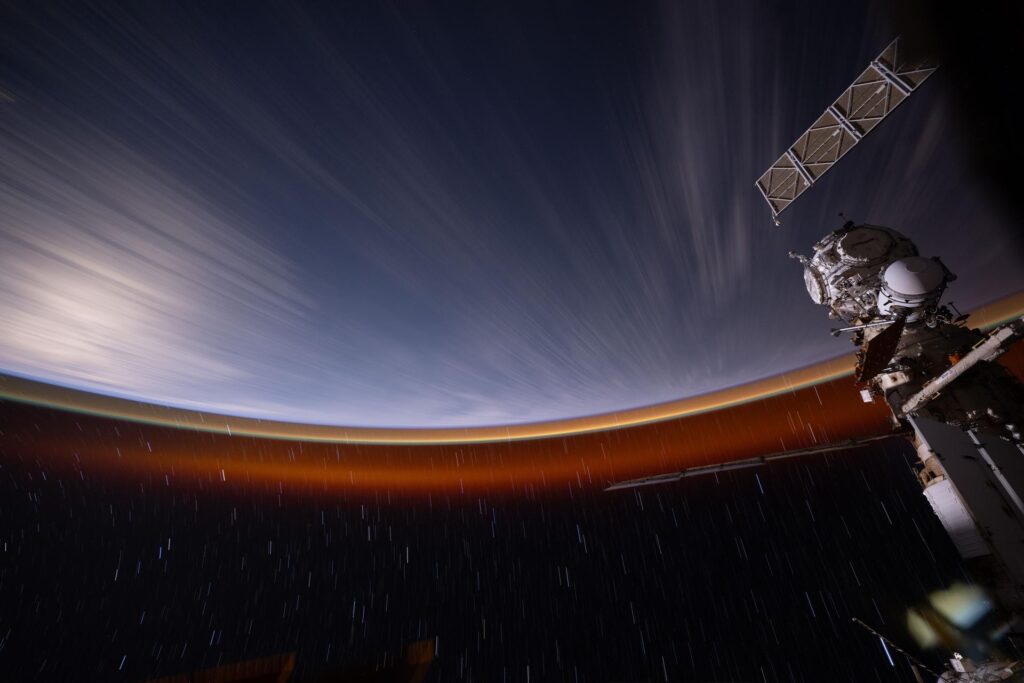
High above Earth, where every movement is calculated and every second counts, two astronauts stepped out into the silence of space to carry out a mission that could shape the future of humanity’s longest-running orbital outpost. NASA astronauts Jessica Meir and Chris Williams successfully completed a demanding spacewalk aboard the International Space Station, marking another crucial step in extending the station’s operational life.
The extravehicular activity, officially designated as US EVA-94, lasted just over seven hours and wrapped up on March 18, 2026. For Williams, it was a milestone moment — his very first spacewalk — while Meir added another mission to her growing experience outside the station.
But beyond the individual achievement, this mission carried far greater importance. It was about preparing the ISS for a major power system upgrade — one that could redefine how long the station continues to operate in orbit.
A Critical Mission Focused on Power and Longevity
The primary objective of the spacewalk was to prepare the station’s 2A power channel — a key component that will soon support new roll-out solar arrays. These advanced arrays are designed to significantly boost the ISS’s power generation capacity, ensuring it can support more experiments, systems, and operations in the years ahead.
During the mission, the astronauts installed an electrical jumper — a small but vital addition that allows engineers to safely maintain and upgrade the power channel. They also performed adjustments to a battery box, fine-tuning the system to ensure stability and efficiency.
Every task, though highly technical, contributes to a larger goal: keeping the ISS functional, reliable, and ready for its next phase of life.
Not everything on the checklist could be completed, however. Due to time constraints, certain secondary tasks — including collecting microbial samples from the station’s exterior and installing a protective lens cover on a Canadarm2 camera — were postponed for a future mission.
The Bigger Challenge: Ageing Solar Systems in Space
To understand why this upgrade matters, it’s important to look at the condition of the ISS itself.
The station’s original solar panels date back to the early 2000s, when the ISS was first assembled in orbit. These panels were designed with a lifespan of around 15 years. Now, more than two decades later, they have naturally degraded due to constant exposure to harsh space conditions — including radiation, micrometeoroids, and extreme temperature swings.
While they are still functional, their efficiency has declined over time.
That’s where the new technology comes in.
Enter ROSA: The Next Generation of Space Power
The upcoming upgrade involves installing roll-out solar arrays, commonly known as ROSA, developed by aerospace company Redwire. Unlike traditional rigid panels, these arrays are compact when launched and then unfurl in space like a giant sheet, maximizing efficiency while reducing launch constraints.
This design allows NASA to effectively “layer” new panels over the old ones, boosting power output without needing to replace the entire system.
The result is a more powerful, more efficient energy supply — something the ISS urgently needs as it continues to host complex scientific experiments and international missions.
Why More Power Means More Science
Power is the backbone of everything that happens aboard the ISS.
From running life-support systems to powering scientific equipment, every experiment depends on a stable and sufficient energy supply. As research on the station becomes more advanced — especially in fields like biotechnology, materials science, and space medicine — the demand for power continues to grow.
The new solar arrays will help meet that demand, enabling more ambitious experiments and expanding the station’s capabilities.
In simple terms, more power means more science — and more discoveries.
Preparing for the Future — and the End
Interestingly, this upgrade isn’t just about extending the life of the ISS. It’s also about preparing for its eventual retirement.
NASA has been working on long-term plans to safely deorbit the station when its operational life comes to an end. The upgraded power systems will play a role in ensuring that process can be carried out in a controlled and safe manner.
This dual-purpose approach — extending usability while planning for a responsible end — reflects the careful balance NASA must maintain as the ISS enters its later years.
What Comes Next: Another Spacewalk on the Horizon
The work is far from over.
A follow-up mission, EVA-95, is already planned and will focus on upgrading another section of the station’s power system — the 3B power channel. Together, these upgrades will form a comprehensive enhancement of the ISS’s energy infrastructure.
Each spacewalk builds on the previous one, gradually transforming the station into a more efficient and future-ready platform.
A Symbol of International Collaboration and Human Persistence
The ISS has always been more than just a spacecraft. It is a symbol of global cooperation, with multiple countries contributing to its construction, maintenance, and operation.
Missions like this highlight the ongoing commitment to keeping that collaboration alive — even as new space stations and commercial platforms begin to emerge.
At the same time, they showcase the human element of space exploration. Behind every upgrade, every repair, and every experiment are astronauts who step into the unknown, working in one of the most challenging environments imaginable.
A Quiet but Powerful Step Forward
While this spacewalk may not have the dramatic flair of a rocket launch or planetary landing, its importance cannot be overstated.
It represents a quiet but crucial step forward — ensuring that the ISS remains a functioning, productive laboratory in space for years to come.
For Jessica Meir and Chris Williams, it was a mission well executed. For NASA, it was another milestone in a long journey of innovation and adaptation.
And for the rest of us, it’s a reminder that even in the vast emptiness of space, progress never stops — it just unfolds, one careful step at a time.