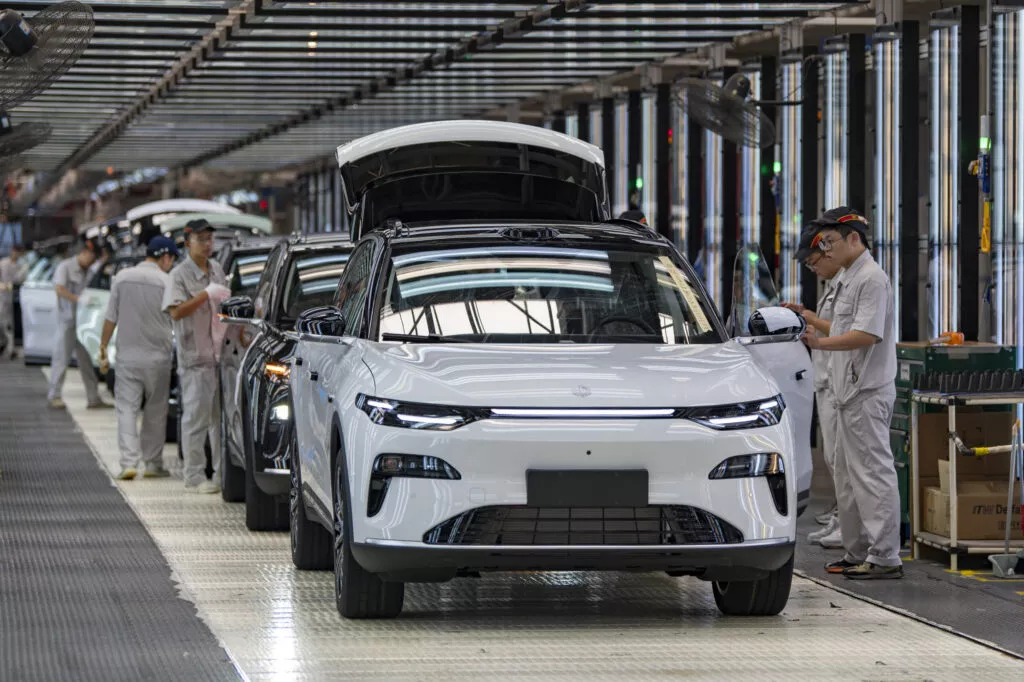
China’s electric vehicle story isn’t slowing down — it’s changing direction entirely. After dominating the EV market over the past two decades, the country is now racing toward something bigger: turning cars into intelligent, self-reasoning machines powered by artificial intelligence. And this isn’t just a tech upgrade, it’s a full shift in how vehicles are being imagined and built.
At the heart of this transformation is China’s broader “AI Plus” strategy, a national push to embed AI across industries — from manufacturing to healthcare and now deep into the automotive space. The goal is not just smarter cars, but independence. China wants to reduce its reliance on high-end foreign semiconductors, which have become a major pressure point in global tech competition. That’s why the next generation of EVs is expected to run on locally developed chips and software ecosystems.
What makes this moment interesting is how the lines are starting to blur. According to industry leaders, there’s no longer a clear distinction between a car company and a tech company. Vehicles are no longer just machines — they’re becoming platforms. AI isn’t just assisting driving anymore; it’s reshaping how drivers interact with the car itself, turning it into something closer to a digital assistant on wheels.
Take Xpeng, for example. Its latest AI system allows drivers to give natural commands like asking the car to park near a specific entrance, without manually selecting a location. The system can even navigate using cameras without relying heavily on maps. It’s a subtle shift, but it changes how intuitive driving can feel, especially in complex urban environments.
Then there’s Xiaomi, which has entered the EV space aggressively. Its HyperOS-powered cars are being designed to handle everyday tasks beyond driving — things like booking restaurants, ordering coffee, or even adjusting the car’s environment based on the driver’s mood. It’s less about driving assistance and more about creating a connected lifestyle experience inside the vehicle.
Meanwhile, Huawei is doubling down on its role in this ecosystem, committing over $10 billion in the next five years to boost computing power for smart driving. Although automotive is still a smaller part of its overall business, it’s currently one of its fastest-growing areas, showing where the company sees future demand.
The chip race is also heating up. Companies like BYD, Geely, and NIO are developing their own semiconductors to reduce reliance on global players like Nvidia and Qualcomm. Even chipmakers like Horizon Robotics are stepping in with processors designed specifically for AI-driven vehicles, capable of handling multiple displays and complex driving tasks simultaneously.
All of this is happening while Chinese automakers continue to challenge global leaders like Tesla. But instead of just competing on battery range or pricing, the battleground is shifting toward intelligence — how smart, responsive, and integrated a car can be.
What’s clear is that this isn’t a gradual evolution. Industry experts are already calling it a full-scale revolution. Cars are no longer just about getting from one place to another — they’re becoming interactive systems that think, adapt, and assist in ways that were once limited to science fiction.
And if China manages to pull this off at scale, it won’t just reshape its own auto industry. It could redefine what the rest of the world expects from a car in the next decade.