Intro: Brussels Turns Up the Heat on TikTok
The battle between regulators and Big Tech just escalated in Europe.
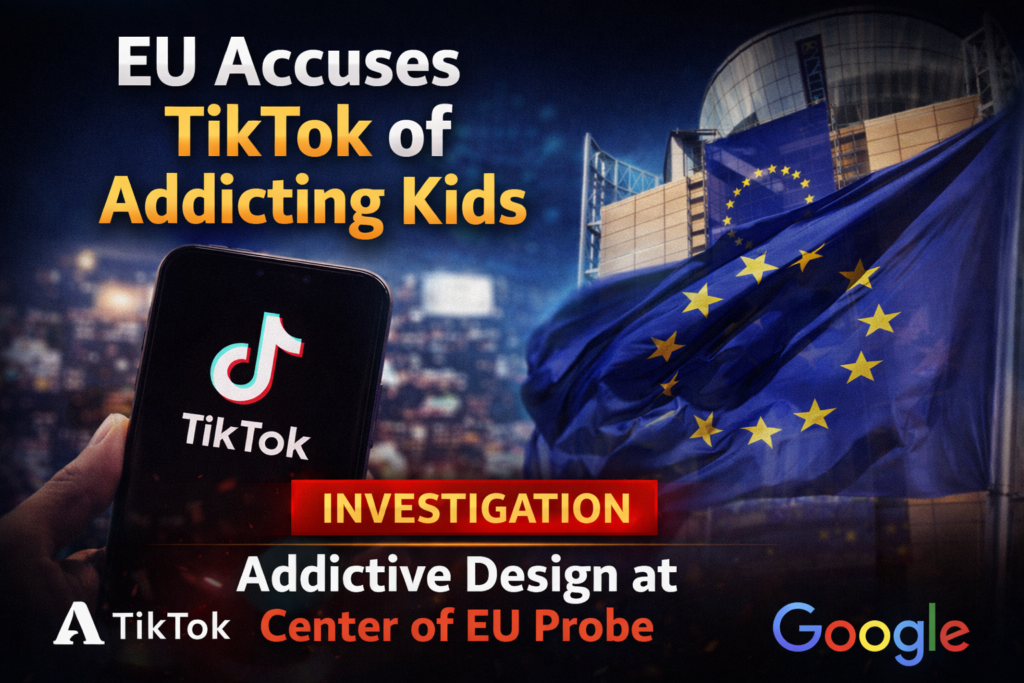
The European Commission has issued preliminary charges against TikTok, accusing the video-sharing giant of breaching the European Union’s Digital Services Act with what it calls “addictive design” features that encourage compulsive use — especially among children.
At the center of the dispute? Infinite scroll, autoplay, push notifications, and algorithm-driven recommendations.
What the EU Is Alleging
After a two-year investigation, regulators say TikTok failed to properly assess how core features of the app could harm users’ physical and mental health — particularly minors and what officials describe as “vulnerable adults.”
Commission spokesperson Thomas Regnier said features like infinite scrolling and autoplay “lead to compulsive use of the app, especially for our kids,” calling the risks to mental health “major” and “alarming.”
The Commission believes TikTok should rethink what it described as the platform’s “basic design.” That’s not a minor tweak — that’s a call for structural change.
What Could Happen Next?
Under the Digital Services Act, social media platforms operating in the EU must actively manage risks to users or face steep penalties.
If TikTok is ultimately found non-compliant, the company could be fined up to 6% of its global annual revenue.
For a platform with 170 million users in the EU alone, that’s a serious threat.
TikTok now has the opportunity to respond and defend itself before any final decision is made.
TikTok Pushes Back
The company has strongly denied the accusations.
In a statement, TikTok described the Commission’s findings as “categorically false and entirely meritless,” and said it will challenge them through all available means.
TikTok also pointed to its existing safeguards, including:
- Custom screen time limits
- Sleep reminders
- Teen accounts with parental controls
- Evening shutdown prompts for younger users
According to the company, these tools allow users and families to make intentional decisions about screen time.
Why This Matters Beyond Europe
This isn’t just a Brussels story — it’s part of a broader global crackdown on youth social media use.
Australia has already banned social media access for under-16s. Governments in Spain, France, Britain, Denmark, Malaysia, and Egypt are considering similar restrictions.
In the United States, TikTok recently settled a major social media addiction lawsuit. Meanwhile, platforms owned by Meta and Google — including Instagram and YouTube — continue to face claims alleging harm to children.
The debate is no longer about whether social media affects young users — it’s about how much responsibility platforms should carry.
The Data That Alarmed Regulators
EU officials cited internal data suggesting:
- 7% of children aged 12–15 spend four to five hours daily on TikTok
- The app is the most-used platform after midnight among teens aged 13–18
Regulators argue TikTok ignores warning signs of compulsive behavior — such as late-night usage patterns and excessive app openings.
They also claim existing time-management tools are too easy to dismiss and require too much effort from parents to be effective.
What the EU Wants Changed
Among the proposed changes:
- Disable or limit infinite scroll
- Introduce stronger nighttime screen breaks
- Reduce personalization intensity in recommender systems
- Add more friction to discourage endless viewing
In short, Brussels wants TikTok to slow down the dopamine loop.
What Worked: Regulatory Momentum
The EU’s action reinforces its position as one of the world’s most aggressive digital regulators. The Digital Services Act was designed precisely for cases like this — where design itself is considered a risk factor.
What Didn’t: A Design Model Under Fire
TikTok’s entire engagement engine is built on personalization and seamless scrolling. If the Commission forces structural changes, it could strike at the heart of how the platform keeps users engaged.
Final Words
This case isn’t just about TikTok. It’s about the future of social media design.
Should platforms be allowed to optimize purely for engagement? Or must they redesign for well-being — even if it slows growth?
As the European Commission and TikTok prepare for the next round, one thing is clear: the era of unchecked infinite scroll may be entering its most serious regulatory test yet.