Intro: A Different AI Path for India?
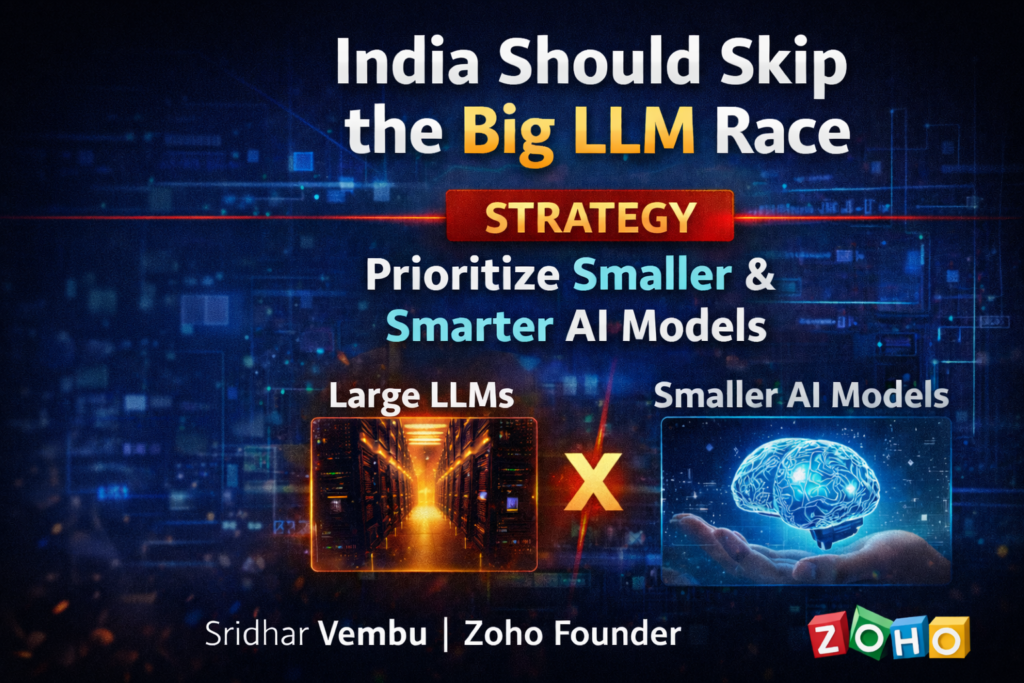
As the world pours billions into ever-larger AI models, Sridhar Vembu is urging India to pause — and think differently.
The Zoho founder and Chief Scientist has said India should not try to compete head-on with the massive Large Language Models (LLMs) dominating the global AI race. Instead, he believes the country should focus on smaller, more energy-efficient, and less capital-intensive approaches.
And this comes just weeks before India hosts one of the biggest global AI gatherings yet.
“This Is a $50–100 Billion Game”
In an interview with PTI, Vembu pointed out that the race to build cutting-edge foundational AI models is extremely expensive — with costs estimated between $50 billion and $100 billion. Add to that the scarcity of GPUs and rising electricity costs, and the barriers become even steeper.
He argued that India should not simply imitate what global Big Tech firms are doing.
According to Vembu, sometimes “staying a little bit behind is a good idea.” Rather than chasing energy-hungry mega-models, India should invest its “brain power” into developing alternative, efficient AI strategies.
Aligning With the Economic Survey
Interestingly, his view echoes observations in India’s recent Economic Survey, which noted that limited access to high-end compute infrastructure and capital makes building foundational models a difficult centerpiece strategy for India.
Instead, the Survey suggested a bottom-up approach — one that aligns more closely with India’s current strengths and constraints.
Vembu appears to agree.
He believes India should pivot toward research in smaller AI models or entirely different architectures that don’t rely on enormous computational resources.
Not Anti-AI — Just Pro-Efficiency
It’s important to note: Vembu isn’t dismissing AI innovation. He acknowledges that large models currently dominate the landscape, particularly those built by global tech giants and emerging Chinese open-source players.
But he questions whether India should enter that capital-intensive arena right now.
Instead, Zoho is reportedly exploring energy-efficient directions in AI — approaches that prioritize intelligence and innovation over brute-force compute power.
“We have to apply our brain power, rather than energy which is scarce,” he emphasized.
The Timing: India AI Impact Summit
This debate unfolds as India prepares to host the India AI Impact Summit, billed as the largest of the four major global AI summits so far — following gatherings in the UK, Seoul, and France.
According to official figures, the event has already drawn over 35,000 registrations and is expected to see participation from more than 100 countries. Around 15–20 Heads of Government, 50+ ministers, and 40+ global and Indian companies are slated to attend.
Some of the biggest names in global tech are expected, including:
- Jensen Huang, CEO of NVIDIA
- Dario Amodei, CEO of Anthropic
- Brad Smith, President of Microsoft
- Demis Hassabis, CEO of Google DeepMind
- Julie Sweet, CEO of Accenture
The summit is expected to showcase over 500 AI startups and host hundreds of sessions focused on responsible, inclusive, and impact-driven AI.
Against this backdrop, Vembu’s comments feel like a strategic counterpoint.
What Worked: Realism Over Hype
Vembu’s argument resonates with India’s structural realities — limited GPU access, energy constraints, and capital intensity. His call for smarter innovation rather than brute-force scaling adds a practical dimension to the AI conversation.
What Didn’t: Risk of Falling Too Far Behind
Critics might argue that avoiding foundational model development could limit India’s long-term competitiveness. AI leadership often shapes global standards, ecosystems, and economic influence.
The challenge will be balancing pragmatism with ambition.
Final Words
India stands at a crossroads in the AI era. Should it chase trillion-parameter models built by global tech giants? Or carve its own path through smaller, efficient, and possibly more sustainable innovations?
Sridhar Vembu believes the latter may be wiser — at least for now.
As the India AI Impact Summit approaches, this debate will likely take center stage. And the world will be watching how India defines its AI future.