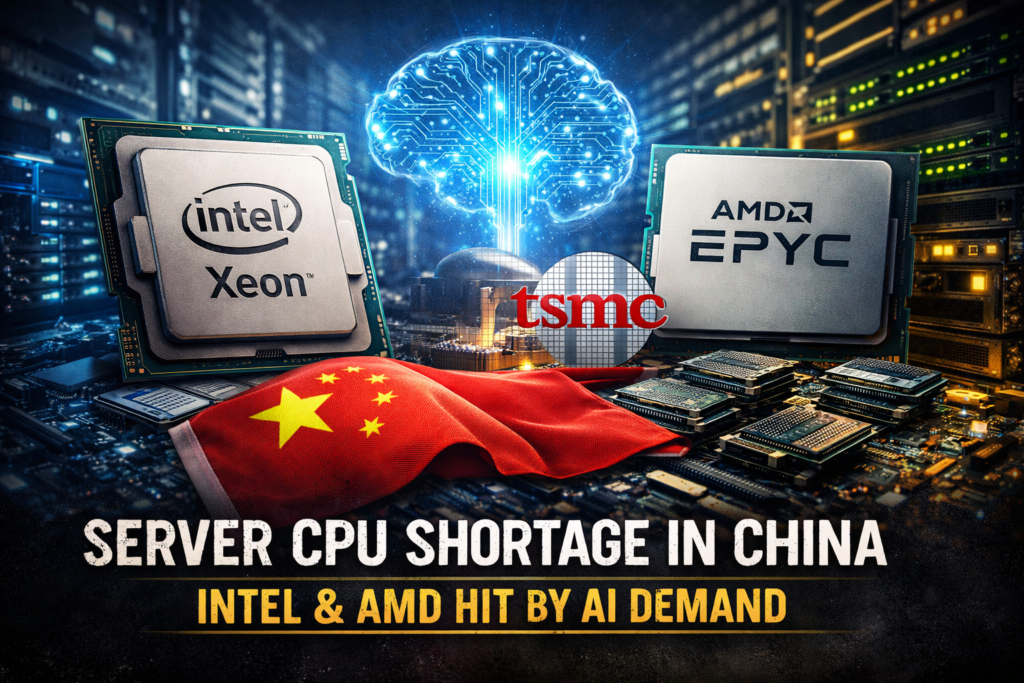
China’s AI gold rush is starting to squeeze more than just GPUs.
According to sources cited by Reuters, both Intel and AMD have notified Chinese customers about tightening supply of server central processing units (CPUs). For some Intel products, delivery lead times are now stretching up to six months — a significant delay in a market where demand is surging.
And the ripple effects are already visible in pricing.
📦 Intel Warns of Six-Month Delays
Sources familiar with the matter say Intel’s fourth- and fifth-generation Xeon processors are particularly constrained in China. The company is reportedly rationing shipments and working through a substantial backlog of unfulfilled orders.
Lead times for certain models have extended to as long as six months. As a result, server CPU prices in China have risen by more than 10% on average, though exact figures vary depending on contracts.
Intel acknowledged earlier supply constraints during its January earnings call, noting that rapid AI adoption has significantly increased demand for “traditional compute.” The company expects inventory levels to hit their lowest point in Q1 but anticipates improvement beginning in Q2 through 2026.
China accounts for over 20% of Intel’s overall revenue, making the situation particularly sensitive.
⚙️ AMD Also Feeling the Pressure
The squeeze isn’t limited to Intel.
AMD has also informed clients of supply limitations. Lead times for some AMD server CPUs have reportedly extended to eight to ten weeks.
Unlike Intel, AMD outsources manufacturing to TSMC, the world’s leading contract chipmaker. However, TSMC has prioritized high-margin AI accelerators, leaving tighter production capacity for standard CPUs.
AMD said it has boosted supply capabilities and remains confident in meeting global demand, citing strong supplier agreements and its partnership with TSMC.
🤖 AI Boom Is Driving the Crunch
The surge in artificial intelligence infrastructure investment is creating intense pressure across the semiconductor supply chain.
While GPUs have dominated headlines, CPUs remain essential for server operations and AI workloads — especially emerging “agentic AI” systems that perform multi-step, autonomous tasks beyond simple chatbot functions. These applications require significantly more processing power.
Memory chip shortages have compounded the issue. As memory prices began rising late last year, Chinese customers reportedly accelerated CPU purchases to lock in better pricing — further tightening supply.
📊 Market Share Shift
Intel and AMD together control the global server CPU market.
According to a recent UBS report, Intel’s market share has dropped from over 90% in 2019 to roughly 60% in 2025. Meanwhile, AMD has climbed from about 5% to over 20% during the same period.
In China, key customers include major cloud and server players such as Alibaba Group and Tencent — both heavily invested in AI infrastructure.
🎯 What This Means
The AI race is no longer just about cutting-edge accelerators — it’s exposing bottlenecks across the broader compute ecosystem.
Longer lead times, rising prices, and supply prioritization decisions could reshape procurement strategies for tech giants and startups alike. If shortages persist into 2026, competition for traditional server CPUs may intensify further.
Final Words
The global AI boom is rewriting the rules of semiconductor demand. For Intel and AMD, the challenge now isn’t just innovation — it’s keeping up with orders.
And as China continues to pour investment into AI infrastructure, server CPUs — once considered routine components — have suddenly become hot commodities.