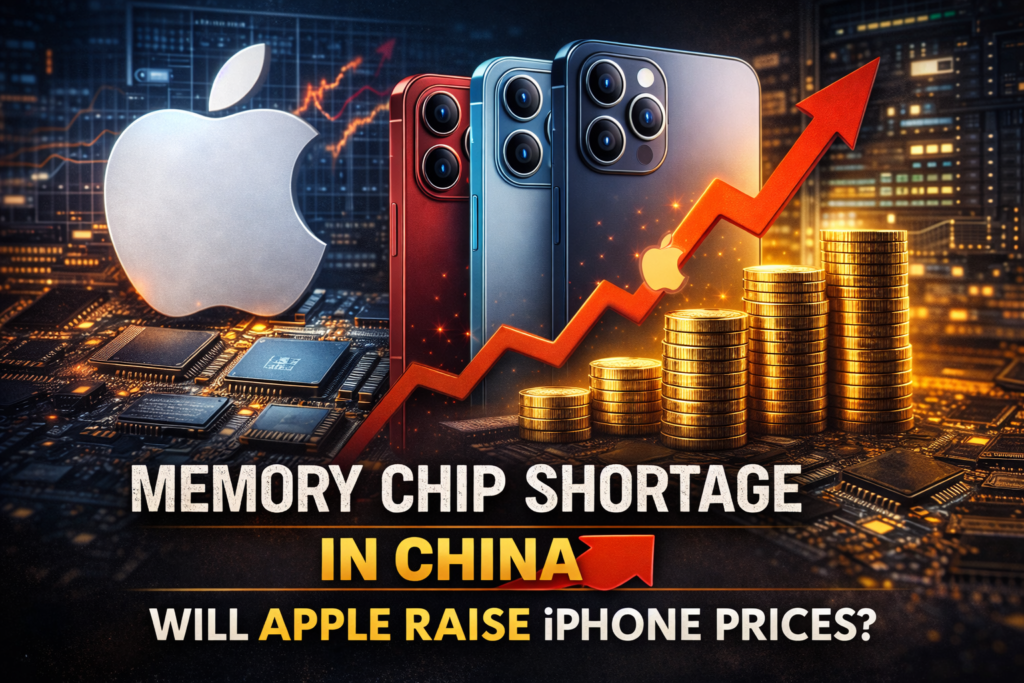
A global memory chip shortage is starting to ripple through the smartphone market — and all eyes are on Apple Inc..
With DRAM prices climbing due to surging AI infrastructure demand, the big question from Silicon Valley to Shenzhen is simple: Will Apple pass those costs on to consumers, or take a hit to protect — and possibly expand — its market share?
📈 AI Boom Is Squeezing Smartphones
The current crunch isn’t just about phones. Tech giants like Meta Platforms, Google, and Microsoft have aggressively expanded AI infrastructure, absorbing massive supplies of memory chips.
Manufacturers are prioritizing higher-margin data center components over consumer electronics. That has pushed up DRAM prices — a critical component that enables power-hungry apps and multitasking on smartphones.
🍎 Tim Cook’s Cautious Tone
During its latest earnings call, Apple predicted strong sales growth driven by demand for its upcoming iPhone 17 models. But CEO Tim Cook acknowledged that memory prices are expected to rise sharply.
When analysts pressed him on whether Apple would increase iPhone prices, Cook avoided a direct answer.
“There are different levers that we can push,” he said, hinting at multiple options without revealing a clear pricing strategy.
That ambiguity is fueling speculation across the industry.
💰 Market Share vs. Margins
Apple led global smartphone shipments last year, with nearly 10% growth, according to IDC data. Its decision on pricing could reshape the competitive landscape.
If Apple keeps prices steady while rivals raise theirs, iPhones could look even more attractive — potentially pulling market share away from Android competitors. But absorbing higher memory costs would pressure margins and possibly unsettle investors.
If Apple hikes prices, competitors would likely follow, lifting the overall price ceiling for premium smartphones.
“This is the biggest question for the industry now,” said IDC research director Nabila Popal.
📱 Rivals Feeling the Heat
Qualcomm, the leading designer of smartphone processors for Android devices, recently warned of weaker-than-expected performance. Its CFO said some handset makers in China lack sufficient memory chips despite strong demand.
Analysts believe Apple has an edge due to long-standing supplier relationships with Samsung Electronics, SK Hynix, and Micron Technology. That leverage may allow Apple to secure supply even in a tight market.
Meanwhile, smaller Android manufacturers are watching closely. If Apple absorbs cost increases and holds prices, Android phones could appear comparatively more expensive — squeezing their expected volumes.
🔄 Samsung’s Role
Samsung adds another layer of complexity. Because it produces its own memory chips through its semiconductor division, its smartphone arm may be better positioned to manage cost increases.
If both Apple and Samsung adjust prices upward, the entire premium smartphone segment could see a coordinated shift.
📉 A Market at a Turning Point
IDC data suggests the global smartphone market could see its first annual decline since 2023 due to memory shortages.
Apple’s next move may define not just its own growth trajectory — but the pricing strategy of the entire industry.
Final Words
In a supply-constrained world, pricing is power.
If Apple absorbs rising costs, it could strengthen its competitive dominance. If it raises prices, it may protect margins while giving rivals cover to do the same.
Either way, the memory chip shortage has transformed a supply chain issue into a strategic crossroads for the world’s most valuable smartphone brand.