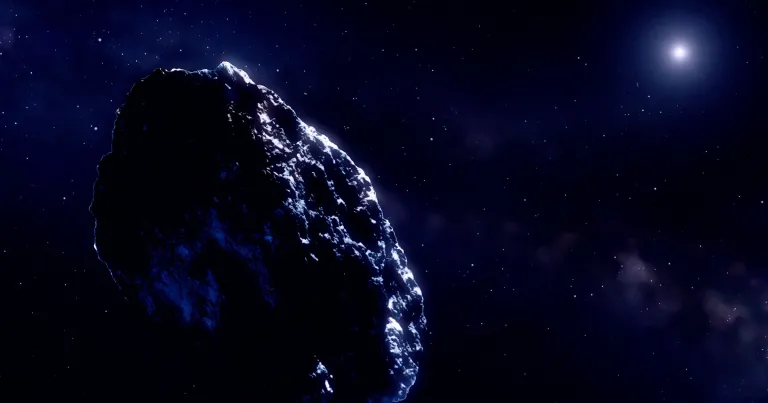
Something quietly crossed into our solar system last year, and now it’s starting to change how scientists think about the universe itself. The interstellar comet 3I/ATLAS, first spotted in July 2025, isn’t just another space rock passing by — it’s turning into one of the most important cosmic discoveries in recent times. What researchers are finding inside it feels less like routine science and more like decoding a message from a completely different star system.
When astronomers first detected it using the ATLAS telescope system, what stood out immediately was its speed — around 137,000 miles per hour. That kind of velocity made it clear this object didn’t belong here. It had entered our solar system from somewhere far beyond, joining a very small and rare category of interstellar visitors. But at that point, no one really knew just how unusual it would turn out to be.
The real breakthrough came from a recent study published in Nature Astronomy, where scientists used the powerful Atacama Large Millimeter/submillimeter Array (ALMA) to analyze the comet’s composition. For the first time ever, researchers detected “semi-heavy” water — also known as deuterated water — in an interstellar object. And the numbers are honestly hard to ignore.
This comet contains about 30 times more heavy water than comets found in our own solar system, and roughly 40 times more than what’s present in Earth’s oceans. That level of enrichment doesn’t happen under normal conditions. In fact, it only forms in extremely cold environments — temperatures below 30 Kelvin, which is colder than most regions we’re familiar with in our cosmic neighborhood.
That detail alone tells a much bigger story. It strongly suggests that 3I/ATLAS was born in a star system far colder than ours, possibly in the outermost, frozen regions where planetary building blocks form very differently. In a way, this comet acts like a preserved fossil, carrying chemical evidence from a place we may never directly observe.
What makes this discovery even more important is that earlier interstellar objects didn’t reveal much about their composition. They passed through too quickly or lacked detectable signals. But 3I/ATLAS is different — it’s the first time scientists have been able to measure the D/H ratio (deuterium to hydrogen) in such an object, giving direct insight into its origins. That ratio essentially acts like a chemical fingerprint, tracing back to the conditions in which it formed.
Researchers believe this comet could be incredibly old, possibly originating from a star system that might not even exist anymore. That idea alone adds a strange, almost poetic layer to the discovery — we’re studying something that carries the memory of a place long gone.
Beyond the curiosity, though, this has real scientific impact. It challenges existing models of how planets and comets form, especially outside our solar system. If such extreme chemical environments are more common than previously thought, it could mean that planetary systems across the galaxy are far more diverse than we imagined.
At its core, this discovery is a reminder of how little we still know. Every interstellar object that enters our solar system isn’t just passing through — it’s bringing data, history, and clues about distant worlds. And with tools like ALMA becoming more advanced, scientists are finally in a position to read those clues in ways that weren’t possible before.
3I/ATLAS may just be one comet, but it’s already pushing us to rethink where we come from — and how many different ways a planet can be born.