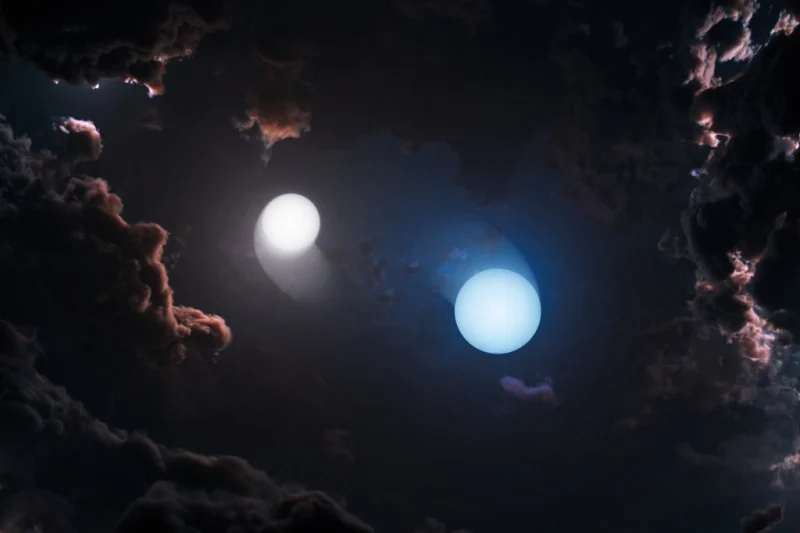
Space always looks calm from far away, but inside regions like the Orion Nebula, things are actually chaotic, messy, and constantly changing. Astronomers have now taken a deeper look into this stellar nursery and uncovered details that were hidden for years. Using the Very Long Baseline Array, scientists managed to study young star systems buried behind thick clouds of gas and dust — something traditional telescopes simply can’t do.
The focus of this research was on two young binary star systems, Brun 656 and HD 294300, both still in their early stages of formation. These stars are essentially newborns, wrapped inside dense material that blocks visible light. That’s where radio astronomy steps in. By observing at radio wavelengths — specifically around 5 GHz — astronomers can “see” through the dust, giving them a rare look at what’s happening inside these hidden environments.
What makes this discovery important isn’t just that the stars were observed, but how precisely their masses were measured. Stellar mass is considered one of the most fundamental properties of a star, because it determines everything — from how it evolves to how it eventually dies. But measuring mass in such young systems has always been difficult. By tracking how these stars orbit each other over time, researchers were able to calculate their masses with much higher accuracy than before.
The Orion Nebula itself sits about 1,300 light-years away and has been forming stars for millions of years. It’s packed with a mix of massive stars, smaller ones, brown dwarfs, and hundreds of young stellar objects still in development. Many of these are grouped in binary or multiple-star systems, which makes studying their motion even more valuable. Their orbital patterns act like clues, helping scientists understand how these systems formed in the first place.
One particularly interesting part of the study involved a system called V* NU Orionis. Observations revealed that one of its components is an intermediate-mass star showing unusual magnetic activity — something not commonly seen at that scale. This hints that magnetic fields could play a bigger role in star formation than previously thought, especially in younger, more massive stars.
The technology behind this is just as fascinating as the discovery itself. The VLBA links multiple radio telescopes spread across vast distances, allowing astronomers to measure tiny shifts in a star’s position with extreme precision. By comparing these shifts over months and years, they can map out orbital motion and extract details that would otherwise remain invisible. It’s like tracking a subtle dance happening light-years away.
All of this feeds into a bigger goal — refining our understanding of how stars are born and evolve. Some of the new measurements matched existing models of star formation, while others didn’t, suggesting that those models might still need adjustments. That’s actually a good thing in science — it means there’s more to discover.
At the end of the day, this isn’t just about distant stars. The mass of a star determines its entire life story — how it shines, what elements it creates, and how it eventually ends, whether quietly as a white dwarf or violently as a supernova. And since stars are responsible for creating the elements that form planets, including Earth, studies like this quietly connect back to our own cosmic origins.