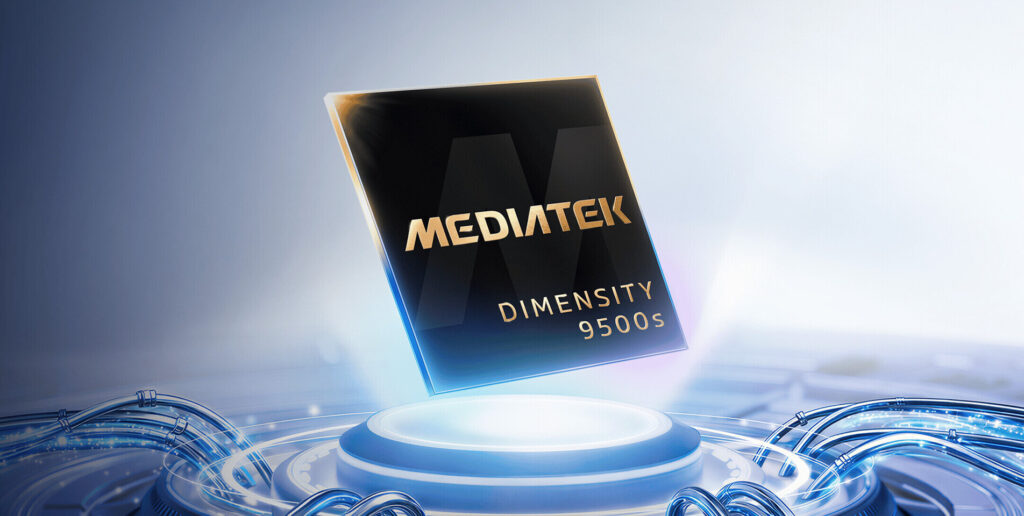
MediaTek has officially lifted the curtain on two new smartphone processors — Dimensity 9500s and Dimensity 8500 — and the message is clear: the next phase of mobile performance will be driven as much by AI as by raw speed.
Announced on Thursday, the new chipsets target two different segments but share a common vision. Whether it’s flagship-grade power or upper mid-range efficiency, MediaTek is betting big on “all big core” CPU designs, advanced AI acceleration, and next-gen gaming and imaging capabilities.
Dimensity 9500s: A Flagship-Class Chip Built for AI and Performance
Sitting just below MediaTek’s absolute top-tier silicon, the Dimensity 9500s is a 3nm chipset that mirrors much of the DNA found in the flagship Dimensity 9500.
At its core is a powerful CPU configuration featuring:
- One Arm Cortex-X925 Ultra core clocked at 3.73GHz
- Three Cortex-X4 cores
- Four Cortex-A720 cores
This “All Big Core” setup is designed to prioritise sustained performance without the traditional mix of efficiency cores.
On the graphics side, MediaTek has paired the chip with the Immortalis-G925 GPU, bringing support for advanced ray tracing, adaptive game technology 3.0, and frame generation features aimed squarely at mobile gamers.
AI is another major focus. The Dimensity 9500s comes with a next-generation MediaTek NPU, built to handle generative AI workloads and emerging agentic AI use cases directly on-device — including large language models and image generation.
Cameras, Displays, and Multimedia Muscle
MediaTek is also pushing hard on imaging and display capabilities with the Dimensity 9500s.
The chipset integrates the MediaTek Imagiq ISP, enabling:
- 8K video recording at 60fps
- Full-focus video with Dolby Vision HDR
- Real-time motion tracking
In terms of hardware support, devices powered by this chip can feature:
- WQHD+ displays with up to 180Hz refresh rate
- Camera sensors up to 320 megapixels
- LPDDR5X RAM and UFS 4.0 storage
Connectivity options are equally comprehensive, with support for Wi-Fi 7, Bluetooth 5.4, dual-SIM 5G, 4G LTE, and global navigation systems including NavIC, Galileo, and BeiDou. MediaTek’s UltraSave 4.0 technology also promises better battery efficiency under heavy workloads.
Notably, the Dimensity 9500s sits very close to the earlier Dimensity 9400+ in terms of specifications and is clearly positioned as a challenger to Qualcomm’s upcoming Snapdragon 8 Gen 5.
Dimensity 8500: Mid-Range Chip, Flagship Thinking
While the Dimensity 9500s targets premium smartphones, the Dimensity 8500 is aimed squarely at the upper mid-range — without feeling like a compromise.
Built on a 4nm process, the Dimensity 8500 also adopts MediaTek’s All Big Core approach, using:
- Eight Cortex-A725 cores clocked up to 3.4GHz
Graphics duties are handled by the Mali-G720 GPU, which MediaTek claims delivers 25% better performance and 20% lower power consumption compared to its predecessor.
The chipset supports:
- 4K video recording at 60fps
- Camera sensors up to 320 megapixels
- WQHD+ displays with up to 144Hz refresh rate
For AI tasks, the Dimensity 8500 integrates the MediaTek NPU 880, now in its eighth generation, bringing on-device support for mainstream language models and image generation features.
Connectivity remains robust, with Wi-Fi 6E, Bluetooth 5.4, and full 5G support matching the flagship-level feature set of the Dimensity 9500s.
Why These Chips Matter
With the Dimensity 9500s and Dimensity 8500, MediaTek is sending a strong signal to smartphone brands: advanced AI, high refresh-rate displays, and powerful cameras are no longer exclusive to ultra-premium devices.
The company’s continued focus on big-core CPU designs and dedicated AI hardware suggests future smartphones will lean heavily on on-device intelligence — from smarter photography to real-time language processing and AI-powered gaming enhancements.
Final Words
MediaTek’s latest Dimensity launches show how aggressively the company is closing the gap with its biggest rivals. The Dimensity 9500s brings near-flagship power and AI capabilities, while the Dimensity 8500 makes a compelling case for premium features trickling down to more affordable phones.
As smartphone makers prepare their next wave of launches, these chips could play a major role in shaping 2026’s performance and AI standards across Android devices.