Artificial intelligence agents are quietly becoming the newest employees inside global corporations. But according to Microsoft, not all of them can be trusted.
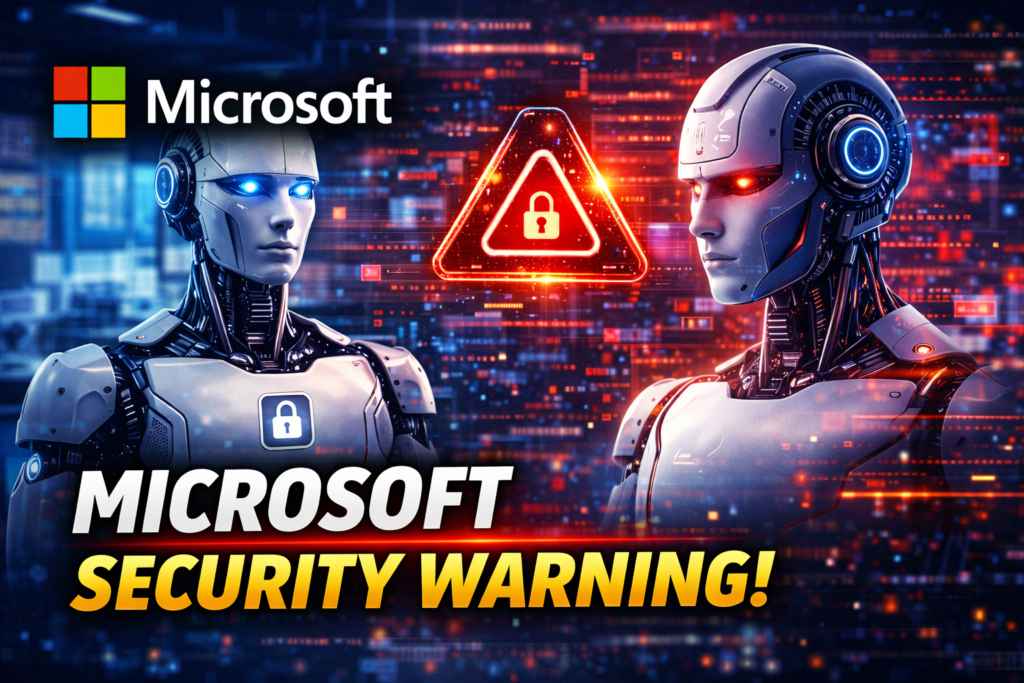
In its latest Cyber Pulse security report, the Redmond-based tech giant has flagged a growing risk tied to what it calls “AI double agents” — automated systems that hold excessive access privileges but lack strong safeguards. The concern? Hackers could manipulate them through prompt engineering attacks and turn them into internal security threats.
The findings are based on Microsoft’s first-party telemetry and new research into enterprise AI adoption.
AI Agents Are Everywhere — Maybe Too Fast
Microsoft says AI agents are being rapidly integrated into enterprise workflows, often without adequate oversight. According to the company, more than 80 percent of Fortune 500 firms are currently deploying AI agents built using low-code or no-code tools.
That ease of development, however, comes with a catch.
Agents created through simplified “vibe coding” methods may skip essential security architecture required for enterprise environments. In short, businesses are moving fast — but not always securely.
What Exactly Is an “AI Double Agent”?
The concept is simple but worrying.
AI agents often have broad permissions to access internal systems, files, and workflows. If those privileges are not carefully managed, bad actors can manipulate the agent’s instructions and redirect its actions.
Microsoft warns that just like human employees, AI agents with too much access — or poorly structured task prompts — can become liabilities.
Researchers cited in the report found that:
- Agents can be tricked by deceptive interface elements.
- Harmful instructions can be embedded within otherwise normal content.
- Manipulated task framing can redirect agents toward unintended actions.
In such cases, the AI doesn’t “know” it’s being misled — it simply follows instructions.
Zero Trust: The Recommended Fix
To counter these risks, Microsoft is urging companies to adopt stronger governance frameworks and Zero Trust security principles.
Zero Trust operates on a simple idea: never automatically trust any user or device — whether inside or outside the network. Every access request must be verified.
The report emphasizes that AI agents require increased observability, clear governance models, and strict access control policies to prevent misuse.
The Shadow AI Problem
One particularly alarming statistic in the report comes from a multinational survey of more than 1,700 data security professionals commissioned by Microsoft.
According to the findings, 29 percent of employees are using AI agents for work-related tasks without IT approval.
This “shadow AI” behaviour creates blind spots in corporate cybersecurity systems, potentially exposing sensitive data and internal workflows.
The Bigger Cyber Risk
Microsoft’s warning reflects a broader shift in enterprise risk management. AI agents are no longer experimental tools — they are becoming embedded in daily operations, decision-making systems, and customer interactions.
But if misconfigured or manipulated, their scale and automation could amplify internal threats far faster than traditional human errors.
As the report notes, AI agents create new opportunity — but also new failure modes.
Final Words
The rise of AI agents in the workplace feels inevitable. They promise efficiency, automation, and smarter workflows. But Microsoft’s latest warning serves as a reality check: power without guardrails can backfire.
If companies want AI to be an asset rather than a liability, security cannot be an afterthought. In the age of AI double agents, governance may be just as important as innovation.