Space just delivered another cosmic surprise.
In the summer of 2025, astronomers detected a fast-moving object slicing through our solar system — an interstellar visitor later identified as Comet 3I/ATLAS. What began as a routine sky survey discovery quickly turned into something far more exciting after the comet flew past the Sun in October and unexpectedly brightened.
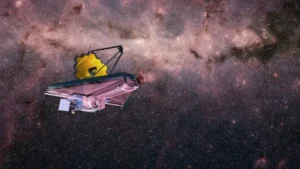
And thanks to NASA’s SPHEREx mission, scientists now have a clearer picture of what this mysterious traveler is made of.
A Post-Sun Explosion No One Expected
After its close brush with the Sun — known as perihelion — Comet 3I/ATLAS didn’t quietly fade into the distance. Instead, it erupted.
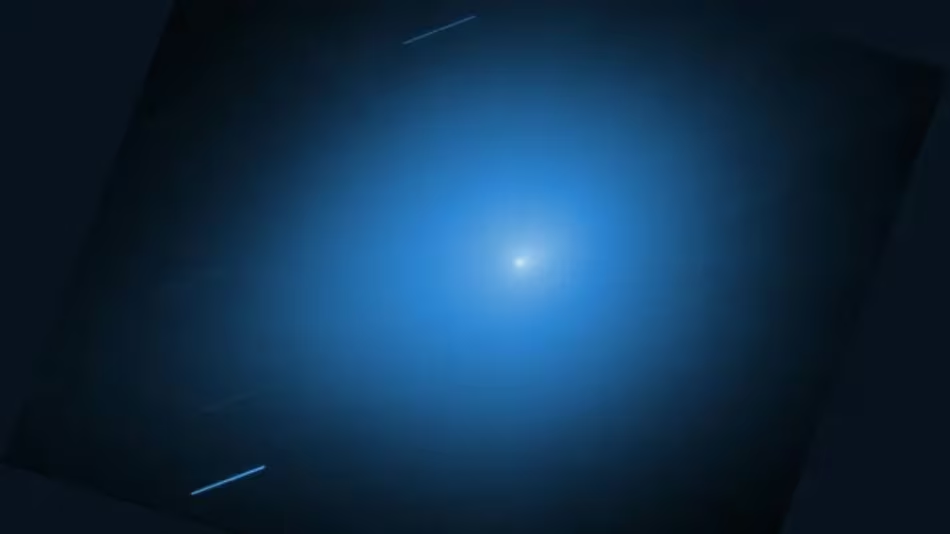
NASA confirmed that new infrared observations from SPHEREx in December 2025 captured a dramatic outburst. The comet suddenly brightened as material burst from its core and streamed into space.
Carey Lisse of the Johns Hopkins Applied Physics Laboratory, who led the study, described the event as a full-scale eruption. The comet was releasing water vapour, carbon dioxide, and dust — turning it into a glowing spectacle visible to deep-space instruments.
For astronomers, this wasn’t just beautiful. It was scientifically priceless.
What SPHEREx Discovered Inside the Comet
SPHEREx, which specializes in infrared sky surveys, was able to analyze the chemical fingerprint of the comet’s coma — the glowing cloud surrounding its nucleus.
The findings were fascinating:
- Water ice
- Carbon dioxide
- Organic molecules
- Methanol
- Methane
- Cyanide
Interestingly, while carbon dioxide levels were high, carbon monoxide was scarce. That chemical imbalance suggests 3I/ATLAS likely formed in a relatively warm environment — quite different from the colder regions where many comets are believed to originate.
Researchers believe the comet’s ices had undergone intense heat processing long before it entered our solar system. That heating may explain why its chemical structure resembles comets we see closer to home.
Why This Matters
Interstellar objects are rare. Before this, only a handful — like ‘Oumuamua and Comet Borisov — have been confirmed visitors from beyond our solar system.
Each one offers a direct sample of material formed around another star.
Comet 3I/ATLAS gives scientists something extraordinary: a chemical snapshot of untouched extraterrestrial matter that developed in a completely different planetary system.
It’s like studying a fossil from another galaxy.
Final Words
Comet 3I/ATLAS may have just passed through our neighbourhood, but its explosive display has left behind a treasure trove of data.
Thanks to SPHEREx’s infrared eye, astronomers now have deeper insight into the building blocks of distant star systems. And if this outburst taught scientists anything, it’s that interstellar visitors don’t just pass by quietly — sometimes, they light up the sky and rewrite what we know about the universe.