For decades, dark matter has been the invisible backbone of modern cosmology — the mysterious substance believed to outweigh ordinary matter and hold galaxies together. But a new theoretical study is stirring debate by asking a bold question: what if dark matter doesn’t exist at all?
Physicist Naman Kumar proposes that the answer may lie not in unseen matter, but in gravity itself.
🌌 Rethinking Gravity’s Behavior
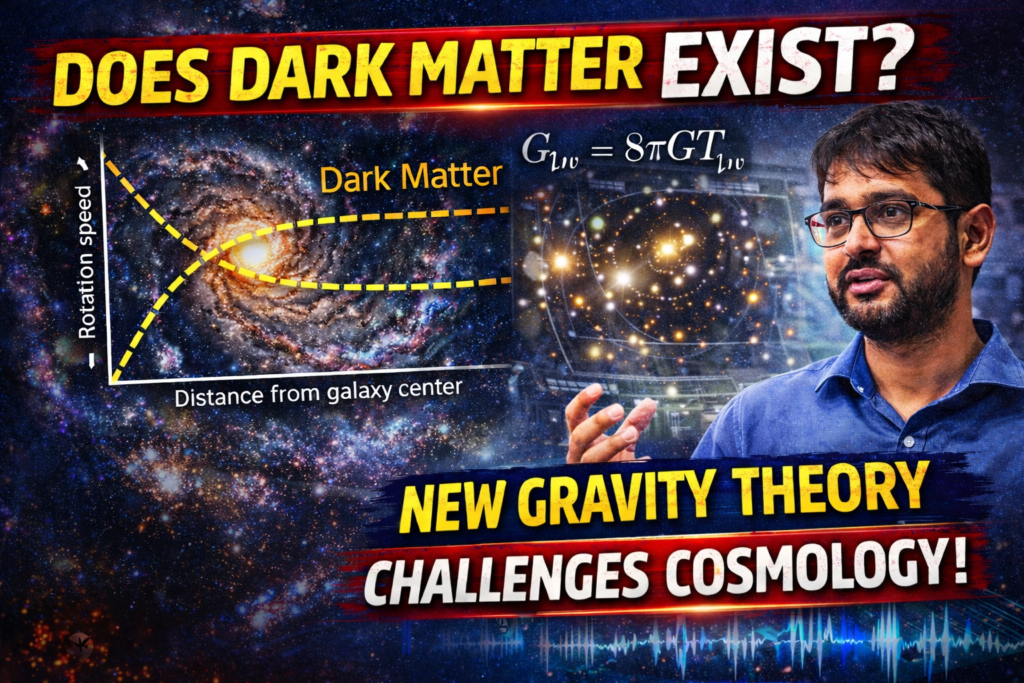
In conventional physics, gravity follows Newton’s inverse-square law — its strength drops off as 1/r² with distance. This rule works beautifully within our solar system but struggles to explain why stars in the outer regions of galaxies orbit much faster than expected.
To resolve that mismatch, scientists introduced dark matter — an invisible mass halo thought to provide the extra gravitational pull needed to keep galaxies intact.
Kumar’s model takes a different approach. Drawing from quantum field theory, he allows Newton’s gravitational constant to “run” with distance. In what he calls an “infrared running” scenario, gravity weakens more slowly at enormous scales, transitioning to a 1/r behavior instead of 1/r².
The result? Flat galaxy rotation curves — without the need to add mysterious dark matter.
When Kumar applied the model to real galactic rotation data, he found that the observed motions could be reproduced using only visible matter. According to him, the findings suggest that this scale-dependent gravity could account for galactic behavior naturally.
📚 Published Findings — With Caution
The research was published in Physics Letters B in 2025. However, Kumar is careful not to overstate the case.
Any modification to gravity must remain subtle enough to stay consistent with early-universe observations — particularly measurements of the cosmic microwave background radiation, which strongly support dark matter’s role in cosmology.
His model reportedly aligns with early cosmological data while diverging only at later cosmic stages. The next major tests will involve gravitational lensing and galaxy cluster observations — two areas where dark matter has shown strong explanatory power.
🧠 A Challenge to the Status Quo
Dark matter remains one of physics’ most widely accepted — yet unobserved — components. Despite decades of experiments, scientists have yet to directly detect dark matter particles.
Alternative gravity theories have surfaced before, including Modified Newtonian Dynamics (MOND), but none have fully replaced the dark matter framework.
Kumar acknowledges that his research does not yet eliminate dark matter entirely. Instead, he argues that it highlights the possibility that gravity may be more complex than currently understood.
💬 Final Words
Science evolves by questioning its own assumptions. While dark matter remains the dominant explanation for cosmic structure, proposals like Kumar’s keep the conversation alive.
Whether this “infrared running” gravity model reshapes cosmology or simply refines it, one thing is clear: the universe still has secrets — and gravity may be hiding more of them than we realize.